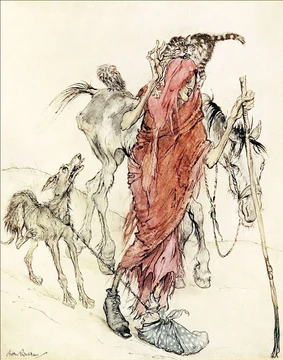
The Gypsy Tsaritsa
A Serbian folktale of a prince, a fruit bride, and a false bride.
Last updated
The Serbian folktale "The Gypsy Tsaritsa" (Ciganka carica) was recorded in the early 1900s. It matches the ATU 408 tale type, "The Love for Three Oranges." The story follows a prince seeking a bride hidden inside a fruit. A false bride then replaces her, and the true bride undergoes several transformations before finally regaining her human form.
Summary
An old woman drawing water from a fountain is struck by a pebble thrown by a prince, breaking her jars. She curses him to find a bride with the ala. The prince goes to the house of an ala, who hides him by transforming him into a broom when her forty sons return. She sends him to her sister, a second ala, who also hides him as a broom among apple trees.
The second ala tells him to pluck apples; he takes three and is warned to open them near water. He opens the first apple near water: a maiden appears, asks for water, and dies. The second maiden also dies. He enters water and opens the third apple; the maiden survives.
The prince leaves her up a tree while he fetches a wedding retinue. A gypsy woman drawing water sees the maiden's reflection, believes it is her own, and stops working. The maiden explains the reflection is hers. The gypsy spots her, calls her down, shoves her into the water where she drowns, steals her clothes, and takes her place atop the tree.
Analysis
The tale is classified as ATU 408, "The Three Oranges". Scholar Christine Shojaei Kawan divided the tale type into six sections, with parts 3 to 5 forming the core: the prince finds fruits and releases maidens but only the third survives; he leaves the princess up a tree near water; a slave or servant sees her reflection and replaces her. The maiden may appear from citrus fruits, pomegranates, other fruits, or eggs. Serbian scholarship notes the heroine can come from apples or eggs, but in most tales she appears from lemons and oranges.
Walter Anderson's unpublished manuscript located variants with eggs in Southeastern Europe; Christine Shojaei-Kawan found the motif of the heroine emerging from eggs in Slavic texts. The tale type is characterized by substitution of the fairy wife for a false bride. Christine Goldberg divided the type into two subtypes: AaTh 408A, where the fruit maiden undergoes a cycle of metamorphosis (fish-tree-human), found from the Middle East to Italy and France, especially in Greece and Eastern Europe; and AaTh 408B, where the girl is transformed into a dove by a needle.
Variants
In a Serbian tale from Leskovac titled "The Tsar's Son and the Golden Apple", a tsar's son seeks a woman who has not been born nor baptized. He finds an old man in a cave, who sends him to his older brother, the king of the animals. The king directs the prince to a hill where he finds a nest with three eggs on the first tree touched by sunrise, warning him to open them near water. The prince breaks the first egg: a maiden appears, asks for water, and vanishes.
The second maiden also vanishes. He reaches a lake and cracks the third egg inside it; a beautiful maiden appears and survives. He leaves her up an apple tree near a well while he arranges the wedding. A gypsy girl convinces the egg maiden to climb down, shoves her into the well, and takes her place.
The prince marries the gypsy. The egg maiden becomes a goldfish in the well, which the prince catches and brings home.
On a Sunday while the prince hunts, the gypsy bride asks for the fish to be cooked. A drop of its blood drips near the door, where an apple tree sprouts with a single fruit. The gypsy feigns illness and wishes to eat the apple, but no one can pluck it.
More in Witchcraft in Fairy Tales
Sources
Compiled from Wikipedia and the sources listed below. Text from Wikipedia is available under CC BY-SA 4.0; this entry is adapted from it.
- Wikipedia: The Gypsy Tsaritsa (CC BY-SA 4.0).
Spotted an error? Know more?
Reader corrections go straight into our review queue. Suggest an edit · How this site is sourced