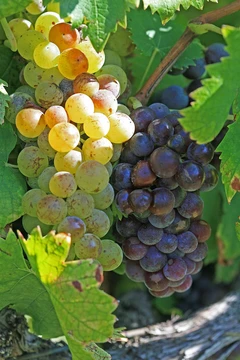
Vidal blanc
A winter-hardy hybrid prized for ice wine and fruity wines.
Vidal blanc is a white hybrid grape variety created in the 1930s by French breeder Jean Louis Vidal from Ugni blanc and the hybrid Rayon d'Or. It is notable for its winter hardiness and ability to produce high sugar levels with moderate to high acidity in cold climates, making it widely used for ice wine production in Canada and the United States.
Quick Facts
- Species
- 50% Vitis vinifera variety Ugni blanc × 50% Rayon d'Or (Seibel 4986)
- Origin
- Jean Louis Vidal
Facts from the source article.
Did You Know?
- Vidal blanc is somewhat resistant to downy mildew but very susceptible to powdery mildew, coulure, and anthracnose.
- The long grape bunches of small berries can be prone to botrytis bunch rot.
- The only synonym recognized by the Vitis International Variety Catalogue is Vidal 256.
Parentage
Vidal blanc is a complex hybrid involving several Vitis species. One parent, Ugni blanc, is a Vitis vinifera variety. The other parent, Rayon d'Or, is a Seibel grape that itself resulted from inter-specific crossings of Aramon du Gard and Seibel 405. The extended family tree includes Vitis rupestris and Vitis aestivalis, as well as contributions from hybrid breeders Thomas Volney Munson, Hermann Jaeger, and Albert Seibel.
History
Jean-Louis Vidal (1880–1976) created the variety in the 1930s for cognac production in the maritime climate of western France, crossing Ugni blanc with Rayon d'Or. Although developed in France, it is no longer an authorized grape there, with only rare plantings remaining in Charente-Maritime. In the late 1940s, French enologist Adhemar de Chaunac brought the grape to Canada for T.G. Bright & Company, experimenting with late harvest and winter vine hang. Commercial ice wine from Vidal blanc did not become popular in Canada until the 1980s.
Wine regions
Vidal blanc is grown extensively in Canada, particularly in Ontario's Niagara Peninsula, as well as British Columbia, Nova Scotia, and Quebec. In the United States, it is widely planted in the Finger Lakes AVA of New York, the Old Mission Peninsula AVA of Michigan, and states including Virginia, Ohio, Indiana, Illinois, Missouri, North Carolina, New Jersey, and many others. It is also cultivated in Sweden, about 500 miles south of the Arctic Circle, for ice wine. In Canada, Inniskillin produces ice wine from Vidal grown in Ontario and the Okanagan Valley of British Columbia; Stag's Hollow in the Okanagan has specialized in dry Vidal wines since the mid-1990s. In the US, the grape is more often used for dry or slightly sweet table wines than for ice wine. Specific plantings include 150 acres in Virginia (2010), 145 acres in Michigan (2006), 35 acres in Indiana (2009), 32 acres in Illinois (2009), and 118 acres in Missouri (2009).
Styles
Vidal blanc wines lack the 'foxy' taste common to many hybrids. According to Jancis Robinson, they produce 'bright and pure' fruit with acidity that balances ice wine sweetness, though they have little aging potential. Oz Clarke notes that Vidal ice wines offer rich concentration of intense fruit flavors. In Missouri, dry styles can be full-bodied with a buttery mouthfeel similar to malolactic Chardonnay, with noticeable acidity and a long finish in favorable vintages. In British Columbia, both dry and ice wine styles exhibit tropical aromas and strong fruity flavors.
More in White Wine Grape Varieties
Spotted an error? Know more?
Reader corrections go straight into our review queue. Suggest an edit · How this site is sourced