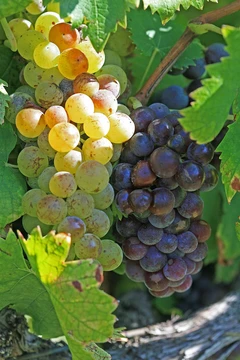
Chenin blanc
A versatile Loire grape with high acidity and many wine styles.
Chenin blanc is a white wine grape variety from the Loire Valley of France, also known as Pineau de la Loire among other names. Its high acidity allows it to be used for styles ranging from sparkling wines to well-balanced dessert wines, though it can produce neutral wines if the vine's natural vigor is not controlled. It is the most widely planted variety in South Africa, where it was historically called Steen.
Quick Facts
- Species
- Vitis vinifera
- Also called
- Steen
- Pineau de la Loire
- Pinot blanco (more)
- Origin
- Loire, France
- Hazards
- Bunch rot
- sunburn
- overproduction
- Regions
- Loire, South Africa
- Notable wines
- Vouvray
- Coteaux du Layon
- sparkling Saumur
Facts from the source article.
Did You Know?
- Chenin blanc has been known under a variety of synonyms, including Agudelo, Agudillo, Anjou, Blanc d'Aunis, and Steen.
- The alcohol level for dessert styles of Chenin rarely goes above 12%, which keeps the wines more in balance.
History
French ampelographer Pierre Galet theorized that Chenin blanc originated in the Anjou wine region sometime in the 9th century, and from there traveled to Touraine by at least the 15th century. The grape may have been the variety described in two royal land grants of Charles the Bald in 845 detailed in the records of the abbey of Glanfeuil as growing on the left bank of the Loire River in vineyards belonging to individuals with the name of Soulangé and Bessé. When Thomas Bohier purchased vineyard land around Chenonceaux on January 3, 1496, several grape varieties were brought in from the Burgundy wine region of Beaune, the Jura wine region of Arbois and nearby Orléans and Anjou. One of these varieties, a white grape known as Plant d'Anjou, was later planted between 1520 and 1535 at a nearby site known as Mont Chenin in Touraine by the Lord of Château de Chenonceau and his brother-in-law, Denis Briçonnet, the abbot of Cormery. Ampelographers believe that Plant d'Anjou was like Chenin blanc, with the grape eventually taking on the name from Mont Chenin. French writer François Rabelais wrote glowingly about the white wines of Anjou, and mentions the medicinal qualities of the grapes at the end of chapter XXV of Gargantua. From France, the grape spread to South Africa, where it was most likely included among the vine cuttings sent to Jan van Riebeeck in the Cape Colony by the Dutch East India Company. In the 20th century, a subvariety of Chenin planted in the Loire was found to be not actually Chenin blanc at all, but rather the Portuguese grape Verdelho, which is banned from French AOC regulations in the Loire.
Viticulture
The Chenin blanc vine is an early budder that ripens from mid to late season. In warmer years, the Loire’s cool climate balances with the heat needed for full ripeness, sometimes yielding wines with real complexity and finesse. Older vines naturally produce smaller harvests, which can boost quality. If noble rot sets in, yields drop further and flavors intensify; the resulting wines have less obvious floral notes but gain more depth and layers. New clones, six of which are officially approved in France, have been bred to bud later and build more sugar during ripening. The vine grows semi-upright, with three- to five-lobed leaves, and its early buds produce conical, winged clusters of yellow-green grapes that mature late. Each berry averages 16.0 mm long, 14.2 mm wide, and weighs about 1.79 grams.
Whether Chenin blanc turns out sweet or dry depends mostly on the region’s climate, while the soil shapes the wine’s overall character. Heavy clay soils, in the right climate, favor rich, botrytized dessert wines that need years to age. Sandy, well-drained soils with low organic matter yield lighter wines that mature sooner. High silex content gives the wine distinctive mineral notes, and limestone soils sharpen the acidity. In Vouvray, the typical argilo-calcaire (calcareous clay) soil produces rounded wines with both acidity and body. Where schist is common, the grapes tend to ripen earlier than on clay-based soils.
The vine faces several hazards beyond unwanted botrytis: spring frost, powdery mildew, and fungal diseases like dead arm that attack the wood. These can be managed with integrated pest control and careful rootstock selection.
Wine regions
Chenin blanc grows in many countries, including China, New Zealand, Canada, and Argentina, but it is only a major planting in a few places. France is the grape’s original home, yet by the early 2000s, South Africa had twice the amount of Chenin blanc planted as France did. The variety’s flexibility and its knack for expressing where it is grown give it what wine expert Jancis Robinson calls a “double life.” In France’s Loire Valley, winemakers treat it as a high-quality grape that can yield world-class bottles, whereas in many New World regions it serves as a workhorse, adding acidity to bulk white blends and delivering simpler flavors rather than a sense of place. Ampelographers believe Chenin blanc first appeared in the Loire Valley around the 9th century, and that region remains the one most tied to the grape in France. In 2008, France had 9,828 hectares of Chenin blanc, mostly in the Indre-et-Loire, Loir-et-Cher, and Maine-et-Loire departments. The Anjou area near Angers, in Maine-et-Loire, held the largest share with 5,044 hectares. Chenin blanc is allowed in many French AOC regions, but it is mainly grown in the Middle Loire appellations of Anjou, Bonnezeaux, Crémant de Loire, Coteaux de l’Aubance, Coteaux du Layon, Jasnières, Montlouis, Quarts de Chaume, Saumur, Savennières, and Vouvray.
Winemaking and wine styles
Chenin blanc is often called the world’s most versatile grape, capable of producing everything from bone-dry wines to luscious dessert wines built for long aging, as well as sparkling wines made in the traditional Champagne method and fortified styles. It works beautifully as a single-varietal wine or as a blending component, lending acidity to a blend. Its range across sweetness levels and quality has drawn comparisons to German Riesling, and in many ways it serves as France’s answer to that grape. A key difference between Old World and New World styles lies in fermentation temperature. Loire producers typically ferment at warmer temperatures, between 60 and 68 degrees Fahrenheit, while New World winemakers in South Africa and elsewhere prefer cooler ferments around 50 to 54 degrees. The cooler temperatures bring out tropical fruit aromas, which Old World producers tend to downplay. The grape can also benefit from skin contact and maceration, which extracts phenolic compounds and adds complexity, bringing out characteristic notes of greengage and angelica. Its naturally high acidity can be softened through malolactic fermentation, giving the wine a creamier, fuller texture, and aging on the lees has a similar effect. Oak use is a matter of producer preference. Old World winemakers generally avoid new oak, which can add vanilla, spice, and toast, though these flavors are often welcome in New World versions. In Savennières, a traditional practice persists of using acacia and chestnut barrels for aging, with acacia sometimes imparting a yellow tint and chestnut adding buttery notes.
More in White Wine Grape Varieties
Spotted an error? Know more?
Reader corrections go straight into our review queue. Suggest an edit · How this site is sourced