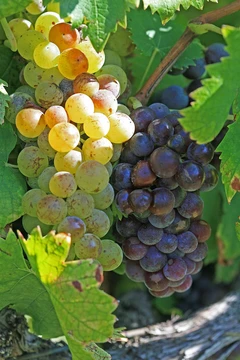
Malvasia
A historic Mediterranean grape family producing diverse wines.
Malvasia, also known as Malvazia, is a group of wine grape varieties historically grown in the Mediterranean region and Macaronesia, now cultivated in many winemaking regions worldwide. The grapes are used to produce white and occasionally red table wines, dessert wines, and fortified wines, and are sometimes blended in wines such as Vin Santo. In modern oenology, the term "Malmsey" is used almost exclusively for a sweet variety of Madeira wine made from the Malvasia grape.
Quick Facts
- Species
- Vitis vinifera
- Also called
- Malvazia
- Origin
- Greece
- Regions
- Mediterranean, California
Facts from the source article.
Did You Know?
- Malvasia tends to prefer dry climates with vineyards on sloping terrain of well-drained soils.
- In damp conditions, the vine can be prone to mildew and rot.
- The rootstock is moderately vigorous and capable of high yields if not kept in check.
History
Most ampelographers believe the Malvasia family of grapes originated in Crete, Greece. The name comes from the Italian name for Monemvasia, a medieval Byzantine fortress on the coast of Laconia in southern Greece, whose port traded wine from the eastern Peloponnese and possibly the Cyclades. During the Middle Ages, Venetian merchants traded Malvasia wine so extensively that wine-shops in Venice were called malvasie. A claim that the name might come from the district of Malevizi near Iraklion, Crete, is not taken seriously by scholars. Malmsey was one of three major wines exported from Greece in medieval times. English tradition associates Malmsey wine with the 1478 death of George Plantagenet, Duke of Clarence, who was rumored to have been drowned in a butt of malmsey wine, as dramatized in Shakespeare's Richard III. Both Monemvasia and Candia have lent their names to modern grape varieties. The Monemvasia grape was long thought ancestral to western European Malvasia, but recent DNA analysis does not suggest a close relationship. DNA analysis does suggest the Athiri grape is ancestral to Malvasia.
Grape varieties and wine regions
Most Malvasia varieties are closely related to Malvasia bianca, except Malvasia di Candia, a distinctly different sub-variety. Malvasia bianca is grown widely in Italy; Sitges in Catalonia; the San Joaquin Valley of California; and the Greek Islands of Paros and Syros. In Central Italy, Malvasia is often blended with Trebbiano; in Rioja, it is blended with Viura. Malvazija Istarska, named after the Istria peninsula shared by Croatia, Slovenia, and Italy, is a main white wine of Croatian Istria and the north Dalmatian coast, introduced by Venetian merchants from Greece. The Dalmatian Maraština is identical to the Italian Malvasia Lunga. Malvasia Bianca di Candia is Italy's most widely planted Malvasia. Malvasia Istriana is grown in Friuli-Venezia Giulia in Collio DOC and Isonzo DOC, and also in Colli Piacentini for sparkling wine. In the 19th and early 20th centuries, sweet passito dessert wines from Malvasia were highly esteemed; after World War II, plantings declined sharply. Today, a few producers make these wines from local varieties such as Malvasia di Grottaferrata in Lazio and Malvasia di Bosa and Malvasia di Planargia in Sardinia.
Wines
Generalizations about Malvasia wine are difficult due to the family's breadth. Most varieties derive from Malvasia bianca, characterized by deep color, noted aromas, and some residual sugar. Red Malvasia varieties tend to produce wines with pale, pinkish to light red color. In youth, Malvasia wines have a heavy body often described as round or fat, with a soft texture. Common aroma notes include peaches, apricots, and white currants. Red Malvasia wines are characterized by richness and chocolate notes. Fortified Malvasia, such as Madeira, are noted for intense smoky notes and sharp acidity. As Malvasia ages, wines tend to develop nutty aromas and flavors, though many have a short lifespan of only a few years. In the past, the names Malvasia and Malmsey occurred interchangeably; now Malvasia generally refers to unfortified white table or dessert wines, while Malmsey refers to a sweet Madeira. Confusion arises because in the past Malmsey referred to any very sweet Madeira regardless of grape, due to phylloxera devastation. EU regulations now require Malmsey to contain at least 85% Malvasia grapes. Vintage-dated Malmseys are often labeled Malvasia or Malvazia.
More in White Wine Grape Varieties
Spotted an error? Know more?
Reader corrections go straight into our review queue. Suggest an edit · How this site is sourced