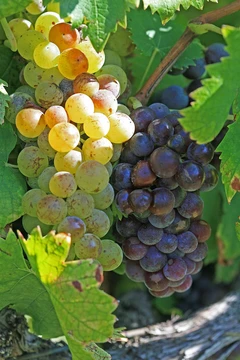
Verdicchio
A historic Italian white grape known for high acidity and greenish hues.
Verdicchio is a white Italian wine grape variety primarily grown in the Marche region of central Italy. Its name derives from the Italian word for green, referring to the slight green-yellow hue the wines can exhibit. The grape is the principal variety behind two DOC wines, Verdicchio di Matelica and Verdicchio dei Castelli di Jesi, and is also used for sparkling and straw wines.
Quick Facts
- Species
- Vitis vinifera
- Vivc number
- 12963
- Also called
- Boschera bianca
- Giallo
- Maceratese
- Maggiore
- Trebbiano verde; more synonyms
- Origin
- Italy
- Regions
- Marche
- Umbria
- Lazio
- Notable wines
- DOC wines: Verdicchio dei Castelli di Jesi
- Verdicchio di Matelica
- Esino
- Colli Pesaresi
Facts from the source article.
Did You Know?
- Verdicchio can produce wines that are virtually colorless with noticeably high acidity and citrus notes.
- Well-made examples from favorable vintages can have flavors of lemons and slight bitter almond notes.
- The naturally high acidity of the grape makes it a good base cuvée variety for producing sparkling wine.
History
Verdicchio has been documented in the Marche region since at least the 14th century. Despite sensitivity to climate and variable yields, it became a popular planting in central Italy, with an estimated 65,000 hectares in the mid-1980s, making it the 15th most planted grape variety globally, ahead of Chardonnay and Pinot noir. Ampelographers consider it likely indigenous to Marche, with genetic ties to Trebbiano and Greco.
Wine regions
Verdicchio is widely grown in Marche, Umbria, and Lazio, but is most associated with the DOC wines of Verdicchio di Matelica and Verdicchio dei Castelli di Jesi. Castelli di Jesi, near Iesi in Ancona province, produces higher volume, while Matelica in Macerata has stricter yield limits, with best sites on hillsides of the Esino Valley. Several DOCs include Verdicchio as a permitted variety: Cerveteri DOC (Lazio) allows up to 15% with Trebbiano and others; Circeo DOC (Lazio) up to 15%; Colli Maceratesi DOC (Marche) up to 30% with Maceratino; Colli Martani DOC (Umbria) up to 15%; Colli Perugini DOC (Umbria) 15–35% with Trebbiano; Colli Pesaresi DOC (Marche) can be primarily Verdicchio; Colli del Trasimeno DOC (Umbria) up to 40%; Controguerra DOC up to 25%; Esino DOC (Marche) 50–100% Verdicchio; Falerio dei Colli Ascolani DOC (Marche) up to 15%.
Clonal variation and plantings
Verdicchio is highly susceptible to clonal mutations, with several sub-varieties known under various synonyms, complicating exact planting counts. In 1996, nearly 10,000 acres were reported, mostly along the Adriatic coast, a dramatic reduction from the mid-1980s estimate of 65,000 hectares. Some experts speculate that many of those earlier plantings may have actually been Trebbiano.
Synonyms
Verdicchio has been called by many different names throughout its history. Among these are Boschera bianca, Giallo, Maceratese, and Maggiore. Other synonyms include Marchigiano, Mazzanico, Niuivres, Peloso, Peverella, Peverello, Peverenda, and Peverise bianco. It has also been known as Pfeffer, Pfeffertraube, Terbiana, Torbiana, Trebbiano di Lugana, Trebbiano di Soave, Trebbiano verde, Trebbiano Veronese, Turbiana, Turbiana Moscato, Turbiano, Turviana, Uva Aminea, and Uva Marana. Additional names are Verdello duro persico, Verdicchio bianco, Verdicchio Dolce, Verdicchio Doratel, Verdicchio Doratello, Verdicchio Giallo, Verdicchio Marchigiano, Verdicchio Marino, Verdicchio Peloso, Verdicchio Scroccarello, Verdicchio Seroccarello, Verdicchio Straccione, Verdicchio Stretto, Verdicchio Verdaro, Verdicchio verde, Verdicchio Verzaro, Verdicchio Verzello, Verdone, Verzaro, and Verzello verde.
More in White Wine Grape Varieties
Spotted an error? Know more?
Reader corrections go straight into our review queue. Suggest an edit · How this site is sourced