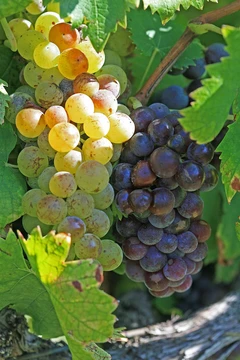
Torrontés
An aromatic Argentine white grape with peach and apricot notes.
Torrontés is a white grape variety primarily associated with Argentina, where it produces fresh, aromatic wines with moderate acidity and a smooth texture. Its distinctive peach and apricot aromas have made it notable among white wine grapes, with three distinct varieties existing in the country: Torrontés Riojano, Torrontés Sanjuanino, and Torrontés Mendocino.
Quick Facts
- Species
- Vitis vinifera
- Also called
- Torrontés Riojano
- Torrontés Sanjuanino
- Torrontés Mendocino
- Torrontel
- and other synonyms
- Regions
- Argentina
Facts from the source article.
Did You Know?
- Torrontés Riojano is also known as Malvasia, Torrontel, and Torrontel Riojano.
- Torrontés Mendocino is also known as Chichera, Loca Blanca, Palet, Torrontel, Uva Chichera and Torrontés Mendozino.
History and relation to other grapes
DNA profiling has shown that Torrontés Riojano, Torrontés Sanjuanino, and Torontel (also known as Moscatel Amarillo) are separate crossings of Mission (originally reported as Criolla Chica) and Muscat of Alexandria. Torrontés Mendocino was found to probably be a crossing of Muscat of Alexandria and another, unidentified grape variety. The presence of Mission in the pedigree was unexpected to researchers. For many years the Argentine Torrontés was believed to be the same as the Galician Torrontés (also known as Albillo Mayor), partly due to migration waves of Galician workers to Argentina. However, recent DNA evidence indicates no direct relationship between the Argentine and Spanish varieties. There is also a less common red wine grape called Torrontés, known under the synonyms Tarrantes and Turrundos.
Wine regions
Torrontés is grown throughout Argentina, with acreage steadily increasing. By the early 21st century it became Argentina's most widely planted white variety, surpassing Pedro Giménez and Ugni blanc. Torrontés Riojano is widely grown in La Rioja and Salta provinces, and is the single most widely planted variety in La Rioja. In Salta, it is often planted in high altitude, sandy vineyards above 1,600 m, where harsh conditions yield high acidity and assertive flavors. Torrontés Sanjuanino is found in San Juan province but planted to a much lesser extent. Torrontés Mendocino is the least widely planted and is mostly found in Rio Negro province. In Chile, Torrontés is grown, though exact plantings are not completely known; it is often called Moscatel de Austria, believed to be Torrontés Sanjuanino. Most Chilean plantings are Torrontés Riojano, used primarily for pisco production. Torrontés is also grown in Samaipata, Bolivia. Spanish wine labeled as Torrontés may come from Galicia's Ribeiro region or other D.O. areas such as Gran Canaria, Montilla-Moriles, and Madrid, though DNA evidence suggests no relationship to the South American variety.
Wine style
Torrontés can produce wines of high quality, but success depends on careful winemaking, particularly in maintaining suitable acid levels. Ideal examples are wines for early drinking that are not too heavy, high in acidity, and intriguingly aromatic in a way reminiscent of Muscat. Poorer examples can come across as bitter and excessively alcoholic. Harvest yield also plays a substantial role in quality. Many examples can be very similar to Gewürztraminer with subtle spice notes mixed with floral bouquet. The wine tends not to age well and is often consumed within a year of its vintage date.
More in White Wine Grape Varieties
Spotted an error? Know more?
Reader corrections go straight into our review queue. Suggest an edit · How this site is sourced