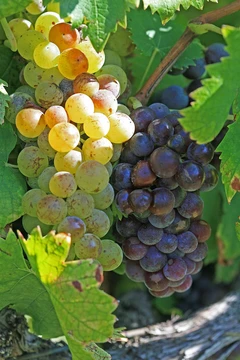
Silvaner
A neutral grape that reveals terroir when yields are controlled.
Silvaner (also spelled Sylvaner) is a white wine grape variety grown primarily in Alsace and Germany, where its official name is Grüner Silvaner. Its neutral flavor and high acidity make it a blank canvas for terroir expression, though it can produce bland wines if yields are not controlled. In 2006, it became eligible for Alsace Grand Cru status in the Zotzenberg vineyard, alongside the region's four noble grapes.
Quick Facts
- Species
- Vitis vinifera
- Also called
- Sylvaner
- Gros-Rhin
- Grüner Silvaner
- Johannisberger
- Sylvaner verde (more)
- Origin
- Central Europe, possibly Austria
- Regions
- Alsace, Austria, Franconia, other regions of Germany
Facts from the source article.
Did You Know?
- In 1940, Silvaner was crossed with Chasselas to produce the white grape variety Nobling.
- The vine is vigorous and productive, with three-lobed leaves and small cylindrical bunches of medium green berries that ripen quickly.
- Silvaner is the wine chosen by the protagonist of Julio Cortázar's novel 62 Modelo para armar.
History
Silvaner is an old grape variety with a long history in Central Europe. Genetic testing showed it is a cross between Traminer and a variety called Österreichisch-Weiß, or Austrian White, which points to its origin in the Austrian Empire. The grape likely arrived in Germany after the Thirty Years’ War; a record from 5 April 1659 documents Austrian Sylvaner being planted at the County of Castell in Franconia, and Germany marked the 350th anniversary of this event in 2009. The name has been linked to the Latin words silva, meaning woods, or saevum, meaning wild, and before modern grape identification, some thought it was related to wild vines. Others, based on the name, guessed it came from Transylvania. After World War II, Sylvaner was widely planted in Germany and Alsace, covering 30 percent and 25 percent of vineyard areas respectively in the 1960s and 1970s. It was Germany’s most planted grape until Müller-Thurgau surpassed it around 1970. Much of the German harvest went into Liebfraumilch, but overproduction hurt the wine’s reputation, and shifting tastes led to many vines being removed. In Franconia, where Liebfraumilch is not allowed and dry wines stayed in fashion, Silvaner remained popular. Single-variety semi-sweet Silvaner, once common, has nearly vanished from German production. More recently, a revival in Alsace, based on low yields from quality sites, led to formal recognition in 2006 when Zotzenberg Sylvaner became the first Alsace Grand Cru. In Julio Cortázar’s novel 62 Modelo para armar, the protagonist orders a bottle of Sylvaner at the Parisian restaurant Polidor.
Distribution and wines
In the 1970s, Brown Brothers experimented with Sylvaner in northeastern Victoria, but nothing seems to have come of it. In Austria, its land of origin, only 34 ha remain due to the trend towards drier styles. In eastern Croatia, Sylvaner (silvanac zeleni) is grown in Slavonija and Srijem, and high-quality semi-dry Silvanac zeleni from Orahovica has become popular. In Alsace, Sylvaner has a controversial place. Since 2006, it may be used in Alsace Grand Cru, previously reserved for the four noble grapes, but only in the Zotzenberg vineyard, which together with Altenberg de Bergheim and Kaefferkopf were allowed to produce mixed variety Grand Cru wines. Zotzenberg Grand Cru wines may consist of Gewürztraminer, Pinot gris, Riesling and Sylvaner in any combination, but a varietally pure Sylvaner Grand Cru may not be labelled as such, only as Zotzenberg. Jean Trimbach viewed this as a recognition of the terroir but said it should stop there. Sylvaner has declined from 25% of Alsace vineyards in the 1970s to 10%. In Germany, Silvaner (spelled with an 'i') peaked at 30% in the 1960s-1970s, but overproduction during the Liebfraumilch years ruined its reputation. It has retreated to its stronghold in Franconia (1425 ha), where on chalky Muschelkalk terroir it can produce wines that compete with the best German whites. These powerful wines are food-friendly and often described as earthy. Under VDP rules, Silvaner may be used for Grosses Gewächs wines only in Franconia and Saale-Unstrut. It is also grown in Rheinhessen (2486 ha) and Palatinate, and is sometimes made into dessert wine. Currently there are 5000 ha in Germany, 5% of total vineyard area. The official German name is Grüner Silvaner.
Red and Blue Silvaner
Red Silvaner and Blue Silvaner are mutated grape varieties grown in limited amounts. Red Silvaner is prone to mutation, with over two hundred variants studied, and quality-focused winemakers are exploring new clones as potential replacements for older types. Blue Silvaner likely resulted from a natural cross between red and green Silvaner, while red Silvaner is believed to have come from a natural mutation of green Silvaner. A 2017 German red Sylvaner wine ranked among the top six percent of wines in the country.
Synonyms
Silvaner is also known under many synonyms, including Arvine, Frankenriesling, Frankentraube, Gamay blanc, Gruen Silvaner, Monterey Riesling, Oesterreicher, Picardon blanc, Plant Du Rhin, Rhin, Rundblatt, Salvaner, Silvánské zelené, Sylván zelený, Sonoma Riesling, Sylvaner verde, Yesil Silvaner, Zeleny, Zirifandel, and Grüner Silvaner, among others.
More in White Wine Grape Varieties
Spotted an error? Know more?
Reader corrections go straight into our review queue. Suggest an edit · How this site is sourced