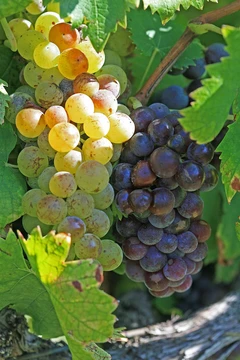
Sauvignonasse
A white grape long confused with Sauvignon blanc and Tokaji.
Sauvignonasse, also called Friulano, Tocai Friulano, or Sauvignon Vert, is a white wine grape of Vitis vinifera widely grown in Italy's Friuli region and neighboring Slovenia. It is notably planted in Chile, where it was long mistaken for Sauvignon blanc. The grape gained prominence after European regulations prohibited the use of the name Tocai on Italian wine labels in 2007.
Quick Facts
- Species
- Vitis vinifera
- Also called
- Friulano
- Tocai Friulano
- Tokaj
- Točaj
- Sauvignon Vert (more)
- Origin
- Italy
- Regions
- Friuli, Chile, Slovenian Littoral
Facts from the source article.
History
The grape is thought to have originated in the Veneto region and spread to Friuli, where it was cultivated from the 1600s. In Italy it was historically called Tocai or Tocai Friulano for centuries. Following the 1632 wedding of Venetian princess Aurora Formentini to Hungarian Count Batthyány, some Tocai Friulano vines were reportedly taken to Hungary. The grape has no known relation to the grapes used in Hungarian Tokaji. To protect the Tokaji name, the European Union banned names easily confused with it, leading Friuli winemakers to label the wine simply as Friulano. In Slovenia's Goriška region, the grape was known as Tokaj; after the EU prohibition, producers first renamed it Sauvignonasse or Zeleni sauvignon, then in 2013 changed the name to Jakot. From Italy the grape spread to France and later to Chile, where it was brought as Sauvignon blanc. In the 1990s ampelographers identified Chilean Sauvignon blanc as Sauvignonasse, called Sauvignon vert in Chile, prompting increased plantings of true Sauvignon blanc. The grape now has little presence outside Friuli-Venezia Giulia and Goriška Brda.
Confusion with Sauvignon blanc
Sauvignonasse has no known genetic relationship with Sauvignon blanc, unlike Sauvignon gris which is a clonal mutation. In the 19th century, cuttings from Bordeaux were brought to Chile labeled as Sauvignon blanc, likely because the vines were interspersed there. The leaves and berry clusters of the two varieties are very similar, and both are susceptible to Botrytis. The wines differ noticeably: Sauvignon blanc is more aromatic with gooseberry and black currant notes, while Sauvignonasse offers softer, floral flavors and lower acidity.
Viticulture and wine
Sauvignonasse buds late and is highly sensitive to downy mildew and oidium. It tends to produce high yields that must be controlled for premium quality. Harvest timing is critical: picking too early yields dull wine lacking varietal character. The grape can reach high alcohol levels, with 14.5% ABV not uncommon. Wine style varies by region: in Friuli and Goriška Brda, it is typically full-bodied with moderate acidity, floral aromas, and delicate fruit; in Chile, Sauvignon vert starts with green apple notes in youth and becomes more medium-bodied with age.
Wine regions
The grape is most noted in Friuli-Venezia Giulia and Goriška Brda, where it is among the most widely planted varieties. In Friuli it is the main white grape in the DOC zones of Colli Orientali del Friuli, Collio Goriziano, Friuli Grave, and Friuli Isonzo, accounting for over 20% of vineyard plantings in those areas. It is believed related to Tocai Italico in Veneto, though plantings around Breganze may be a different vine. Argentina has a small amount of Friulano vines.
More in White Wine Grape Varieties
Spotted an error? Know more?
Reader corrections go straight into our review queue. Suggest an edit · How this site is sourced