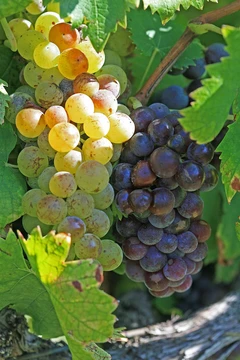
Sauvignon blanc
Crisp white wine with grassy to tropical flavors.
Sauvignon blanc is a green-skinned grape variety that most likely originated in the Loire Valley wine region in France, though it has also been historically cultivated in Bordeaux. It produces a crisp, dry, and refreshing white wine, with flavors ranging from grassy to tropical depending on climate. Along with Riesling, it was one of the first fine wines to be bottled with a screwcap in commercial quantities.
Quick Facts
- Species
- Vitis vinifera
- Origin
- France
- Hazards
- Powdery mildew
- black rot
- and Botrytis cinerea
- Regions
- South Africa
- Chile
- New Zealand
- California
- Iran
- Loire Valley
- Bordeaux
- Ukraine
- Argentina
- Notable wines
- Sauternes, Sancerre
Facts from the source article.
History
The Sauvignon blanc grape has its roots in France’s Val de Loire region, with the earliest known mention appearing in 1534 within Francois Rabelais’s book Gargantua. Whether the vine truly originated in western France remains uncertain; current research points to a possible descent from Savagnin, and it has also been linked to the Carmenere family. During the 18th century, this vine crossed with Cabernet Franc in Bordeaux to produce Cabernet Sauvignon. In the 1800s, Bordeaux vineyards frequently mixed Sauvignon blanc with Sauvignon vert and the pink-berried Sauvignon gris. Before the phylloxera epidemic devastated French vineyards, these blended cuttings made their way to Chile, where such field mixes persist. Despite their similar names, Sauvignon blanc is unrelated to the Sauvignon rosé mutation found in the Loire Valley. Charles Wetmore, founder of Cresta Blanca Winery, brought the first Sauvignon blanc cuttings to California in the 1880s, sourced from Château d’Yquem’s Sauternes vineyards. The grape reached New Zealand in the 1970s as an experimental variety intended for blending with Müller-Thurgau.
Climate and geography
Sauvignon blanc vines are late to bud but quick to ripen, making them well-suited to sunny climates as long as the heat isn't extreme. In warmer wine regions like South Africa, Australia, and California, the grape does best in cooler pockets such as the Alexander Valley. When temperatures climb too high, the grapes can over-ripen quickly, leading to dull flavors and flat acidity. Warmer global conditions have pushed harvests earlier than in the past. The grape originated in France's Bordeaux and Loire Valley, and is also grown in Italy and Central Europe.
Wine regions
In Australia, particularly the Margaret River region, the grape is often blended with Sémillon. Varietal styles from Adelaide Hills and Padthaway tend to be more ripe in flavor with white peach and lime notes and slightly higher acidity. In the early 1990s, ampelographers began to distinguish Sauvignon blanc from Sauvignonasse plantings in Chile. Non-blended Chilean Sauvignon blanc is noticeably less acidic than wines of New Zealand and more similar to the French style. The region of Valparaíso is the most notable area for Sauvignon blanc in Chile due to its cooler climate. In Brazil, vines called Sauvignon blanc are really Seyval blanc. In France, Sauvignon blanc is grown in the maritime climate of Bordeaux and the continental climate of the Loire Valley. The climates of these areas slow ripening, allowing the grape more time to develop balance between acidity and sugar levels. Winemakers in France pay careful attention to terroir characteristics; chalk and Kimmeridgean marl of Sancerre and Pouilly produces wines of richness and complexity, while gravel soil near the Loire imparts spicy, floral and mineral flavors. Bordeaux wines have a fruitier personality.
Winemaking
Sauvignon blanc grapes are picked at different times in New Zealand and Chile to get various blending traits from the changing ripeness. When very unripe, the grapes have a lot of malic acid. As they ripen, they start to taste like red and green peppers, and eventually the sugars balance out. The grape's typical flavors come from chemicals called methoxypyrazines. In Marlborough's Wairau Valley, slight unevenness in the land can cause different ripeness levels across a single vineyard, which gives the wine a similar flavor profile.
What winemakers do after picking also shapes the wine. One key choice is how long the crushed grapes stay in contact with their skins. Early on in New Zealand's wine industry, there were no wineries in the South Island, so grapes had to be trucked and ferried to the North Island, sometimes all the way to Auckland. This long trip meant more skin contact, which made the wine more intense and pungent. Some winemakers, like those in the Loire, purposely leave a bit of must on the skins for later blending. Others, like in California, usually avoid skin contact because it can shorten the wine's aging potential.
Fermentation temperature matters too. French winemakers ferment at warmer temperatures, around 16 to 18 degrees Celsius, to highlight mineral flavors. New World winemakers prefer cooler temperatures to bring out fruit and tropical notes. A few Loire winemakers use malolactic fermentation, a technique more common in New Zealand. Oak aging can soften the wine's high acidity and round out its flavors. But some winemakers, including those in New Zealand and Sancerre, choose stainless steel tanks to keep the wine sharp and intense.
More in White Wine Grape Varieties
Spotted an error? Know more?
Reader corrections go straight into our review queue. Suggest an edit · How this site is sourced