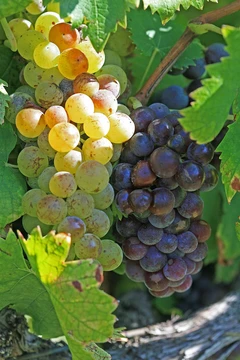
Sémillon
A thin-skinned grape essential for Sauternes and Hunter Valley wines.
Sémillon, a white wine grape with a golden hue, produces both dry and sweet styles, chiefly in France and Australia. Its delicate skin and vulnerability to noble rot make it the primary variety in Sauternes and Barsac, two renowned sweet wine appellations.
Quick Facts
- Also called
- Blanc doux
- Colombier
- Malaga
- Groendruif
- Wyndruif
- Hunter River Riesling
- Origin
- West of France
- Hazards
- Sunburn, Botrytis cinerea
Facts from the source article.
History
The Sémillon grape originated in the Bordeaux region. It was recorded as Sémillon de Saint-Émilion in 1736, and its name resembles the local pronunciation of that town. It reached Australia early in the 19th century. By the 1820s, Sémillon covered over 90% of South Africa's vineyards, where it was called Wyndruif. It was once the most planted grape globally. In the 1950s, over 75% of Chile's vineyards were Sémillon, but today it accounts for only 1% of South African Cape vines.
Viticulture
Sémillon is relatively easy to cultivate, with vigorous vines that consistently yield six to eight tons per acre. It is fairly resistant to disease except for rot. The grape ripens early and, in warmer climates, takes on a pinkish hue. Its thin skin makes it susceptible to sunburn in hot areas, so it does best with sunny days and cool nights. Sémillon wines are heavy, low in acidity, and have an almost oily texture. The grape has high yields and can age for a long time. It is one of only three approved white varieties in Bordeaux, alongside Sauvignon blanc and Muscadelle. For sweet wines like Sauternes, the grapes must be affected by Botrytis cinerea, which concentrates sugar and flavour.
Regional production
In France, Sémillon is the leading white grape in Bordeaux, where it is blended with Sauvignon blanc and Muscadelle. Dry versions are called Bordeaux blanc and are permitted in Pessac-Léognan, Graves, Entre-Deux-Mers, and other regions, though Sémillon is usually a minor component. For sweet wines from Sauternes, Barsac, and Cérons, Sémillon is often the dominant variety, exposed to Botrytis cinerea that shrivels the grapes and intensifies acid and sugar. Fewer clones are now cultivated, leading producers to project a future shortage of quality wine. In 2008, 17 Bordeaux producers, including Château d'Yquem, Château Olivier, Château Suduiraut, and Château La Tour Blanche, formed an association to grow their own clones. In Australia, Sémillon is widely grown, especially in the Hunter Valley, where it was long called Hunter River Riesling. Four styles are made: a commercial style often blended with Chardonnay or Sauvignon blanc; a sweet Sauternes-style; a complex, minerally early-picked style with great longevity; and a high-quality dry style released soon after vintage. The latter two styles, pioneered by Lindemans, Tulloch, McWilliam's Elizabeth, Drayton's, and Tyrrell's, are considered unique to Australia.
More in White Wine Grape Varieties
Spotted an error? Know more?
Reader corrections go straight into our review queue. Suggest an edit · How this site is sourced