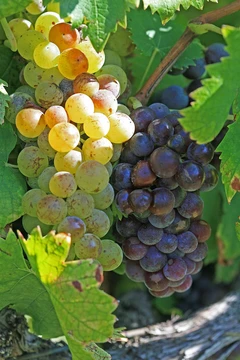
Roussanne
A challenging Rhône white grape with aromatic, age-worthy wines.
Roussanne is a white wine grape originating in the Rhône wine region of France, where it is frequently blended with Marsanne. It is the only other white variety, besides Marsanne, permitted in the northern Rhône appellations of Crozes-Hermitage, Hermitage, and Saint-Joseph, and is one of six white grapes allowed in Châteauneuf-du-Pape, where it may also be blended into red wines. The grape's name likely derives from the French word 'roux', referring to the russet color of its ripe berries.
Quick Facts
- Species
- Vitis vinifera
- Also called
- Roussanne Blanc, Bergeron and other synonyms
- Origin
- France
- Regions
- Rhône
- Notable wines
- Château Beaucastel Châteauneuf-du-Pape Blanc Vieilles Vignes
Facts from the source article.
Did You Know?
- Synonyms include Bergeron (in Savoie), Fromental, and Roussette.
- The pink-skinned Roussanne du Var in Provence is unrelated to Roussanne.
Viticulture and winemaking
The Roussanne vine ripens late and produces irregular yields that can be further reduced by poor wind resistance. It is susceptible to powdery mildew and rot, though better clones have recently alleviated some difficulties. The grape prefers a long growing season but should be harvested before potential alcohol reaches 14% to avoid imbalance; picking too soon can result in high acidity. Winemakers must guard against oxidation, and controlled oak use can benefit the wine. In blends, Roussanne contributes aromatics, elegance, and acidity, with aging potential.
Wine regions
Roussanne likely originated in the northern Rhône, where it is important in Crozes-Hermitage, Hermitage, Saint-Joseph, and Saint-Péray (used for still and sparkling wines). Plantings have declined as Marsanne gains ground due to its higher productivity. In the southern Rhône, Roussanne is a primary component in Châteauneuf-du-Pape white wines, sometimes comprising 80–100% of the blend, and appears in some Côtes du Rhône whites. Outside the Rhône, it is grown in Provence and Languedoc-Roussillon, often blended with Chardonnay, Marsanne, and Vermentino in vin de pays. In Savoie, known as Bergeron, it produces highly aromatic wines in Chignin. Internationally, it is grown in Liguria and Tuscany (permitted in Montecarlo bianco), Australia (documented in Victoria since 1882, used in blends and varietal wines), California (Central Coast and Yuba County), the northern Golan Heights (produced in Israel), South Africa, Washington State (first experimental plantings in 1990, often blended with Viognier), the Texas High Plains, and New Jersey.
California Roussanne/Viognier controversy
In the 1980s, California winemaker Randall Grahm of Bonny Doon Vineyard smuggled cuttings of what he believed was Roussanne from a Châteauneuf-du-Pape vineyard, bypassing quarantine regulations. He planted them in the Santa Cruz Mountains and made a Rhône-style blend with Marsanne. In 1994, Grahm sold cuttings to Sonoma Grapevine, which propagated and distributed them across the state, including to Caymus Vineyards. In 1998, John Alban of Alban Vineyards observed that the plantings at Caymus resembled Viognier more than Roussanne. DNA analysis confirmed they were Viognier, as were all vines from Grahm's original vineyard.
Wines
Roussanne wines are characterized by intense aromatics, including notes of herbal tea. In youth, they show floral, herbal, and pear notes, which become nutty with age. Savoie Roussanne is marked by pepper and herbal notes. Wine expert Oz Clarke notes that Roussanne wines and Roussanne-dominated blends can drink well in the first 3 to 4 years, then enter a 'dumb phase' until around 7 or 8 years, when they develop more complexity and depth.
More in White Wine Grape Varieties
Spotted an error? Know more?
Reader corrections go straight into our review queue. Suggest an edit · How this site is sourced