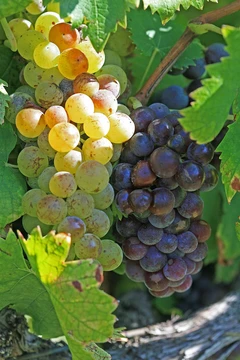
Riesling
An aromatic, high-acid white grape expressive of its terroir.
Riesling is a white grape variety believed to have originated in the Rhine Valley of western Germany. It is an aromatic grape known for flowery, perfumed aromas and high acidity, used to produce dry, semi-sweet, sweet, and sparkling wines. Though the 20th most grown variety globally by area, it is considered among the top three white wine varieties for quality, alongside Chardonnay and Sauvignon blanc.
Quick Facts
- Species
- Vitis vinifera
- Also called
- Rhein Riesling, Johannisberger
- Origin
- Rhine, Germany
- Hazards
- Underripeness in colder regions
- Notable wines
- Eiswein
- Trockenbeerenauslese
- Beerenauslese
- Grosses Gewächs
- Alsace Grand Cru
- Wachau Smaragd
Facts from the source article.
Did You Know?
- Riesling is one of the few wines that can stand up to the stronger flavours and spices of Thai and Chinese cuisine.
- In Germany, cabbage is sometimes cooked with Riesling to reduce the vegetable's smell.
History
The earliest known written reference to Riesling dates from March 13, 1435, when the storage inventory of Count John IV of Katzenelnbogen in Rüsselsheim listed vine cuttings called Rießlingen. The modern spelling Riesling first appeared in 1552 in Hieronymus Bock's Latin herbal. In Alsace, a 1348 map contains the text zu dem Russelinge, though it is uncertain whether this refers to the grape; by 1477 Riesling was documented there as Rissling. In Austria's Wachau, a stream and vineyard named Ritzling are locally claimed to have given Riesling its name, but no documentary evidence supports this. Earlier claims that Riesling originated from wild Rhine vines lack support. DNA fingerprinting by Ferdinand Regner identified one parent as Gouais blanc (Weißer Heunisch) and the other as a cross between a wild vine and Traminer. Because both Heunisch and Traminer have long histories in Germany, the cross is presumed to have occurred somewhere in the Rhine valley. It has been suggested, but not proved, that red-skinned Riesling is the forerunner of white Riesling; the genetic differences between them are minuscule.
Longevity
Most people drink Riesling young, when it bursts with fruity and floral notes like green apple, grapefruit, peach, and honey, all balanced by a crisp, high acidity. But that same acidity, along with a wide range of flavors, also makes it a prime candidate for aging. Wine expert Michael Broadbent has praised German Rieslings that are centuries old. Sweet versions, like Trockenbeerenauslese, are especially good for cellaring because their high sugar acts as a preservative, though top-quality dry and off-dry Rieslings have also remained enjoyable for over a hundred years. The Ratskeller in Bremen’s town hall holds more than 650 German wines, including Rieslings in barrels dating back to 1653. More typical aging spans are 5 to 15 years for dry wines, 10 to 20 for semi-sweet, and 10 to 30-plus for sweet ones. Some Rieslings develop a petrol-like aroma, often compared to kerosene or rubber. Many experienced drinkers seek this out, but it can put off those who prefer the wine’s youthful fruitiness. This note appears most often in aged Australian Rieslings. Some German producers, especially those focused on volume, see petrol as a flaw and try to avoid it, even if that means making wines less suited to long aging.
Production regions
Riesling is a grape that strongly reflects the character of its growing site, thriving especially in slate and sandy clay soils. Germany produces roughly 40% of the world’s Riesling, and the country’s versions are prized for their clear, transparent flavors that showcase the land, along with a balance of fruit and mineral notes. The grapes typically ripen from late September to late November, and in some years, late-harvest fruit is picked as late as January. German Riesling is seldom blended with other grapes and is usually fermented in neutral steel tanks or old oak, though some producers in the Palatinate and Baden use new oak for fuller-bodied, higher-alcohol wines. Before temperature-controlled fermentation became common, cold winters often stopped fermentation early, leaving natural sugars and lower alcohol. In the Mosel, such wines were bottled in tall, tapered green bottles; in the Rhine region, brown glass was used. Harvest sugar levels are key in Germany, where the prädikat system classifies wines by must weight and sweetness. Riesling is also the main grape for Deutscher Sekt, Germany’s traditional sparkling wine.
Production
The delicate nature of the Riesling grape requires special handling during harvesting to avoid crushing or bruising the skin, which could leak tannin into the juice and give a coarse taste. The grapes and juice may be chilled throughout vinification: right after picking, after processing through a bladder press, and during fermentation in temperature-controlled stainless steel tanks kept between 10 and 18 °C. Unlike Chardonnay, most Riesling does not undergo malolactic fermentation, preserving the tart, acidic characteristic that gives the wine its thirst-quenching quality. Riesling is often cold stabilized by storing the wine just above its freezing point until much of the tartaric acid crystallizes and precipitates out, preventing wine diamonds in the bottle. After this, the wine is normally filtered again to remove any remaining yeast or impurities. In viticulture, the two main components for growing Riesling are to keep it long and slow, meaning a climate that allows a long, slow ripening, and proper pruning to keep yield low and flavor concentrated.
More in White Wine Grape Varieties
Spotted an error? Know more?
Reader corrections go straight into our review queue. Suggest an edit · How this site is sourced