Pinot gris
A versatile white grape with pinkish-gray berries and two major styles.
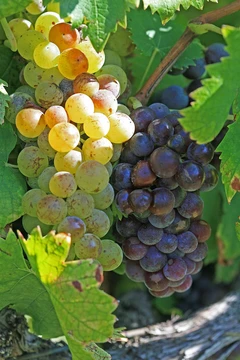
Pinot gris, also known as pinot grigio or Grauburgunder, is a white wine grape of the species Vitis vinifera. It is thought to be a mutant clone of pinot noir, typically displaying a pinkish-gray hue, and produces wines that range in color from deep golden yellow to copper and light pink. The grape is notable for being one of the more popular varieties for skin-contact wine and for its two widely recognized styles: the full-bodied, spicy Alsatian and the lighter, more acidic Italian.
Quick Facts
- Species
- Vitis vinifera
- Also called
- (see list of synonyms)
- Origin
- Burgundy, France
- Regions
- (see major regions)
- Vivc number
- 9275
Facts from the source article.
History
Pinot gris dates back to the Middle Ages in Burgundy, where it likely went by the name Fromenteau. It traveled alongside pinot noir, reaching Switzerland by 1300. Emperor Charles IV was said to be fond of it, and Cistercian monks brought cuttings to Hungary, planting them in 1375 on the slopes of Badacsony near Lake Balaton. There, the grape earned the name Szürkebarát, meaning "grey monk." In 1711, a German merchant named Johann Seger Ruland came across a wild grape in the Palatinate and made wine from it, calling it Ruländer. It was later identified as pinot gris. The grape was widely grown in Burgundy and Champagne until the 18th and 19th centuries, but low yields and inconsistent harvests led to its decline in those regions. Germany faced a similar drop in interest, though early 20th-century vine breeders created clonal varieties that offered more reliable harvests. DNA research at the University of California, Davis, showed that pinot gris and pinot noir are nearly identical genetically, with the color difference resulting from a centuries-old mutation. In 1961, the Santa Margherita wine group in northern Italy became the first to turn pink pinot grigio grapes into a white wine. Around 2005, pinot gris gained widespread popularity, especially in its pinot grigio form and similar New World wines.
Regions
Pinot gris is grown around the globe, with total cultivated area worldwide about 115,000 hectares. In France, it is a major grape in Alsace, grown on 13.9 percent of the region's vineyard surface in 2006, and is one of the so-called noble grapes of Alsace along with Riesling, Gewürztraminer, and muscat. The cool climate and warm volcanic soils of Alsace, with dry autumns allowing extended hang time, produce wines of very powerful flavors. Other French regions include Burgundy and the Loire. In Italy, key areas are Alto Adige, Friuli-Venezia Giulia, Oltrepò Pavese, Roverè della Luna, and Trentino. German plantings are concentrated in Baden and the Palatinate. New World regions include Oregon, California, Washington, and New Mexico in the United States; Marlborough in New Zealand; Tasmania, Yarra Valley, Adelaide Hills, and other Australian areas; South Africa; and British Columbia and Ontario in Canada. Other countries with notable plantings include Argentina, Austria, Belgium, Chile, the Czech Republic, Crimea, Hungary, Luxembourg, Moldova, Romania, Slovakia, Slovenia, Switzerland, and Turkey.
Viticulture
Pinot gris prefers cool weather, with top regions in Alsace, northeastern Italy, and Oregon. Its small, pinecone-like clusters can show blue-gray, pinkish-gray, or pinkish-brown berries. The wine may be sweet or, if fermented dry, high in alcohol. Winemakers often blend it with Pinot Noir to make the latter lighter and richer.
Wine characteristics
Pinot gris is a chameleon of a grape, with its character shifting dramatically based on where it's grown and how it's made. In Alsace, it turns into a medium to full-bodied wine with a rich, floral scent and a spicy kick, and unlike most versions, it can actually improve with age. Germany’s take is fuller-bodied, balancing acidity with a touch of sweetness. Oregon produces a medium-bodied wine with a yellow to copper-pink hue and aromas of pear, apple, or melon. California’s is lighter, crisp, and refreshing, with hints of pepper and arugula. Italy’s Pinot grigio is light, often lean, pale in color, sometimes slightly fizzy, and sharply acidic. True to its name, it’s an early-to-market wine, often bottled just 4 to 12 weeks after fermentation.
More in White Wine Grape Varieties
Spotted an error? Know more?
Reader corrections go straight into our review queue. Suggest an edit · How this site is sourced