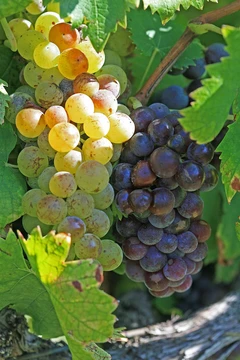
Pedro Ximénez
Spanish white grape used for sweet fortified sherry.
Pedro Ximénez is a white Spanish wine grape variety primarily grown in the Montilla-Moriles region, where it is used to produce an intensely sweet, dark dessert sherry. The grapes are dried under the sun to concentrate their sweetness, then fortified and aged in solera, yielding a thick, black liquid with strong raisin and molasses flavors. It is also cultivated in Australia, often for blending and fortified wines.
Quick Facts
- Species
- Vitis vinifera
- Also called
- PX, Pedro Jiménez (more)
- Origin
- Spain
- Regions
- Montilla-Moriles, Jerez, Australia, Chile
Facts from the source article.
Did You Know?
- Pedro Ximénez is highly susceptible to botrytis bunch rot, downy mildew, esca, eutypa dieback, and termite damage, but has some resistance to powdery mildew.
- The vine can be very vigorous and productive, producing large clusters of berries of irregular sizes, sometimes due to millerandage.
History
Several apocryphal legends surround the grape's origins. In 1661, German ampelographer F. J. Sachs speculated that Pedro Ximénez originated in the Canary Islands or Madeira and was later brought to German wine regions before a Spanish soldier or a Catholic Cardinal introduced it to Málaga and Sierras de Málaga. This theory, spread by other German writers, suggested a relationship with Elbling or Riesling, but DNA evidence in the late 20th and early 21st centuries disproved those theories. Today ampelographers believe the grape probably originated in Andalusia, where it has been grown since at least the early 17th century. In 1618, Vicente Espinel described the wine of "Pedro Ximénez de Malaga". DNA analysis in 2007 showed that Pedro Ximénez is an offspring of the Arabic table grape Gibi, which was once grown in southern France and the Iberian Peninsula, possibly introduced during Moorish rule. Gibi is also a parent of the Extremadura grape Alarije, making it a half-sibling. The name's origin remains unclear; French ampelographer Joseph Roy-Chevrier speculated in 1905 that it was named after the village of Jiménez in Sanlúcar de Barrameda, while another theory holds it was named after a notable vintner.
Wine regions
Pedro Ximénez is most widely grown in Spain, with 6,950 ha in cultivation as of 2019, predominantly in Montilla-Moriles, where it is used for fortified PX wines. After harvest, the grapes are traditionally dried on mats in the sun, similar to straw wine production, producing a high-sugar, low-acid wine that may be fortified and aged in solera. The grape is also found in the DOs of Jerez de la Frontera, Málaga and Sierras de Málaga, and Valencia. Because it is disease-prone and does not thrive in Jerez's albariza soils, Sherry producers there often purchase Pedro Ximénez wine from Montilla-Moriles for blending. In 2008, plantings were recorded in the Canary Islands (less than 1 ha), Castile-La Mancha (117 ha), Catalunya (12 ha), and Extremadura (639 ha). In Portugal, 350 ha were planted in 2010, known as Perrum, mainly in Evora and Borba in the Alentejo region, with some in the Algarve; it is mostly used as a blending varietal.
Other uses
Retired casks used to age Pedro Ximénez Sherry are often sent to Scotland and Ireland for aging fine whisky. The sweet wine infused in the wood imparts flavor and aroma to the whisky during maturation. Most whiskies are only finished in these casks for a short time after spending most of their maturation in other casks, and the Pedro Ximénez sweetness is sometimes combined with smoky peat flavor.
More in White Wine Grape Varieties
Spotted an error? Know more?
Reader corrections go straight into our review queue. Suggest an edit · How this site is sourced