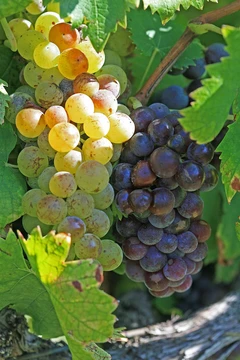
Pallagrello bianco
A revived Campanian white grape with a long royal history.
Pallagrello bianco is a white Italian wine grape variety native to Campania. It was planted in 1775 in the fan-shaped Vigna del Ventaglio vineyard created for King Ferdinand I of the Two Sicilies. Thought extinct after the phylloxera epidemic and World Wars, it was rediscovered in an abandoned Campanian vineyard in the 1990s.
Quick Facts
- Origin
- Campania, likely province of Caserta between Piedimonte Matese and Alife
- First written records
- Late 18th century under synonym Pallarelli
- Notable historical planting
- 1775 in Vigna del Ventaglio vineyard, Caserta
- Rediscovery
- 1990s
Facts from the source article.
Did You Know?
- Today Pallagrello bianco is grown almost exclusively in Campania, particularly in the province of Caserta, with some hectares in communes along the Volturno river, Caiazzo, Castel Campagnano and Castel di Sasso.
- According to Master of Wine Jancis Robinson, Pallagrello bianco wines have a profile similar to Viognier, with peach and apricot aromas, moderate acidity, and high potential alcohol.
- The grape can be made in a varietal style, either unoaked in stainless steel or barrel fermented like Chardonnay.
History and name
Ampelographers believe Pallagrello bianco likely originated in Campania, in what is now the province of Caserta between the communes of Piedimonte Matese and Alife. The name Pallagrello derives from the Italian word pagliarello, referring to the straw mat on which grapes were laid after harvest to dry for straw wine. The first written records date to the late 18th century under the synonym Pallarelli. Under another old synonym, Piedmonte bianco, it was one of the varieties in the fan-shaped Vigna del Ventaglio vineyard, planted in 1775 by architect Luigi Vanvitelli for King Ferdinand's royal palace at Caserta. The vineyard, on sloping terrain in the San Leucio frazione, was a semicircle subdivided into ten segments, each planted to a different grape. Plantings declined sharply after the phylloxera epidemic and World Wars, and the variety was thought extinct until rediscovered in the 1990s by a local winemaker in an abandoned Campanian vineyard.
Viticulture and relationship to other grapes
Pallagrello bianco is a mid to late ripening variety with a natural tendency to be very low yielding. It has good resistance to botrytis bunch rot, suiting it for late harvest wines. Its clusters resemble a fox's bush tail, larger at the top and tapering to a point, a trait shared with Coda di Volpe. At one point the two were thought identical, but DNA analysis in the early 21st century showed they are distinct and unrelated. DNA evidence also distinguished Pallagrello bianco from the Emilia-Romagna grape Pignoletto, grown in Campania under the synonym Pallagrello di Caserta but with no known relationship. Although both Pallagrello bianco and Pallagrello nero likely originated in the same part of Campania and have been linked historically, ampelographers have determined that Pallagrello bianco is not a color mutation of Pallagrello nero; DNA profiling has yet to determine how the two may be related.
More in White Wine Grape Varieties
Spotted an error? Know more?
Reader corrections go straight into our review queue. Suggest an edit · How this site is sourced