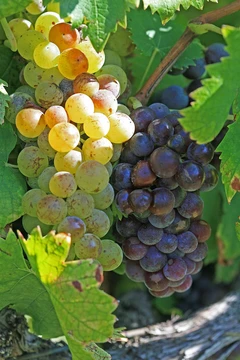
Nosiola
A Trentino white grape used for dry wines and Vin Santo.
Nosiola, sometimes called Groppello bianco, is a white wine grape from Italy, mainly found in Trentino’s Valle dei Laghi, just north of Lake Garda. Winemakers use it for single-variety DOC wines and blend it into wines like Sorni Bianco from Trento. It also yields a Vin Santo-style dessert wine, made from grapes dried before fermentation.
History
The name Nosiola is thought by ampelographers to come from the Italian word nocciola (hazelnut), possibly referring to the toasted hazelnut aromas in varietal wines or to the berries themselves, which unlike most white grapes do not turn dark brown when very mature. Another theory holds that the name is a corruption of ociolet, meaning "little eyes" in the local Trentino dialect, linked to the likely extinct 18th-century grape Uva dall'Occhio bianca. Nosiola may also be related to the ancient Roman grape Raetica, once the most widely planted white wine grape in northern Italy, but no conclusive historical or DNA evidence confirms this. DNA analysis has connected Nosiola to the Swiss grape Rèze from Valais, showing a parent-offspring relationship; since Rèze was documented nearly five centuries before Nosiola and Groppello di Revò, it is likely the parent. The grape's origin remains uncertain, though its long association with Trentino makes that region the most probable source, with Alto Adige as another possibility where it is known as Spargelen.
Viticulture and confusion with other grapes
Nosiola is a mid to late ripening variety that buds early, making it vulnerable to spring frost. It is sensitive to humidity, which can lead to fungal infections like sour rot and powdery mildew. Its thick skins and easy desiccation suit passito winemaking, but the stems may dry out before the grapes fully ripen. Nosiola is sometimes confused with the Veneto grape Durella due to similarities in synonyms and appearance.
Wine regions
In 2000, 193 ha of Nosiola were planted in Italy, almost entirely in Trentino, especially the Valle dei Laghi between Trento and Lake Garda. Other plantings occur around Merano in South Tyrol, the Lagarina Valley, and Val di Cembra. Around the communes of Calavino, Cavedine, Lasino, Padergnone, and Vezzano, nearly 10 ha are dedicated to the rare Vino Santo dessert wine under Trentino DOC, where berries lose 60–80% of their weight after drying on racks, yielding little juice; slow fermentation and 7–10 years of aging produce about 30,000 half-bottles annually. Nosiola is the primary component (70%) in Sorni DOC white wines, with Müller-Thurgau, Sylvaner verde, and Pinot blanc permitted for the remainder; grapes must be harvested at no more than 14 tonnes/ha and the wine must reach at least 10% alcohol. In Trentino DOC, a 100% Nosiola varietal wine is made with the same yield limit and a minimum alcohol of 10.5%, while the Vino Santo style requires 16% alcohol and at least three years of oak and bottle aging. Nosiola also appears as a minor blending component in Valdadige DOC wines, subject to the same yield and alcohol requirements.
Wine styles
Master of Wine Jancis Robinson describes Nosiola as producing very aromatic, light-bodied wines with a possible slight bitter note, featuring citrus, apricot, and peach fruit flavors along with a characteristic subtle hazelnut note. As a Vin Santo, often aided by noble rot, the wines become fuller-bodied and luscious with notes of orange peel, apricot, lime, pineapple, and quince. Wine writers Joe Bastianich and David Lynch note apple and lemon notes with some minerality.
More in White Wine Grape Varieties
Spotted an error? Know more?
Reader corrections go straight into our review queue. Suggest an edit · How this site is sourced