Muscat Blanc à Petits Grains
A small-berried Muscat grape of ancient Greek origin.
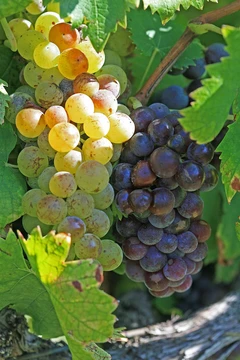
Muscat Blanc à Petits Grains, a white wine grape from Greece, belongs to the Muscat family. Its name reflects its small berries and compact clusters. Known as Moscato bianco, Muscat Canelli, and Muskateller, among other local names, it can also produce pink or reddish-brown berries, with stable color variants classified separately.
Quick Facts
- Species
- Vitis vinifera
- Also called
- See list of synonyms
- Origin
- Greece
Facts from the source article.
Uses
Muscat Blanc à Petits Grains plays a major role in Greek wine, especially on Samos and near Patras in the Peloponnese. On Samos, winemakers use it for Vin Doux Naturel, aromatic dry whites, and Liastos straw wine. The best fruit comes from vineyards at 500 to 1000 meters elevation. The island is currently reinventing itself, with new independent producers leaning toward dry and sparkling styles. Near Patras, the grape also goes into Vin Doux Naturel. It appears across Greece; Spina in Crete stands out for its dry wines. In Italy, this grape is the most widespread Muscat variety, known locally as Moscato Bianco. It is the oldest known grape in Piedmont and forms the base of Asti and Moscato d’Asti, plus aromatized and fortified vermouths. It also shows up in fortified dessert wines and the semi-sparkling Frizzante. French winemakers blend it with Grenache blanc and Muscat of Alexandria for vins doux naturels from the Frontignan area, including Banyuls, Côtes d’Agly, Grand Roussillon, Rivesaltes, and St-Jean de Minervois. It is the main grape in the Rhône’s Muscat de Beaumes-de-Venise and gets blended with Clairette blanc for the sparkling Clairette de Die (sold as Tradition). In Alsace, it produces highly aromatic dry wines. In the Hérault region, it is the primary grape for Muscat de Mireval. Spain calls it Moscatel de Grano Menudo, where it ranks as the second most planted Muscat. It grows throughout Spain, with the largest plantings in Castilla-La Mancha.
Viticulture
Muscat Blanc à Petits Grains is a tricky vine to grow. It naturally gives small harvests and is easily hit by mildew and the grape berry moth. Leaf roll, odium, and grey rot are also common problems. The vine needs a long season because it starts budding early but doesn't ripen until late. In Australia, it ripens early enough for low-alcohol Moscato wines, with picking starting in early February. For fortified wines, the harvest moves to mid-March, which is considered mid-season. In France, it is one of the first grapes picked, sometimes as early as mid-August in hot, dry years like 2009, especially in Mireval and other Mediterranean areas. Grapes for the fruity sec style are harvested seven to ten days before those for Vin Doux Naturel. Winemakers also produce a vendange tardive, or late harvest, to take advantage of the concentrated sugars and flavors.
History
Ampelographers link this grape to the Anathelicon moschaton used by the Ancient Greeks and the Roman Apiane vines, the latter named for how insects like bees (Latin apis) relish eating the fruit’s flesh. The Greeks likely brought it to France through their port at Marseille; later, Romans spread it to the Narbonne area during their conquest of Gaul. By Charlemagne’s era, it was a key export from Frontignan. Records show plantings in Germany by the 1100s, and it gained popularity in Alsace by the 1500s. In the 1700s, it reached South Africa, where it became the foundation of the celebrated Vin de Constance, with its grapes thought to have come from Frontignan.
Synonyms
Muscat Blanc à Petits Grains goes by many names, including Muscat Canelli and various Frontignan-based titles. In Greece, it is called White Muscat or Aspro Moschato. Bulgaria knows it as Tamyanka, North Macedonia as Temjanika, and Serbia as Tamjanika. Hungary calls it Sárgamuskotály, while Austria and Germany use Gelber Muskateller. Spain has several names: Moscatel de Grano Menudo, Moscatel Castellano, Moscatel Commun, Moscatel de Frontignan, Moscatel de Grano Pequeño, Moscatel Fino, Moscatel Morisco, and in Catalan, Moscatell Gra Menut. This grape is frequently mistaken for two other distinct varieties: Muscat of Alexandria and Muscat Ottonel.
More in White Wine Grape Varieties
Spotted an error? Know more?
Reader corrections go straight into our review queue. Suggest an edit · How this site is sourced