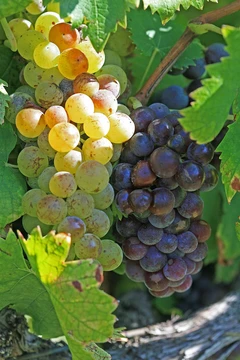
Marsanne
A Northern Rhône white grape often blended with Roussanne.
Marsanne is a white wine grape most commonly found in the Northern Rhône region, where it is often blended with Roussanne. In Savoie it is known as grosse roussette, and in Switzerland it is called ermitage blanc or simply ermitage. The grape is also grown in Australia, New Zealand, Canada, the United States, and Spain (where it is known as Marsana).
Quick Facts
- Species
- Vitis vinifera
- Also called
- See list of synonyms
- Origin
- France
- Regions
- Rhône, Australia, California
- Notable wines
- White Hermitage
Facts from the source article.
Did You Know?
- Marsanne produces deeply colored wines that are rich and nutty, with hints of spice and pear.
- As Marsanne ages, the wine takes on an even darker color and develops an oily, honeyed texture with aromas of nuts and quince.
- Marsanne is also known under the synonyms Avilleran, Champagne Piacentina, Johannisberg, Metternich, and Roussette de Saint Peray.
Wine regions
Marsanne most likely originated in the Northern Rhône, specifically in the village and abbey of Marsanne in the Drôme. It is a principal component of white wines from the Hermitage, Crozes-Hermitage, and Saint-Joseph AOCs, and is the most widely planted white grape in the Hermitage AOC, where it is often blended with Roussanne. Under AOC regulations, up to 15% of Marsanne (along with Roussanne) can be added to red Hermitage wine. In the Saint-Péray AOC, Marsanne is used for both still and sparkling wines. In the Southern Rhône, it is not permitted in Châteauneuf-du-Pape blends, though Clairette blanc adds similar characteristics. Marsanne appears in some Côtes du Rhône white wines and is found in Savoie and the Languedoc, where it is often blended with Viognier. It is a permitted grape in the Cassis wine of Provence, though not widely used. Outside France, Marsanne is grown in Valais, Switzerland, where it is known as Ermitage and made into both sweet wines and dry steely whites with high alcohol. In Australia, it was first planted in Victoria in the 1860s; the Tahbilk vineyard has Marsanne vines dating to 1927, some of the oldest in the world.
Viticulture
Marsanne is less temperamental than Roussanne but can underperform in poor sites. In hot climates it may overripen and produce flabby wine; in cool climates it may not ripen fully, yielding bland, neutral flavors. To maintain acidity, winemakers often harvest just before full ripeness, though some Australian winemakers let the grapes hang longer to increase alcohol and aging potential.
More in White Wine Grape Varieties
Spotted an error? Know more?
Reader corrections go straight into our review queue. Suggest an edit · How this site is sourced