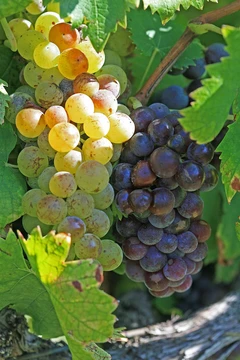
Müller-Thurgau
A widely planted crossing of Riesling and Madeleine Royale.
Müller-Thurgau is a white wine grape, a cross of Riesling and Madeleine Royale. Hermann Müller from Thurgau, Switzerland, created it in 1882 at Germany’s Geisenheim Grape Breeding Institute. It is the most planted “new breed” variety from the late 19th century, with about 22,201 hectares globally.
Quick Facts
- Species
- Vitis vinifera
- Also called
- Rivaner
- Riesling x Sylvaner
- Rizvanec
- Origin
- Geisenheim Grape Breeding Institute, Germany
- Hazards
- Mildew
- Regions
- Austria, Czech Republic, Germany, Hungary, Luxembourg, Slovenia, Slovakia
Facts from the source article.
Did You Know?
- Müller-Thurgau is also known as Rivaner, Riesling x Sylvaner, Riesling-Sylvaner, Rizvanec (Slovenia), and Rizlingszilváni (Hungary).
- In 2007, the 125th anniversary was celebrated at the Geisenheim Grape Breeding Institute.
- Synonyms include Miler Turgau, Müllerka, Müllerovo, Rizvanac Bijeli, and Rizvaner.
History of the grape variety
Dr. Müller aimed to combine the intensity and complexity of Riesling with the earlier ripening ability of Silvaner, though the resulting grape did not fully achieve these goals. By the 1970s, Müller-Thurgau had become Germany's most-planted variety, partly because it thrives in a wide range of climates and soil types, including flat areas where other grapes struggled, and because it was more profitable than sugar beet. Its wines are mild with low acidity, fruity, best consumed young, and not generally considered age-worthy, making it economical for producing large volumes of medium sweet wines like Liebfraumilch and Piesporter, popular until the 1980s. A turning point came on 1 January 1979, when temperatures fell to 20 °F (−7 °C), devastating many new varieties but not hardier ones like Riesling. In subsequent decades, German winemakers diversified, and Müller-Thurgau now ranks behind Riesling, though it still accounted for about 8% of new German plantings from 2006 to 2008.
German growing regions
As of 2024, German regional plantings were: Rheinhessen 3,797 ha, Baden 2,081 ha, Palatinate 1,563 ha, Franconia 1,347 ha, Mosel 714 ha, Nahe 462 ha, and Saale-Unstrut 117 ha. Outside Germany, the grape has achieved moderate success in Italy, southern England, Luxembourg (as Rivaner), Switzerland (as Riesling × Silvaner), the Czech Republic, and the United States.
More in White Wine Grape Varieties
Spotted an error? Know more?
Reader corrections go straight into our review queue. Suggest an edit · How this site is sourced