Gros-plant-du-pays-nantais
A dry Loire white from folle-blanche, often aged on lees.
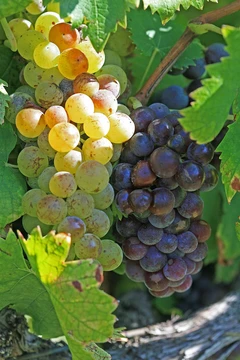
Gros-plant-du-pays-nantais, often shortened to gros-plant, is a dry white wine from the Loire Valley vineyards, primarily in the Loire-Atlantique department. It is made mainly from the folle-blanche grape variety and is known for its pale color with green sheen, floral and citrus aromas, and high acidity. In 2010, it was France's leading premium wine by volume, with 79,380 hectolitres produced.
Quick Facts
- Country
- France
- Sub regions
- Pays nantais
- Location
- Loire-Atlantique
- Maine-et-Loire
- Vendée
- Climate region
- Temperate Oceanic
- Soil
- Brown metamorphic sand and gravel
- Planted
- 1,372 ha en 2008
- Grapes
- Folle blanche
- Wine produced
- 79,380 hl in 2008
Facts from the source article.
Did You Know?
- The term "gros plant" may refer to the grape's high yield or the size of the vine.
- The second part of the appellation, Pays nantais, refers to a subdivision of the former province of Brittany.
History
Grape growing in the region was introduced by the Romans around the 1st century, and a decree by Emperor Probus in 276 granted the right to plant vines. With the spread of Christianity, Saint Martin of Vertou planted vines throughout the southern Loire area of Nantes. The vineyard expanded in the 16th century with the introduction of folle-blanche, which was called "Gros Plant" for its high yields. Under Dutch brokers seeking wines for distillation, the vineyard flourished until the 17th century; the customs barrier at Ingrandes made Nantes wines more profitable than those from Anjou or Touraine. The 18th century brought devastating frosts in the Great Winter of 1709 and overproduction, after which distillation declined in favor of Cognac. The French Revolution affected the vineyards through the Vendée wars. In the 19th century, the vineyard reached 50,000 hectares, mainly for distillation. Phylloxera arrived in 1884, destroying two-thirds of the folle-blanche plantings. Replanting with grafted vines and hybrids reduced the area to 5,000 hectares, then to 2,500 hectares in the 1950s. The Syndicat de Défense was created in 1951, and the wine obtained VDQS status on February 26, 1954, through legal proceedings.
Geographical location
The wine is produced in the Nantes vineyards along the Loire Valley, in the same area as Muscadet, with additional communes in the western Pays de Retz near the Atlantic Ocean. Its preferred terroir is the sandy soils around Lac de Grand-Lieu. Hydrography is important, with vines grown near oceans, lakes, and rivers such as the Sèvre Nantaise, Maine, Boulogne, and Acheneau. Vineyards are planted on slopes of 3% or more at altitudes between 5 and 90 meters, on coarse-textured, shallow to moderately deep soils developed on disintegrated or arenized bedrock. The geological structure includes plutonic and metamorphic rocks from Precambrian times. Sandy-gravel soils on Pliocene detritus formations are particularly favorable.
Vineyard
The Gros-plant-du-pays-nantais growing region largely mirrors that of Muscadet, stretching across the Nantes vineyard from Ancenis to Pornic. Two key production zones are the eastern Sèvre-et-Maine area and the Logne, Boulogne, and Herbauges region, though the Pays de Retz is the most favored spot. This appellation covers 92 communes: 69 in Loire-Atlantique, 16 in Maine-et-Loire, and 4 in Vendée. While only the folle-blanche grape makes Gros-plant, other varieties like Melon de Bourgogne, Cabernet Franc, Gamay, Cabernet Sauvignon, Chenin Blanc, and Pinot Gris grow here but cannot use this appellation.
Grape varieties
Gros-plant is made from the two main grape varieties, folle-blanche B and montils B, and an accessory variety, colombard B, though only folle-blanche is actually grown. This variety, probably of Charentais origin, was cultivated in the region after the Middle Ages when English, Dutch, and Scandinavian demand created a craze for planting it between Bordeaux and La Rochelle. Small acidic white wines called "Rochelle blanc" were produced for export. The white wines of Charente gave rise to cognac after the siege of La Rochelle, when distillation prevented spoilage. Thereafter, dry white wines prized by the Dutch were produced further north, around Nantes. Folle-blanche is susceptible to cryptogamic diseases such as black rot, gray mold, mildew, and wood diseases. After phylloxera, grafted folle-blanche became highly susceptible to oidium and mildew, and increased vigor made it more prone to gray mold, leading to its near disappearance from Cognac vineyards. The cool climate of the Nantes region is ideal for growing folle-blanche. In 2002, an experimental plot tested blending at least 80% folle-blanche with 20% montils, colombard, or pinot gris. Well-drained, low-fertility soil helps curb the vine's vigor. Planting density is 5,000 vines per hectare, with row spacing no more than two meters and vine spacing no less than one meter. Vines are pruned using short methods (cordon de Royat, gobelet, fan), single guyot, or Guyot Nantais, and the number of fertile eyes per vine is limited to fourteen.
More in White Wine Grape Varieties
Spotted an error? Know more?
Reader corrections go straight into our review queue. Suggest an edit · How this site is sourced