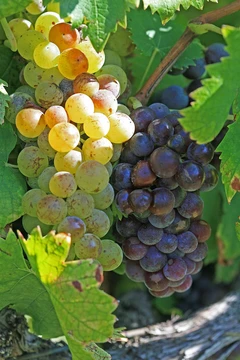
Greco (grape)
An ancient Italian grape with white and black varieties.
Greco is an Italian wine grape that may be of Greek origin, with the name relating to both white (Greco bianco) and black (Greco nero) varieties. While more land is dedicated to Greco nero, Greco bianco is the grape most commonly referred to by "Greco". It is notably used in the Campania region to produce the DOCG wine Greco di Tufo and in Calabria for the DOC wine Greco di Bianco.
History
The Greco grape’s lineage may stretch back over two and a half millennia, when ancient Greek colonists possibly brought its ancestor vine to southern Italy. Some historians and Italian vintners think it could have been used in blending for the celebrated Roman wines Falernian and Aminean. As the vine spread across Italy, the name “Greco” became attached to multiple varieties with potential Greek origins. Experts disagree on whether Greco is one grape with different clones or a collection of distinct varieties all called Greco. They also debate if any of Italy’s so-called Greek vines still grow in Greece today. After World War II, Greco and many southern Italian grapes faced a steep decline. War-damaged vineyards and a mass exodus of growers to cities or abroad led to widespread vineyard removal, pushing several varieties toward extinction. Family winemakers and heritage initiatives, like the Villa of the Mysteries project led by Piero Mastroberardino, helped keep the Greco vine alive in southern Italy. In the early 2000s, DNA testing revealed that some Italian plantings labeled Greco are genetically the same as the grape Asprinio.
Greco bianco
The Greco bianco vine is a late-ripening variety, finishing its growing cycle well into the season, and it is particularly vulnerable to downy and powdery mildew. Experts in ampelography identify the vine by its unique "winged" clusters. Once the grapes undergo veraison, they take on a golden-grey hue, and the phenolic compounds within them give the wine a notably deep color. The wines themselves are known for their aromatic profile; some critics, including Jancis Robinson, find them reminiscent of Viognier. Typical scents include peach and fresh green foliage, and as the wine matures, it can acquire more herbal notes.
This grape is most commonly grown in southern Italy, where it appears in several DOC designations. In Calabria, a particular clone is used to make the sweet dessert wine Greco di Bianco, which is produced in a partial passito style from grapes that are dried somewhat after picking. On Capri, Greco is often blended with Biancolella and Falanghina to create dry wines. In Apulia, it is an allowed blending component in the Gravina DOC. In Campania, it is the star of the Greco di Tufo DOCG, made near the town of Tufo in the province of Avellino, and it is also permitted in Lacryma Christi wines from the slopes of Mount Vesuvius.
Greco plays a primary role in two DOCG regions, though it is also a permitted component in many DOCs across southern Italy. The Greco di Tufo DOCG, located north of the Fiano di Avellino DOCG, includes the town of Tufo and seven other hillside communities. This region was granted DOCG status in 2003. Despite being only a third the size of Fiano di Avellino, it is Campania’s largest producer of DOC-quality wine. The vineyard soils here come from tuff, a volcanic ash rock that gives the town its name. All DOCG wines must contain at least 85% Greco, with Coda di Volpe usually making up the rest. According to Master of Wine Mary Ewing-Mulligan, these wines are typically ready to drink three to four years after harvest and can continue to develop well for ten to twelve years. A sparkling spumante version is also allowed.
Greco nero
The red wine variety Greco nero is the most widely planted Greco variety in Italy, with an estimated 3,200 ha planted. Most Greco nero is found in the Calabria region, where it is often blended with Gaglioppo. Several DOCs permit its use. In Bivongi DOC, for red and rosé wines, Greco is permitted to make 30–50% of the blend along with Gaglioppo, Nocera, Nero d'Avola and Castiglione. In Campidano di Terralba DOC on Sardinia, Greco may make up to 20% of the blend with Bovale di Spagna, Bovale Sardo, Pascale di Cagliari and Monica. In Donnici DOC in Calabria, Greco is permitted up to 10–20% of the blend with Gaglioppo, Malvasia bianca and Pecorello. In Lamezia DOC, Greco may make up to 25% of the blend with Nerello Mascalese, Nerello Capuccio and Gaglioppo. In Melissa DOC, for red blends, Greco is permitted up to 5–25% with Gaglioppo and white varieties. In Pollino DOC, the southernmost Calabrian wine region, Greco is permitted up to 40% of the blend with Gaglioppo and white grape varieties.
More in White Wine Grape Varieties
Spotted an error? Know more?
Reader corrections go straight into our review queue. Suggest an edit · How this site is sourced