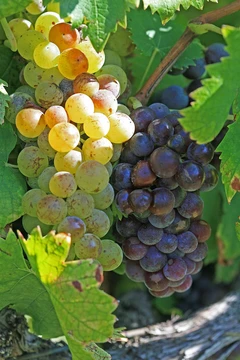
Grüner Veltliner
Austria's most planted white grape, known for food-friendly versatility.
Grüner Veltliner is a white wine grape variety grown primarily in Austria, Hungary, Slovakia, and the Czech Republic. It is the most-planted grape variety in Austria, accounting for 32.6% of all vineyards in the country as of 2008. The grape is known for producing wines that range from simple, youthful styles to ageworthy, mineral-driven examples.
Quick Facts
- Species
- Vitis vinifera
- Also called
- Grüner Muskateller, Veltliner (more)
- Origin
- Austria?
- Regions
- Lower Austria, Burgenland, Slovakia, Moravia
- Notable wines
- Smaragds from Wachau
Facts from the source article.
Did You Know?
- The single surviving vine of St. Georgener-Rebe, a parent of Grüner Veltliner, is thought to be over 500 years old.
- Grüner Veltliner is very susceptible to downy and powdery mildews and to infestation from a species of rust mites.
- In Austria, Grüner Veltliner has historically been trained in the Lenz Moser Hochkultur method, with vine trunks allowed to grow 1.3 m high and rows spaced 3.5 m apart.
History
The grape’s history may stretch back to Roman times, and its name points to Veltlin in northern Italy, though no actual connection to that area has been proven. Austria is considered its likely origin. First called Weißgipfler, it appeared under its current name in a document from 1855, and by the 1930s Grüner Veltliner was the standard term. Before World War II it was seen as an ordinary Austrian grape, but Lenz Moser’s Hochkultur training method spurred rapid expansion from the 1950s, making it the country’s most planted variety. DNA analysis in 2007 revealed it is a natural cross of Savagnin (Traminer) and a rare Austrian vine from Sankt Georgen am Leithagebirge. That parent vine was discovered in 2000 in an overgrown pasture that had not held a vineyard since the late 1800s, and it was assumed to be the last vine there for over a century. In February 2011, the single surviving specimen—thought to be more than 500 years old—was vandalized but survived, later becoming a protected natural monument. Cuttings are now being propagated for commercial use.
Wine regions
Grüner Veltliner is most closely associated with Austria, where it covers almost a third of all vineyards. It is authorized in five DAC regions: Weinviertel (the only permitted grape), Leithaberg, Traisental, Kremstal, and Kamptal. It is also found in Donauland (now Wagram) and Wachau. The Weinviertel region, along the border with the Czech Republic and Slovakia, is home to more than half of all Austrian Grüner Veltliner, with 8,529 ha reported in 2012. Here it can achieve high yields for simple wines or, with restricted yields, produce full-bodied, dry examples with pepper, mineral, and citrus notes. Around Lake Neusiedl, 1,272 ha are planted on the east side and 882 ha on the west side, where sweet Auslese and botryized Trockenbeerenauslese styles are possible. In Krems-Hollenburg, one of Austria's oldest commercial vineyards contains Grüner Veltliner vines over 150 years old. In Slovakia, known as Veltlinske Zelené, it is the most planted white grape, with 3,805 ha representing almost one-fifth of all plantings. In the Czech Republic, known as Veltlínské zelené, 1,713 ha were in production as of 2011.
Styles
Grüner Veltliner ranges from simple, early-drinking wines to those built for long aging. Young examples are typically low in aroma, gaining complexity over time. Common flavors include white pepper, lentil, and celery, with some wines showing citrus or, in fuller-bodied versions, a honeyed richness. Although white pepper is often considered a signature trait, this note has become far less common in recent years and is now missing from many classic bottles. In top vintages, well-made Grüner Veltliner can resemble Burgundian Chardonnay. Unoaked versions may display a minerality like Riesling. The wine is almost always dry, spicy, and peppery, often full-bodied. With bottle age, it can develop aromas and flavors reminiscent of white Burgundy.
Synonyms
Over the years Grüner Veltliner, colloquially sometimes referred to as GrüVe, has been known under many synonyms including Bielospicak, Dreimänner, Grauer Veltliner, Green Veltliner, Grün Muskateller, Grüner Muskateller, Manhardsrebe, Muskatel Zeleny, Ranfol bianco, Valteliner, Veltliner, Veltlinske zelené, Veltlínské zelené, Weisser Veltliner, Weissgipfler, Zeleni Vetlinac, Zöld Veltelini, and many others.
More in White Wine Grape Varieties
Spotted an error? Know more?
Reader corrections go straight into our review queue. Suggest an edit · How this site is sourced