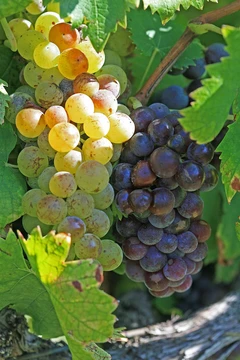
Gouais blanc
A peasant grape that became the ancestor of noble varieties.
Gouais blanc, or Weißer Heunisch, is a white grape rarely planted today, yet it holds importance as a forebear to numerous classic French and German varieties. Its French name comes from the old word 'gou', a scornful term reflecting its peasant reputation, while the German name ranks it among the inferior "Hunnic" grapes.
Quick Facts
- Species
- Vitis vinifera
- Also called
- Heunisch
- Heunisch Weiss
- and (other synonyms)
- Origin
- Central Europe
- Regions
- formerly Germany and northern France
- Notable wines
- None, nearly extinct
Facts from the source article.
History
Gouais was widely planted in central and northeastern France during medieval times, where it produced simple, acidic white wines and was grown in unfavourable plots less suited for Pinot noir or Pinot gris, making it the grape of the peasantry rather than the nobility. Its earlier history is uncertain, though it has been proposed as the grape given to the Gauls by Roman Emperor Marcus Aurelius Probus, who overturned Domitian's ban on grape growing north of the Alps. Another hypothesis suggests a Croatian or Pannonian origin, while the Vitis International Variety Catalogue lists Austria as its origin, likely indicating Central Europe. Gouais blanc was also grown in the Jura, but phylloxera wiped it out in France, and it now survives only in the INRA collection at Domaine de Vassal, Montpellier. DNA fingerprinting in the late 1990s identified it as the ancestor of many classical European grape varieties, surprising given the old division into Frankish and Hunnic grapes.
Crosses and relationships to other grapes
Gouais blanc is closely related to Pinot noir, possibly one of its progeny, meaning many great European grapes from Pinot and Gouais crosses are highly inbred. DNA fingerprinting at the University of California, Davis identified Gouais blanc as an ancestor of Aligoté, Aubin vert, Auxerrois, Bachet noir, Beaunoir, Blaufränkisch, Franc Noir de la-Haute-Saône, Gamay Blanc Gloriod, Gamay noir, Melon de Bourgogne, Knipperlé, Peurion, Roublot, and Sacy. Dameron is another result of the same cross, while a cross with Pinot fin teinturier produced Romorantin. Pollinated by Traminer/Savagnin, it produced Räuschling, Petit Meslier and Aubin; pollinated by a cross of a wild grape with Traminer, it produced Riesling and Elbling. With Chenin blanc it produced Colombard, Balzac blanc and Meslier Saint François, and with Bastardo (Tressot) it produced Genouillet. Despite the synonym Enfarine blanc, Enfariné noir (Gouais noir) is not a color mutation of Gouais blanc. Gouget noir may be related to Gouais blanc.
Wine regions
Gouais blanc has mostly survived as a museum curiosity, with regular attempts to ban it from French soils since the Middle Ages. It continues to be commercially grown at several vineyards in Switzerland, and a few historically interested producers have recently planted small amounts. The first North American commercial planting was in 2019 at Pamar Vineyard in Oregon's Willamette Valley, with wine to be released in 2023. It has also been grown for over 100 years by Chambers Rosewood Winery in Rutherglen, Australia.
More in White Wine Grape Varieties
Spotted an error? Know more?
Reader corrections go straight into our review queue. Suggest an edit · How this site is sourced