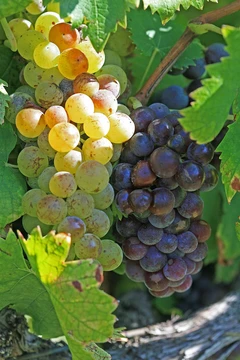
Gewürztraminer
A pink-skinned white grape with a spicy, lychee-scented bouquet.
Gewürztraminer is an aromatic white wine grape variety with pink to red skin, best suited to cooler climates. It produces wines that are typically off-dry and feature a pronounced bouquet of lychees, roses, and passion fruit, sometimes with a slight spritz. The variety is known for its high natural sugar content and is often referred to colloquially as Gewürz in English, though not in German.
Quick Facts
- Species
- Vitis vinifera
- Also called
- Gewurztraminer
- Traminec
- Gewürz
- Gertie
- Gentil Rose Aromatique
- Traminer Musque (more)
- Origin
- Tramin, Italy
- Notable wines
- From Alsace, especially the Vendange Tardives
Facts from the source article.
Did You Know?
- The German name Gewürztraminer literally means 'spice Traminer' or 'perfumed Traminer' and is attested from the 16th century.
- Gewürztraminer and lychees share the same aroma compounds.
- The variety's genetic instability means the Traminers are best regarded as a family of related clones rather than distinct varieties.
History
The history of the Traminer family is complicated due to its unstable genome. The ancient Traminer variety, a green-skinned grape, takes its name from the village of Tramin in South Tyrol, northern Italy. Ampelographer Pierre Galet believed Traminer was identical to Savagnin blanc, which produces vin jaune in the Jura. It has been suggested that Savagnin blanc developed slight differences in leaf shape and geraniol content as it spread across the Alps. Varieties such as Frankisch in Austria, Gringet in Savoie, Heida in Switzerland, Formentin in Hungary, and Grumin from Bohemia are considered very similar to Savagnin blanc, possibly clones of the Traminer family. Viognier may be a more distant relative. At some point, a pink-skinned mutation occurred, called Red Traminer or Savagnin rose. Galet believed a musqué mutation in Red Traminer led to Gewürztraminer, though in Germany these names are regarded as synonymous. The Baden vineyard of Durbach claims its own Red Traminer called Durbacher Clevner, said to have been brought from Chiavenna, Italy, in 1780. The Klevener de Heiligenstein in Alsace may be an outpost of these vines and is described as a less aromatic form of Gewürztraminer.
Crosses
Winemakers have spent decades trying to make Gewürztraminer easier to grow. In 1932, Georg Scheu created Würzer by crossing it with Müller-Thurgau; this grape now grows in Rheinhessen and England. Other German crosses gave us Septimer and Perle. Siegerrebe, a cross with Madeleine Angevine, ripens early and set Germany’s record for must weight at 326 °Oechsle. Müller-Thurgau and Siegerrebe together produced Ortega. Hungary’s Cserszegi fűszeres came from a cross with Irsai Oliver. In 1938, Harold Olmo crossed Sémillon and Gewürztraminer at U.C. Davis to make Flora, planted in California and New Zealand. A 1965 cross at the University of Illinois with Joannes Seyve 23.416 yielded Traminette, a cold-hardy hybrid. Australian breeder A.J. Antcliff crossed Gewürztraminer with Merbein 29-56 to get Taminga. Between 1924 and 1930, a cross with Trebbiano gave Italy the pink-skinned Manzoni rosa. In the 1970s, Czech breeder Josef Veverka crossed Gewürztraminer with Müller-Thurgau to create Pálava, a pink-skinned, earlier-ripening grape grown in Moravia and Slovakia.
Regions
In Europe, Gewürztraminer is grown in Austria, Bulgaria, Croatia, Czech Republic, France, Germany, Greece, Hungary, Italy, Luxembourg, North Macedonia, Romania, Serbia, Slovakia, Slovenia, Spain, and Turkey. In the New World, it is grown in California, Northern Michigan, New Zealand, and in Argentina's Mendoza and Trevelin regions, as well as Chile. In the Middle East, it is grown in the Golan Heights. Cool Australian regions producing fine examples include Adelaide Hills, Eden Valley, Tasmania, Clare Valley, Yarra Valley, Great Southern, Canberra Region, Australian Alps, and Macedon Ranges. Canadian regions include Vancouver Island, Okanagan Valley, Niagara Peninsula, north shore of Lake Erie, and Prince Edward County. In Alsace, it is the second most planted grape and most characteristic, with styles ranging from very dry to very sweet, including vendange tardive and Sélection de Grains Nobles. Around Heiligenstein, Klevener de Heiligenstein is a Red Traminer, not true Gewürz, and produces more restrained wines. Germany has about 10 square kilometres of the variety, often dry in style, but much may be Red Traminer. The Traminer is native to Trentino-Alto Adige/Südtirol in Italy, and both pink and green grapes may be called Traminer. Luxembourg has also been prominent in Gewürztraminer production.
Vine and viticulture
Gewürztraminer is sensitive to soil and climate and highly susceptible to disease, especially viral infections and rot in damp conditions. In hot climates, its natural sweetness leads to insufficient acidity, and early picking prevents varietal aroma development. Fine silicious soils enhance spicy character and aging ability, while coarse dolomitic soils produce floral, light wines. Shoot trimming and cluster thinning can increase terpene concentrations but do not significantly affect pH or titratable acidity. Drought reduces yield through lower cluster and berry weight and titratable acidity, but water stress does not impact °Brix due to high sugar content.
More in White Wine Grape Varieties
Spotted an error? Know more?
Reader corrections go straight into our review queue. Suggest an edit · How this site is sourced