Chardonnay
A versatile green-skinned grape from Burgundy, now grown worldwide.
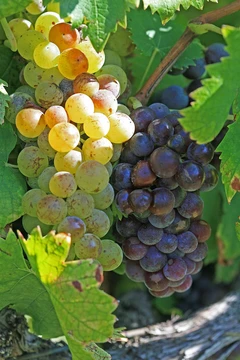
Chardonnay is a green-skinned grape variety used in white wine production, originating in the Burgundy wine region of east-central France. It is now grown wherever wine is produced, from England to New Zealand, and is considered a 'rite of passage' for new wine regions. The grape is neutral in flavor, with many wine characteristics derived from terroir and oak, and it is vinified in many styles, from lean, mineral wines to oaked, tropical-fruit-driven examples.
Quick Facts
- Also called
- Aubaine
- Beaunois
- Gamay blanc
- Melon blanc (more)
- Regions
- Worldwide
- Wines
- Chablis
- white Burgundy
- Champagne
- Italian Franciacorta
- Soil
- Chalk, limestone
- Hazards
- Millerandage
- powdery mildew
- frost and coulure
- Wine cool
- Lean
- crisp
- high acidity
- Wine medium
- Honey, tropical fruit
- Vivc number
- 2455
Facts from the source article.
Did You Know?
- For much of its history, a connection was assumed between Chardonnay and Pinot noir or Pinot blanc, but Pierre Galet disagreed, believing Chardonnay was unrelated to any other major grape variety.
- Chardonnay first came to Australia in the collection of James Busby in 1832, but only took off in the 1950s.
- In Italy, Chardonnay was commonly confused with Pinot blanc, often interplanted and blended, despite Chardonnay grapes becoming more golden-yellow near harvest.
Viticulture
Chardonnay is known for its relative ease of cultivation and adaptability to different conditions, being highly 'malleable' in reflecting terroir and winemaker influence. The vine is vigorous, with extensive leaf cover that can inhibit energy and nutrient uptake in grape clusters, requiring aggressive pruning and canopy management. Dense planting forces vines to compete for resources, funneling energy into clusters. Yields can be high, but quality drops beyond 80 hl/ha; premium producers limit yields to less than half that. Sparkling wine producers focus less on yield limits. Harvest timing is crucial as the grape rapidly loses acidity upon ripening. Chardonnay is an early-budding vine, usually a week after Pinot noir, making it vulnerable to spring frost; a Burgundian method involves aggressive pruning just before budburst to delay it by up to two weeks. Millerandage, coulure, and powdery mildew can pose problems. Its early ripening allows it to thrive in short growing seasons and be harvested before autumn rain and rot set in.
France
In France, Chardonnay is the second-most widely planted white grape variety, behind Ugni blanc. It first rose to prominence in Chablis and Burgundy. In Champagne, it is often blended with Pinot noir and Pinot Meunier, but also used for single-varietal blanc de blancs sparkling wines. Chardonnay appears in AOC wines of the Loire Valley and Jura, as well as vin de pays wines of the Languedoc. In Burgundy, Pinot noir vines outnumber Chardonnay by nearly three to one. Chardonnay is found in Chablis, the Côte d'Or (largely Côte de Beaune), Côte Chalonnaise, and Mâconnais. It is grown in eight grand cru vineyards, including the Montrachets, Charlemagne, Corton-Charlemagne, and Le Musigny. Burgundy examples were long considered the benchmark for expressing terroir through Chardonnay. The Montrachets are noted for high alcohol levels, often above 13%, and deep flavor concentration. Chassagne-Montrachet vineyards tend to produce hazelnut aromas, while Puligny-Montrachet wines have more steely flavors. Corton-Charlemagne examples can show marzipan, and Meursault wines are the most round and buttery.
North America
Chardonnay took off in North America, especially California, where it developed a character quite unlike the French original. By 1990, it had become the region’s top white grape, pushing Riesling aside. You’ll find it across the U.S. in states like California, Oregon, Texas, Virginia, and Washington, plus many others from Alabama to Vermont. Up in Canada, it grows in British Columbia, Nova Scotia, Ontario, and Quebec, while in Mexico it’s planted in Baja California’s Valle de Guadalupe and Coahuila’s Valle de Parras. California’s first commercial success with Chardonnay came from the Livermore Valley. Wente Vineyards created a clone that spread through several vineyards in the 1940s. Then, in the 1950s, James David Zellerbach founded Hanzell Vineyards, aiming for a Burgundian style. His work inspired others, leading to Chateau Montelena’s famous 1976 blind-tasting win over Burgundy at the Judgment of Paris. That victory sparked a surge in demand, and by 1988 California had more Chardonnay vines than France. By 2005, nearly 100,000 acres made up about a quarter of the world’s total plantings. Early winemakers tried to copy Burgundy, but soon shifted to richer, buttery, oaked wines. Starting in the 1970s, they harvested grapes at higher ripeness and Brix levels, using new oak for bigger body and mouthfeel. Critics like Frank J. Prial of The New York Times complained these wines weren’t food-friendly and had alcohol levels so high they felt unbalanced.
Winemaking
Chardonnay lends itself to almost any winemaking style, from dry still wines to sparkling wines and sweet late-harvest or botrytized wines, though its susceptibility to other rot makes the latter rarer. The two most influential winemaking decisions are whether to use malolactic fermentation (MLF) and the degree of oak influence. MLF converts harder malic acid into softer lactic acid and diacetyl, creating buttery notes; wines without MLF have more green apple-like flavors. Oak can be introduced during fermentation or barrel aging, and depending on charring, can impart toastiness, caramel, cream, smoke, spice, coconut, cinnamon, cloves, and vanilla. Other significant decisions include fermentation temperature and time spent aging on the lees. Burgundian winemaking favors extended lees contact and bâtonnage (stirring the lees). Colder fermentation temperatures produce more tropical fruit flavors like mango and pineapple. Old World winemaking often uses wild or ambient yeast, though some use cultivated yeast for aromatic qualities; a particular yeast used in Champagne is Prise de Mousse. A drawback of wild yeast is slow, unpredictable fermentation, potentially producing very different wine each year. Domaine des Comtes Lafon, which uses only wild yeast, had its 1963 Chardonnay batch take five years to complete fermentation.
More in White Wine Grape Varieties
Spotted an error? Know more?
Reader corrections go straight into our review queue. Suggest an edit · How this site is sourced