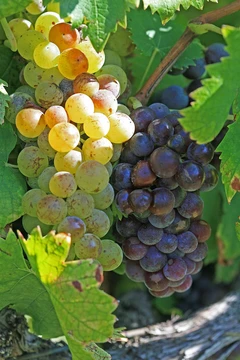
Aurore (grape)
A cold-hardy hybrid grape with early ripening and foxy character.
Aurore (also known as Seibel 5279) is a white complex hybrid grape variety created by French viticulturist Albert Seibel. It is used for wine production mostly in the United States and Canada, where it ripens early and is planted in short growing seasons. The grape is a cross of Seibel 788 and Seibel 29, and is also used as a table grape despite poor shipping suitability.
Quick Facts
- Species
- Interspecific crossing
- Also called
- Seibel 5279 and other synonyms
- Origin
- France, created by Albert Seibel
- Regions
- Northern United States, Canada, and United Kingdom
Facts from the source article.
Did You Know?
- Aurore is often confused with a South American table grape called Aurora, bred at the Instituto Agronomico de Campinas in Brazil.
- Aurore is known under synonyms including Feri Szőlő, Finánc Szőlő, Redei, and S-5279.
History
Albert Seibel created Aurore at his nursery and vineyard in Aubenas, Ardèche in the Rhône Valley, naming it after Aurora, the Roman goddess of the dawn. The name Aurora remains a synonym for the grape. Originally bred as a table grape, it fell out of favor because the berries spoiled quickly and dropped from the stem during transit. Aurore was first introduced to the United States via Ellis Island in the 1940s and spread from New York across the country, becoming the most widely planted non-Vitis labrusca variety in New York. Since the 1970s, plantings have declined as growers turned to Vitis vinifera and other hybrids. The first Canadian plantings occurred in 1946. Aurore is a complex hybrid, with lineage including Vitis vinifera, Vitis rupestris, and Vitis lincecumii. Its parent Seibel 788 resulted from crossing Sicilien (Bicane × Pascal blanc) and Clairette Dorée Ganzin (Bourboulenc × Ganzin 60, itself Aramon noir × Vitis rupestris). Seibel 29 is a cross of an unknown Vitis vinifera and the Munson hybrid (Jaeger 70), itself a cross of Vitis lincecumii and Vitis rupestris.
Viticulture
Although classified as a white grape, Aurore clusters often show a pink tinge similar to Pinot gris and Gewürztraminer but less dark. The vine is vigorous and productive, requiring winter pruning and summer leaf-pulling to control yields and foliage. It ripens very early, even before Chasselas in cold climates, and is moderately winter-hardy to -20 °F. Aurore resists downy mildew but is susceptible to Eutypa dieback, powdery mildew, black rot, and botrytis bunch rot. Its smooth leaves attract angular leaf scorch and Japanese beetles; organic growers may use diatomaceous earth dust, though rain washes it off. The thin-skinned berries split easily if rain nears harvest, and mature berries tend to fall from the stem.
Wine regions
Aurore originated in France, where about 288 hectares were planted in the northeast and southwest in the early 20th century, but it is now rare there. Outside France, it is found in several US states, notably Minnesota, New York, New Hampshire, and Nebraska. In 2009, New York crushed 3,530 tons of Aurore for blended and varietal wines. Jewell Towne Vineyards in New Hampshire produces a varietal Aurore. Other US states with plantings include Connecticut, Indiana, Kansas, Massachusetts, Michigan (Leelanau Peninsula AVA), Missouri, New Mexico, Ohio (Lake Erie AVA), Pennsylvania, Washington (Puget Sound AVA), West Virginia, and Wisconsin. In Canada, Aurore was once widely planted in British Columbia but declined after the 1980s as the Okanagan Valley shifted to international varieties. Ontario crushed about 200 tons total between 2007 and 2012, and Québec producers such as Domaine des Côtes d'Ardoise still make varietal examples.
More in White Wine Grape Varieties
Spotted an error? Know more?
Reader corrections go straight into our review queue. Suggest an edit · How this site is sourced