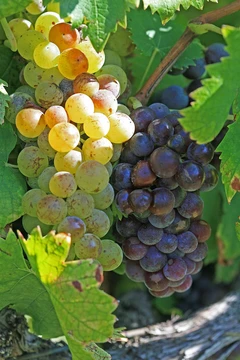
Arneis
A crisp, floral white grape from Piedmont with a historic role in Nebbiolo blends.
Arneis is a white wine grape variety from Piedmont, Italy, primarily grown in the Roero hills northwest of Alba. It produces crisp, floral, dry and full-bodied wines with notes of pears and apricots. The name means 'worthless thing' in Piemontese, reflecting its reputation as a difficult grape to cultivate.
Quick Facts
- Species
- Vitis vinifera
- Also called
- See list of synonyms
- Origin
- Italy
- Regions
- Piedmont
- Notable wines
- Roero Arneis, Langhe Arneis
Facts from the source article.
History
Wine historians disagree on how long Arneis has been cultivated in Piedmont and under what name. A potential root of the name in the Piemontese dialect, renesi, appears in descriptions of several grape varieties in the 15th century. Some historians believe Arneis may be the Ranaysii grape documented in 1432 near Chieri in the province of Turin, while a Reneysium grape was recorded in 1478 around Canale in the province of Cuneo. The first usage of the name Arneis occurs in Count Giuseppe di Rovasenda's 1877 text, where the grape was already well established in Piedmont. Despite sharing synonyms, Arneis has no genetic relationship with Nebbiolo, but the two have a close historic connection. For centuries, Arneis was used to soften the tannins of Nebbiolo in Barolo wines, earning synonyms like Nebbiolo bianco and Barolo bianco. In vineyards, Arneis was planted with Nebbiolo to attract birds away from the more valuable Nebbiolo clusters. In the 20th century, as Barolo producers focused on 100% Nebbiolo, Arneis acreage declined nearly to extinction. By the 1970s, only Bruno Giacosa and Vietti produced Arneis. A renaissance in the 1980s revived interest, with plantings reaching 745 ha by 2000, then declining to around 610 ha by 2006, nearly all in Roero and Langhe.
Wine regions
Arneis is primarily found in Piedmont, featuring in the white DOC/G wines of Roero and Langhe. It is permitted as a blending grape in red Nebbiolo-based Roero wines, though this use is now rare. In 2004, nearly 1 million gallons of DOC Arneis were produced in these regions. Outside Piedmont, limited plantings exist in Liguria and Sardinia. In the United States, Arneis is mostly in Sonoma County and Oregon's Willamette Valley, with some in Mendocino, Russian River Valley, Paicines, Santa Ynez Valley, and Willcox, Arizona. In the 21st century, plantings have appeared in Tasmania, Victoria, New South Wales (Australia), and Gisborne (New Zealand).
Viticulture and winemaking
The Arneis vine is difficult to cultivate, with naturally low acidity and a tendency to over-ripen if harvested after September. It is prone to powdery mildew, though recent cloning research has identified more tolerant clones. Low crop yields and easy oxidation contributed to its 20th-century decline. Better understanding revived the variety, as chalky, sandy Roero soils give more acidity and structure, while sandy clay soils produce elegant, exotic perfume. Historically used to soften Nebbiolo, Arneis is now mostly a varietal wine. Oak-fermented or aged versions are more full-bodied, while unoaked Arneis offers more aromatics. It can produce highly perfumed wines with aromas of almonds, apricots, peaches, pears, and hops. Some producers make a late-harvest passito Arneis.
More in White Wine Grape Varieties
Spotted an error? Know more?
Reader corrections go straight into our review queue. Suggest an edit · How this site is sourced