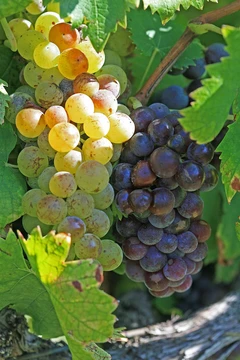
Airén
A drought-resistant Spanish white grape, often used for brandy.
Airén is a white wine grape variety of Vitis vinifera, native to Spain, where it accounts for nearly a quarter of all grapes grown. As of 2017, it was the world's fourth most planted wine grape by surface area, with 252,000 hectares, though it is almost exclusively found in Spain. Despite its vast planted area, Airén is often grown at low vine density, so other varieties like Cabernet Sauvignon and Merlot have more individual vines.
Quick Facts
- Species
- Vitis vinifera
- Also called
- see list of synonyms
- Origin
- Spain
- Regions
- La Mancha
- Notable wines
- Vinos de Madrid
Facts from the source article.
Description
The bud burst is cotton-like, bronze or yellowish with a light reddish edge. The vine has a trailing growth habit, and its leaves are average-sized, pentagonal, with yellowish-green upper surfaces and velvety lower surfaces. The bunches are large, of average compactness, and cylindrical or long-cone shaped. The grapes are large, spherical, and yellowish. The variety is late to bud and ripen, yields 4.5 to 6 kg per vine, and is very drought-resistant; its fertile base buds tolerate very short pruning.
History
The first recorded mention of Airén was in 1615. In the 15th century it was known as Lairén, cited in Gabriel Alonso de Herrera’s “Agricultura General”, where he preferred the name “Datileña” because the grapes were bunched like dates. He stated the wine was not very strong nor had much body, and suggested the grapes would make better raisins. In 1807, Roxas Clemente described two types of Layrén: one matching the modern Airén from La Mancha, and a table grape called Datileña. The first type was also known as Mantúo Laerén and Laerén de Rey, grown in Sanlúcar, Xerez, Trebujena, Arcos, Espera, Moguer, Tarifa, Paxarete, Valdepeñas, and Manzanares, where it gave excellent wines for spirits. The second type, Datileña, was used for raisins and to mix its must with Ximénez, grown in Sanlúcar, Xerez, Trebujena, Algeciras, Arcos, Espera, Moguer, Málaga, Motril, Albuñol, Adra, and Paxarete. In 1885, Abela noted Mantúo Laerén also in Córdoba (as Mantúo Lairén), Cáceres, Ciudad Real, Málaga, Sevilla, and Toledo (as Lairén). In 1914, García de los Salmones listed Lairén in Madrid, Villacañas, Tarancón, Campo de Criptana, Frejenal de la Sierra, Montefrío, Baeza, Coín, Fiñana, Cazalla de la Sierra, Espera, and Córdoba, and as Airén in Albacete. In 1954, Marcilla defined Airén as typical of La Mancha, grown almost exclusively there, and also mentioned Lairén in Montilla and Extremadura. In 1965, Fernández de Bobadilla described Mantúo Laerén, and in 1976, Hidalgo described Airén.
Viticulture and uses
Airén is permitted in the DOs of Alicante, Bullas, Jumilla, La Mancha, Valdepeñas, and Vinos de Madrid; as Layrén it is allowed in Montilla-Moriles. It is commonly planted at low density, around 1500 vines per hectare, which can reduce wine quality. Its vineyards cover vast areas, but as Spanish production shifts toward red wine, many Airén vines are being uprooted. The grape often produces acidic, characterless wine, and its principal use has been in the manufacture of Spanish brandy.
More in White Wine Grape Varieties
Spotted an error? Know more?
Reader corrections go straight into our review queue. Suggest an edit · How this site is sourced