
Mount Etna
Active stratovolcano on Sicily's east coast, among Europe's tallest.
Last updated
Where it is
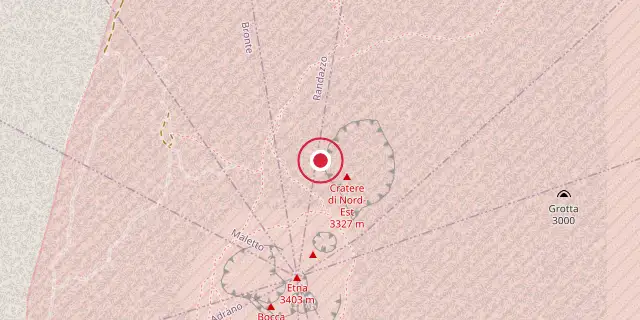
Coordinates: 37°45′18″N 14°59′42″E (37.7550, 14.9950) · Open in OpenStreetMap
Coordinates and connected clubs: the infobox of Wikipedia: Mount Etna (CC BY-SA 4.0). Map: drawn by Codexery from OpenStreetMap tiles.
Mount Etna, often called simply Etna, is an active stratovolcano on Sicily’s eastern coast, situated in the Metropolitan City of Catania between Messina and Catania. It sits above the convergent boundary where the African Plate meets the Eurasian Plate. As of September 2024, its summit stands at 3,403 meters (11,165 feet), making it the highest peak in Italy south of the Alps and one of Europe’s tallest active volcanoes. Its height shifts with summit eruptions: in 2021, the southeastern crater reached 3,357 meters (11,014 feet), only to be overtaken by the Voragine crater after eruptions in the summer of 2024.
The volcano covers 1,190 square kilometers (459 square miles) and has a basal circumference of 140 kilometers (87 miles). This makes it the largest of Italy’s four active volcanoes—roughly two and a half times the height of Mount Vesuvius, the next biggest. While many mountains in the European–North-African region west of the Black Sea, such as Mont Blanc, are taller, Mount Teide on Tenerife in the Canary Islands is the only taller volcano in that region.
Etna is among the most active volcanoes globally, with activity that is nearly continuous. The fertile volcanic soils from these eruptions support widespread agriculture, including vineyards and orchards on the lower slopes and across the Plain of Catania to the south. Because of its recent activity and proximity to populated areas, the United Nations designated it a Decade Volcano. In June 2013, it was added to the UNESCO World Heritage List.
Etymology and mythology
The name “Etna” may come from the Greek αἴθω (aíthō), meaning “to burn,” possibly through a shift in pronunciation from Ancient to Koine Greek. Another theory traces it to a Siculian or Sicanian dialect word (aith-na, “the fiery one”), from the Indo-European root h₂eydʰ- (“to burn; fire”). Alternatively, it could derive from the Phoenician attuna, meaning “furnace” or “chimney.” In Classical Greek, it was called Αἴτνη (Aítnē), a name also given to Catania and the city originally known as Inessa.
In Latin, it is Aetna, and in Arabic, Jabal al-Nār (جبل النار, “the Mountain of Fire”). In Roman and Greek mythology, the god of blacksmithing, Vulcan (or Hephaestus), had his forge beneath the mountain. Greek myth also says the monster Typhon was imprisoned there by Zeus.
Locally, it is known as Muncibbeḍḍu in Sicilian and Mongibello in Italian.
Lore & Background
Mount Etna's volcanic activity began about 500,000 years ago, with eruptions under the sea off the ancient coastline of Sicily. About 300,000 years ago, volcanism shifted southwest of the summit, then moved to the present centre 170,000 years ago, building a stratovolcano through alternating explosive and effusive eruptions.
From about 35,000 to 15,000 years ago, highly explosive eruptions generated large pyroclastic flows, with ash found as far as 800 km north. Thousands of years ago, the eastern flank collapsed in a massive landslide, forming the Valle del Bove (Valley of the Ox) and causing a tsunami that left marks in the eastern Mediterranean. The name Mongibello is an old local name for Mount Etna itself, not just a specific area of the volcano.
Reader's Guide
Mount Etna is significant as one of the world's most active volcanoes, with a history of eruptions documented since at least 1400 BCE. Its fertile volcanic soils support extensive agriculture, including vineyards and orchards on its lower slopes and the Plain of Catania. The volcano's activity has shaped both the landscape and human settlement, with flank eruptions sometimes threatening inhabited areas. Etna's designation as a Decade Volcano by the United Nations and its UNESCO World Heritage status (2013) underscore its global importance for volcanology and hazard mitigation.
The mountain's height varies with summit eruptions; for example, the southeastern crater reached 3,357 m in 2021 but was surpassed by the Voragine crater after summer 2024 eruptions. Etna covers 1,190 km², making it the largest of Italy's four active volcanoes, about two and a half times the height of Mount Vesuvius. Only Mount Teide in the Canary Islands surpasses it in the European–North-African region west of the Black Sea.
Did You Know?
- The volcano is moving toward the Mediterranean Sea at an average rate of 14 mm per year.
- In 396 BCE, an eruption of Etna reportedly thwarted the Carthaginians in their attempt to advance on Syracuse during the Second Sicilian War.
- The name Mongibello is used for the area containing the two central craters and the craters southeast and northeast of the volcanic cone.
Frequently Asked Questions
What is Mount Etna known for?
Etna sits directly above the convergent boundary where the African and Eurasian tectonic plates collide, which fuels its frequent eruptions and continuously reshapes its summit. Its height actually shifts over time as different craters gain or lose material during eruptive episodes.
Where does Mount Etna live?
The volcano is anchored on Sicily's eastern coastline, positioned between the cities of Messina and Catania. It rises so prominently from the island's landscape that it is visible across a wide stretch of the surrounding Mediterranean.
Ranked in
More in Volcanic Mountains
Sources
Compiled from Wikipedia and the sources listed below. Text from Wikipedia is available under CC BY-SA 4.0; this entry is adapted from it.
- Wikipedia: Mount Etna (CC BY-SA 4.0).
- Word definitions: the Codexery glossary, each quoted from its Wikipedia article.
Spotted an error? Know more?
Reader corrections go straight into our review queue. Suggest an edit · How this site is sourced