
Mount Hood
Active stratovolcano and highest peak in Oregon.
Last updated
Where it is
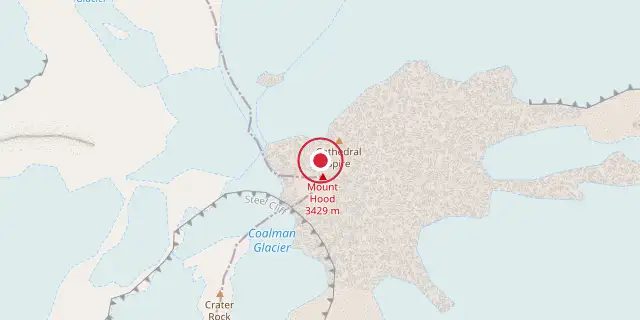
Coordinates: 45°22′26″N 121°41′46″W (45.3740, -121.6960) · Open in OpenStreetMap
Coordinates and connected clubs: the infobox of Wikipedia: Mount Hood (CC BY-SA 4.0). Map: drawn by Codexery from OpenStreetMap tiles.
Mount Hood is an active stratovolcano in the Cascade Range, located in the Pacific Northwest region of the United States. It is the highest mountain in Oregon and the fourth highest in the Cascade Range, with a summit elevation of 11,239 feet (3,426 m). The mountain is considered the Oregon volcano most likely to erupt, with an estimated 3 to 7% chance of eruption in the next 30 years, and is characterized as 'potentially active' by the U.S. Geological Survey.
Lore & Background
Mount Hood was formed by a subduction zone on the Pacific Coast and rests in the Pacific Northwest. It was given its present name on October 29, 1792, by Lt. William Broughton, a member of Captain George Vancouver's exploration expedition, who named it after British admiral Samuel Hood.
The mountain has 12 named glaciers and snowfields, and its summit area consists of several andesitic or dacitic lava domes. The last major eruptive period took place around 1781 to 1782, producing dacitic lava domes, pyroclastic flows, and mudflows, with minor eruptive episodes continuing until about 1865–1866. The prominent Crater Rock below the summit is hypothesized to be the remains of an eroded dome from that period.
Reader's Guide
Mount Hood is significant as the highest mountain in Oregon and a prominent feature of the Cascade Volcanic Arc. It attracts an estimated 10,000 climbers annually and hosts multiple ski areas, including Timberline Lodge, which offers the only year-round lift-served skiing in North America. The mountain is monitored by the USGS Cascades Volcano Observatory due to its potential for future eruptions, which could produce dangerous lahars from its glaciers.
Its indigenous names are disputed, with the name Wy'east appearing in 20th-century literature but lacking evidence of genuine indigenous origin. The mountain sits partly within the reservation of the Confederated Tribes of Warm Springs, and some scholars suggest it may have lacked a specific name in indigenous languages, being referred to by a general term for snow-capped summit. Mount Hood's volcanic history includes at least four major eruptive periods in the past 15,000 years, and it has experienced several earthquake swarms since 1950.
Did You Know?
- Mount Hood is one of several locations in North America offering year-round lift-served skiing, including Timberline Lodge, Mammoth Mountain in California, and Whistler-Blackcomb in Canada.
- A climber suffocated in 1934 while exploring ice caves melted by fumaroles on Coalman Glacier, but this was not the only volcanic fatality in the Cascades prior to the 1980 eruption of Mount St.
- Two United States Navy ammunition ships have been named Mount Hood, one of which was destroyed in 1944 in an explosion at Manus Naval Base.
More in Volcanic Mountains
Sources
Compiled from Wikipedia and the sources listed below. Text from Wikipedia is available under CC BY-SA 4.0; this entry is adapted from it.
- Wikipedia: Mount Hood (CC BY-SA 4.0).
- Word definitions: the Codexery glossary, each quoted from its Wikipedia article.
Spotted an error? Know more?
Reader corrections go straight into our review queue. Suggest an edit · How this site is sourced