Iota Cassiopeiae
A quintuple star system with a magnetic variable primary.

PopePompus · CC BY-SA 4.0
Iota Cassiopeiae, also called Huagai, is a star system in the constellation Cassiopeia with multiple components. Its Bayer designation comes from the Latinized form ι Cassiopeiae, shortened to Iota Cas or ι Cas. The system shines at a combined apparent magnitude near 4.5, which is bright enough to see without a telescope. Parallax measurements place it roughly 133 light-years (41 parsecs) away from Earth.
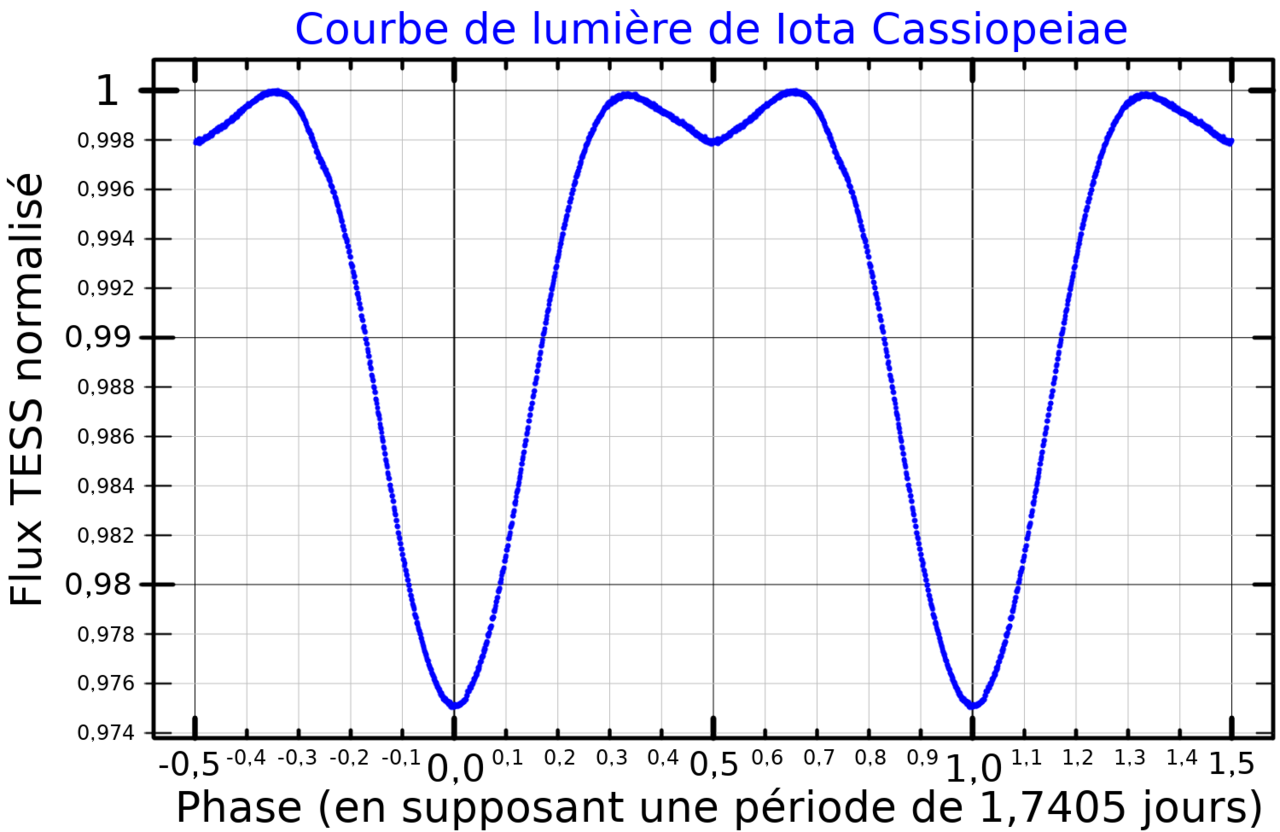
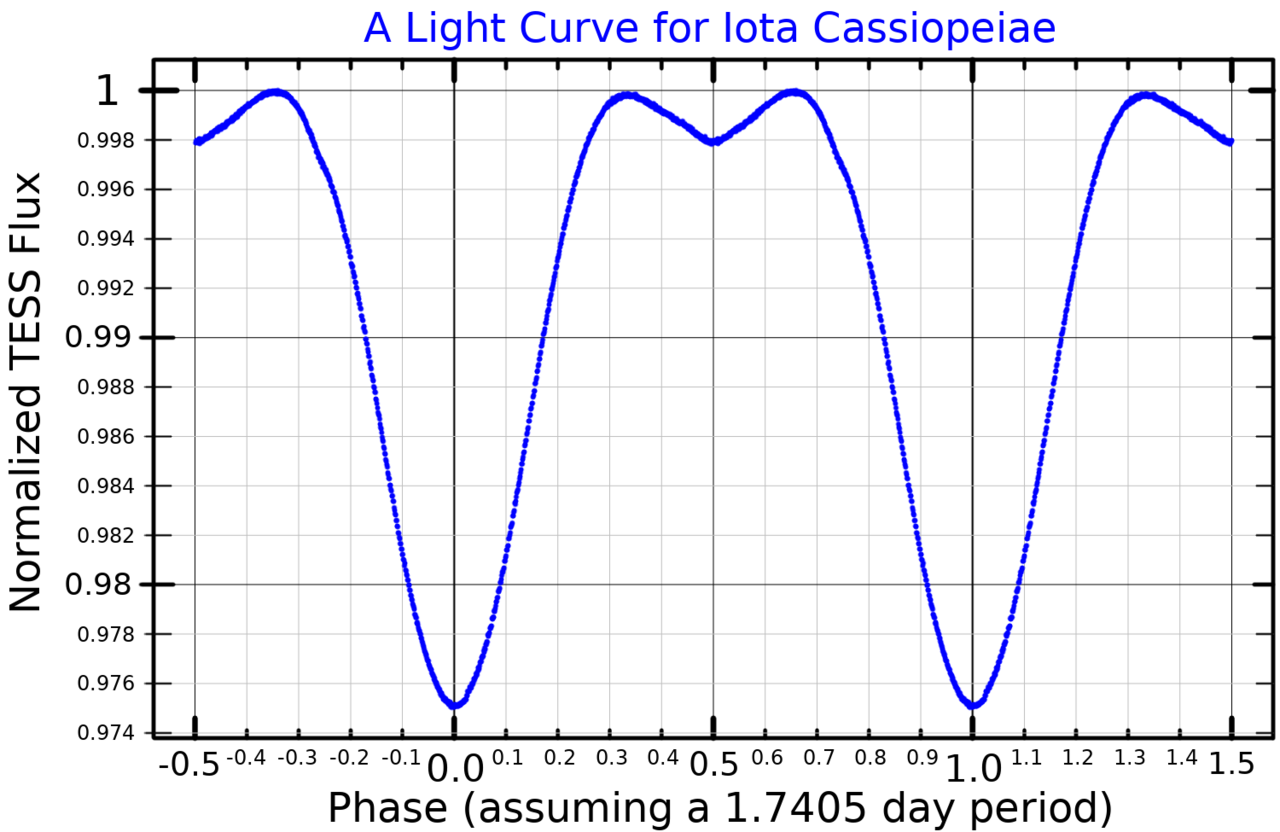
The system is quintuple. Its brightest member, ι Cassiopeiae A, is a white A-type main-sequence star with an average apparent magnitude of +4.61. This star is itself a close binary, resolved using adaptive optics; the two components are labeled Aa and Ab (though sometimes A and Aa, respectively). The primary is an Alpha2 Canum Venaticorum-type variable star, its brightness shifting between magnitudes +4.45 and +4.53 over a 1.74-day period due to its magnetic field. This variability was first noted by Karl D. Rakos in 1962, though earlier observations had already shown its spectrum to be changeable. The fainter companion is a G-type star with a mass of . The pair orbits each other roughly every 49 years.
ι Cassiopeiae B is a yellow-white F-type main-sequence dwarf with an apparent magnitude of +6.87. It circles ι Cassiopeiae A on a poorly constrained orbit with a period of about 2,400 years and a semi-major axis near 6.5 arcseconds. This object may drive Kozai–Lidov cycles in the inner binary.
ι Cassiopeiae C is itself a binary, made up of two stars designated Ca and Cb (or C and c). One is a K-type star, the other an M-type star. It currently lies about 7 arcseconds from the AB pair. Because the AB orbit's semi-major axis is roughly 6.5 arcseconds, the true semi-major axis of C's orbit around AB is thought to be considerably larger than 7 arcseconds.
In Chinese astronomy, this star belongs to the asterism Huá Gài ("Canopy of the Emperor"), which includes 16 stars—seven forming the canopy proper and nine forming the shaft (Gàng). The IAU Working Group on Star Names approved the name Huagai for Iota Cassiopeiae Aa on 25 December 2025, and it is now listed in the IAU Catalog of Star Names. The star 50 Cassiopeiae was named Gang.
- Bayer designation
- ι Cassiopeiae
- Combined apparent magnitude
- ~4.5
- Distance
- ~133 ly (41 pc)
- Number of components
- Quintuple star system
- Variable star type
- Alpha2 Canum Venaticorum-type
- Brightness variation range
- +4.45 to +4.53
- Variability period
- 1.74 days
Lore & Background
Iota Cassiopeiae is known to be a quintuple star system. The brightest component, ι Cassiopeiae A, contains a white-colored A-type main-sequence star with a mean apparent magnitude of +4.61. The primary is itself a tighter binary star system, with the two stars resolved by adaptive optics. These are designated Aa and Ab (although confusingly they may also be labeled as A and Aa, respectively). The primary is classified as an Alpha2 Canum Venaticorum-type variable star, and the brightness of the system varies from magnitude +4.45 to +4.53 with a period of 1.74 days, because of its magnetic field. The variability in brightness was first detected by Karl D. Rakos in 1962, although its spectrum was known to be variable from earlier observations. The fainter companion is a G-type star with a mass of . The orbital period of the system is about 49 years.
ι Cassiopeiae B is a yellow-white F-type main sequence dwarf with an apparent magnitude of +6.87. It orbits around ι Cassiopeiae A approximately every 2,400 years with a semi-major axis of around 6.5 arcseconds, but the orbit is not very well constrained. This object may be causing Kozai–Lidov cycles in the inner orbital pair. ι Cassiopeiae C is itself another binary, designated Ca and Cb, or just C and c. It comprises two stars, a K-type star and an M-type star. It is currently at an angular distance of about 7 arcseconds from the AB pair. Since the semimajor axis of the AB orbit is about 6.5 arcseconds, the true semimajor axis of C's orbit around them is thought to be significantly larger than 7 arcseconds.
Reader's Guide
Iota Cassiopeiae is notable as a quintuple star system, one of the more complex hierarchical multiples visible to the naked eye. Its primary component is an Alpha2 Canum Venaticorum-type variable star, whose brightness changes due to its magnetic field—a class of star that helps astronomers study stellar magnetism and rotation. The system's multiple orbits, including a tight 49-year binary pair and a wide 2,400-year orbit for component B, provide a laboratory for understanding long-term dynamical interactions such as Kozai–Lidov cycles. The discovery of its variability by Karl D. Rakos in 1962, building on earlier spectral observations, marks a step in the study of magnetic chemically peculiar stars. The system also carries cultural significance: its Chinese name Huagai, approved by the IAU Working Group on Star Names in 2025, links it to the asterism Huá Gài ("Canopy of the Emperor"), part of a 16-star grouping in Chinese astronomy. The system's faint components—an F-type dwarf and a binary of K- and M-type stars—extend its scientific interest as a multi-wavelength target for stellar evolution and multiplicity studies.
Did You Know?
- Iota Cassiopeiae is a quintuple star system.
- The system's Chinese name Huagai was approved by the IAU Working Group on Star Names on 25 December 2025.
Nomenclature & Cultural Heritage
Iota Cassiopeiae carries a Bayer designation derived from the Greek letter iota, Latinized into its current form and commonly abbreviated as Iota Cas or ι Cas. Beyond Western cataloguing traditions, this star holds a place in Chinese astronomical heritage as a member of the Huá Gài asterism, literally meaning "Canopy of the Emperor." That asterism comprises sixteen stars in total, split into two subgroups: seven forming the canopy proper and nine forming the Gàng, or "Shaft." In a significant modern development, the IAU Working Group on Star Names formally approved the name Huagai for the component designated Iota Cassiopeiae Aa on 25 December 2025, and the name now appears in the official IAU Catalog of Star Names. Notably, the companion star 50 Cassiopeiae received the name Gang, preserving the ancient Chinese pairing of canopy and shaft. The system's combined apparent magnitude of roughly 4.5 means it has been visible to unaided observers across cultures for millennia, making its dual naming tradition a small window into how different civilizations mapped the same patch of sky.
The Quintuple Architecture
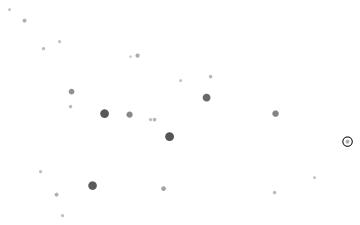
What makes Iota Cassiopeiae remarkable is that it is not a single point of light but a quintuple system, containing five stellar components arranged in a nested hierarchy. The dominant member, designated ι Cassiopeiae A, is itself a tight binary resolved through adaptive optics imaging. Its primary, Aa, is a white A-type main-sequence star with a mean apparent magnitude of +4.61, while its companion, Ab, is a cooler G-type star with a mass of approximately 0.98 solar masses. Separately, component B is a yellow-white F-type main-sequence dwarf shining at magnitude +6.87. The final pair, designated C, consists of two even fainter stars: a K-type and an M-type dwarf, currently sitting at an angular separation of roughly seven arcseconds from the AB pair. Together these five objects form a gravitationally bound family whose combined glow reaches about magnitude 4.5, placing the system roughly 133 light-years from Earth.
Magnetic Variability of the Primary
The primary star Aa belongs to a fascinating class of variable stars known as Alpha2 Canum Venaticorum-type, or Alpha2 CVn, variables. In these stars, a strong magnetic field shapes the surface into darker polar regions that rotate in and out of view, producing periodic brightness changes. For Iota Cassiopeiae Aa, the system's combined brightness oscillates between magnitudes +4.45 and +4.53 over a period of just 1.74 days, a direct signature of that magnetic activity. The photometric variability was first formally detected by Karl D. Rakos in 1962, though earlier spectroscopic observations had already hinted that the star's spectrum was not stable over time. The two components of the A binary were not directly separated until adaptive optics technology matured enough to resolve them, confirming the tight pairing and allowing astronomers to attribute the variability specifically to the Aa component. The 49-year orbital period of the Aa-Ab pair means the two stars complete one full circuit around their shared barycenter roughly every half-century, a timescale that spans a human lifetime.
Orbital Dynamics & Long-Term Architecture
The outer architecture of Iota Cassiopeiae reveals a system operating on vastly different timescales. Component B, the F-type dwarf, traces a wide orbit around the inner AB pair with a period estimated at approximately 2,400 years and a semi-major axis of about 6.5 arcseconds. However, astronomers caution that this orbit is not yet well constrained, leaving some uncertainty in its precise shape and inclination. One intriguing hypothesis is that B's gravitational influence may be driving Kozai–Lidov cycles in the inner Aa-Ab binary, periodically tilting and eccentricizing their orbit over long timescales. Meanwhile, the C pair—comprising the K-type and M-type stars—sits at a current angular distance of roughly seven arcseconds from the AB system. Because the AB pair's own semi-major axis is also about 6.5 arcseconds, the true semi-major axis of C's orbit around the central pair must be significantly larger than the seven arcseconds currently observed, suggesting a much wider and more extended outer envelope than the snapshot position implies.
Gallery
Frequently Asked Questions
What is Iota Cassiopeiae?
Iota Cassiopeiae (also known by its Chinese name Huagai) is a quintuple star system located in the constellation Cassiopeia. It carries the Bayer designation ι Cassiopeiae and is commonly abbreviated as Iota Cas or ι Cas.
What type of variable star is Iota Cassiopeiae?
The system is classified as an Alpha2 Canum Venaticorum-type variable, meaning its primary component exhibits small periodic brightness changes driven by magnetic activity on its surface. Its combined magnitude shifts only slightly, between +4.45 and +4.53.
How far away is Iota Cassiopeiae from Earth?
Parallax measurements place the system at roughly 133 light-years, or about 41 parsecs, from our solar system.
How many stars are in the Iota Cassiopeiae system?
It is a quintuple system, meaning five stellar components are bound together. The brightest member, ι Cassiopeiae A, is a white A-type main-sequence star that is itself a close binary pair.
Can I see Iota Cassiopeiae without a telescope?
Yes. With a combined apparent magnitude near 4.5, the system is bright enough to be spotted by the unaided eye under reasonably dark skies.
More in Variable Stars, Part 6 1-24
Spotted an error? Know more?
Reader corrections go straight into our review queue. Suggest an edit · How this site is sourced