
Gamma Arietis
A binary star system once marking the equinoctial point.

PopePompus · CC BY-SA 4.0
Gamma Arietis is a star system in the northern constellation Aries, likely composed of two or possibly three stars. Its Bayer designation comes from the Latinized form of γ Arietis. Historically known as "The First Star in Aries," it once marked the nearest visible star to the equinoctial point. With a combined apparent visual magnitude of 3.86, it is easily visible without a telescope and ranks as the fourth-brightest star in Aries. Parallax measurements place it about 166 light-years from the Sun.
The system's two main components are γ1 Arietis (also called Gamma Arietis B) and γ2 Arietis (Gamma Arietis A). The latter is formally named Mesarthim, the traditional name for the entire system. γ1 Arietis may itself be a spectroscopic binary with a low-mass companion.
English scientist Robert Hooke discovered the double-star nature of this system in 1664. The two stars are separated by 7.606 arcseconds, resolvable with a small telescope, and their orbital period exceeds 5,000 years.
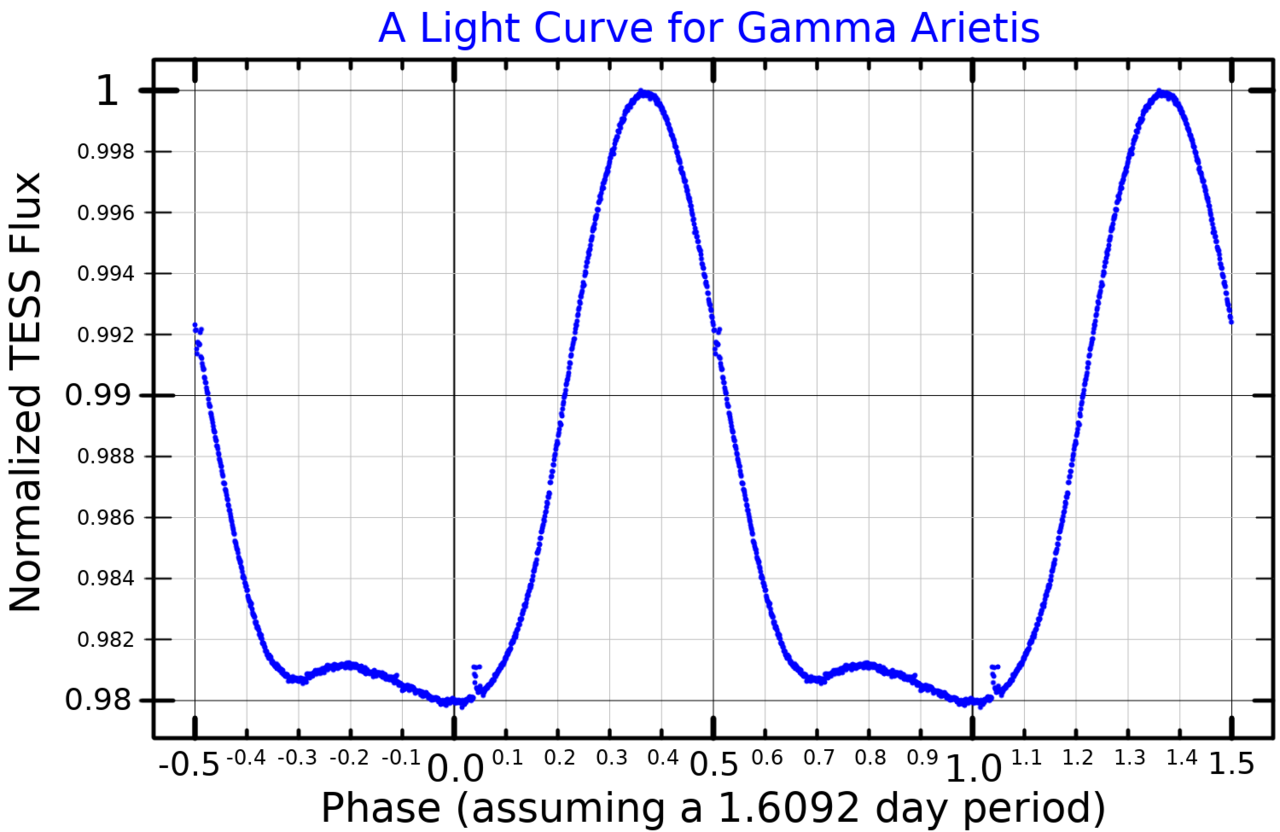
The brighter component, γ2 Arietis, is an α2 Canum Venaticorum variable star. This type has a strong magnetic field and enhanced spectral lines of certain metals, with brightness changes driven by high chromospheric activity as the star rotates. Its brightness varies by 0.04 magnitudes over a 2.61-day period. It is also an Ap star, a chemically peculiar type with enhanced lines of many metals. Its spectral class is A2IVpSiSrCr, indicating strong lines of silicon, strontium, and chromium, along with elevated europium, mercury, and manganese. This suggests it is an A2-class subgiant. A 2016 study identified a probable low-mass red dwarf companion in a close orbit around γ2 Arietis.
The slightly fainter visible star, γ1 Arietis, is a Lambda Boötis star—chemically peculiar, with unusually low abundances of iron-peak elements in its spectrum. Its stellar classification is A0Vnp, with a magnitude of 4.64. The 'n' notation indicates rapid rotation, with a projected rotational velocity of 201 km/s. Its spectral class has also been given as A0IV-V(n)kB8, meaning its calcium K lines resemble those of a B8 star. Older studies often classified it as B9 or B9.5 with a luminosity class of IV or V, indicating either a main-sequence star or a subgiant.
Both visible stars have similar masses, luminosities, effective temperatures, and radii, and the system is about 34 million years old.
- Bayer designation
- γ Arietis
- Combined apparent magnitude
- 3.86
- Distance
- approximately 166 ly
- Number of visible components
- 2
- Angular separation of components
- 7.606 arcseconds
- Orbital period of the pair
- greater than 5,000 years
- Age of the system
- about 34 million years
Lore & Background
The double star nature of this system was discovered by the English scientist and astronomer Robert Hooke in 1664. The two components have an angular separation of 7.606 arcseconds, which can be resolved with a small telescope. The orbital period of the pair is greater than 5,000 years. The brighter component, γ2 Arietis, is an α2 CVn type variable star, a type of star with a strong magnetic field and enhanced spectral lines of some metals, with high chromospheric activity causing brightness changes as the star rotates. Its brightness varies by 0.04 magnitudes with a period of 2.61 days. It is also an Ap star, a type of chemically peculiar star with enhanced lines of many metals. The spectral class has been given as A2IVpSiSrCr, noting the particular strength of lines of silicon, strontium, and chromium, although other lines such as europium, mercury, and manganese are also stronger than in a normal star. This spectral type suggests that the star is an A2-class subgiant. One study from 2016 identified a low-mass companion to γ2 Arietis, a probable red dwarf in a close orbit. The marginally fainter of the two visible stars, γ1 Arietis, is a Lambda Boötis (chemically peculiar) star with a stellar classification of A0Vnp and a magnitude of 4.64. Lambda Boötis stars are identified based on unusually low abundances of iron peak elements in their spectra. This star is spinning rapidly with a projected rotational velocity of 201 km/s, as suggested by the 'n' (nebulosity) notation. The spectral class of this component has also been given as A0IV-V(n)kB8, indicating that calcium K lines in its spectrum are more typical of a B8 star. Older studies often classified it as B9 or B9.5 with a luminosity class of IV or V, indicating either a main sequence or subgiant. γ1 Arietis may itself be a spectroscopic binary with a low mass companion.
Reader's Guide
Gamma Arietis holds a notable place in astronomical history as 'The First Star in Aries,' having once marked the equinoctial point. Its double star nature, discovered by Robert Hooke in 1664, makes it one of the early telescopic binary discoveries. The system's brighter component, γ2 Arietis, is an α2 CVn variable star and an Ap chemically peculiar star, exhibiting brightness variations tied to its rotation and strong magnetic field. The fainter component, γ1 Arietis, is a Lambda Boötis star with unusually low iron-peak abundances and rapid rotation. The system's traditional name, Mesarthim, originally shared with Beta Arietis as Sheratan, underwent a corruption in medieval manuscripts that Bayer erroneously explained as a Hebrew term meaning 'servants.' In 2016, the IAU Working Group on Star Names approved the name Mesarthim specifically for the component γ2 Arietis. In Chinese astronomy, Gamma Arietis is part of an asterism called Bond, along with Beta and Alpha Arietis. In Hindu astrology, Gamma Arietis and Beta Arietis are identified as Ashvins, the twin Rigvedic deities who act as doctors of the divine world.
Did You Know?
- Gamma Arietis was called 'The First Star in Aries' because it was at one time the nearest visible star to the equinoctial point.
- The brighter component, γ2 Arietis, varies in brightness by 0.04 magnitudes with a period of 2.61 days.
- In Hindu astrology, Gamma Arietis and Beta Arietis are the Ashvins, twin Rigvedic deities.
A Fourth-Magnitude Anchor in a Dim Sky
Gamma Arietis, known by the name Mesarthim, holds the distinction of being one of only four stars bright enough to stand out in the constellation Aries. At fourth magnitude, it shares this modest luminous company with Hamal at second magnitude, Sheratan at third, and 41 Arietis, also fourth magnitude. This scarcity of bright stars makes Aries a notably dim region of the sky, one that ranks 39th among all constellations by area, spanning 441 square degrees—roughly 1.1 percent of the entire celestial sphere. Situated in the Northern celestial hemisphere, Aries occupies the stretch between Pisces to the west and Taurus to the east. For an observer scanning this mid-sized zodiacal region, Mesarthim serves as one of the few reliable visual landmarks, a quiet fourth-magnitude point of light in a constellation that otherwise blends into the background of the spring sky.
The Vernal Equinox and Hipparchus's Reference Point
In 130 BC, the Greek astronomer Hipparchus established the First Point of Aries, the location of the vernal equinox, by defining it as a point situated south of Gamma Arietis. This designation gave the equinox marker its name, tying it permanently to the constellation in which the Sun crossed the celestial equator from south to north more than two millennia ago. However, the slow wobble of Earth's axis, known as the precession of the equinoxes, has since shifted this point out of Aries and into neighboring Pisces. Astronomers project that by approximately 2600 AD the First Point of Aries will have drifted further into Aquarius. Despite this celestial migration, the Sun's apparent passage through Aries now occurs from late April through mid-May, and the constellation retains its cultural association with the arrival of spring. Mesarthim thus occupies a unique historical position: it was once the anchor star for one of the most important reference points in the entire calendar system.
A Constellation's Shifting Identity Across Cultures
The stars that now form Aries, and among them Mesarthim, have carried very different meanings across civilizations. In the earliest Babylonian records, the clay tablets known as the MUL.APIN identified this region not as a ram but as The Agrarian Worker or The Hired Man, a figure tied to agricultural cycles. The transformation into the ram likely emerged through later Babylonian tradition, possibly linked to the growing association with Dumuzi the Shepherd. In ancient Egypt the constellation was connected to Amun-Ra, the ram-headed god of fertility and creativity, and earned the title Lord of the Head because it marked the vernal equinox, the Indicator of the Reborn Sun. Greek mythology later layered on the story of the golden ram that carried Phrixus to safety from a jealous stepmother. In China the same stars were read as twin inspectors, while in the Marshall Islands they formed a porpoise. Mesarthim, as a member of this constellation, has been a silent participant in every one of these cultural reimaginings.
Depicted and Re-Depicted Across the Ages
The visual representation of Aries, and by extension the position of Mesarthim within it, has changed repeatedly over two millennia of astronomical illustration. Ptolemy, writing in his Almagest, noted that Hipparchus had placed Alpha Arietis at the ram's muzzle, yet Ptolemy himself excluded that star from his constellation figure, listing it merely as an unformed star above the head. John Flamsteed's Atlas Coelestis followed Ptolemy's lead, mapping the star above the figure and depicting Aries in a lying-down posture. Medieval Muslim astronomers offered yet another interpretation: al-Sufi drew the ram in a running pose, glancing backward, while some Islamic celestial globes rendered it as a generic four-legged animal with what appeared to be antlers rather than horns. Early Bedouin observers even placed a ram elsewhere in the sky, using the Pleiades as its tail. The constellation was not fully embraced as a distinct entity until classical times, and its artistic identity has remained in flux ever since, with Mesarthim shifting position within each new interpretation.
Gallery
Frequently Asked Questions
What is Gamma Arietis?
Gamma Arietis is a multiple star system in the northern constellation Aries, made up of two (and possibly three) visible components. It carries the Bayer designation γ Arietis and holds the title of the fourth-brightest star in Aries.
How far away is Gamma Arietis?
Parallax measurements put the system at roughly 166 light-years from the Sun. Despite that distance, its combined apparent visual magnitude of 3.86 keeps it easily visible to the naked eye.
Why was Gamma Arietis historically significant?
It was long called 'The First Star in Aries' because it sat nearest the vernal equinoctial point among visible stars. Precession of the equinoxes has since shifted that point, so the star no longer marks that position.
How are the two main components of Gamma Arietis arranged?
γ1 Arietis and γ2 Arietis are separated by about 7.6 arcseconds of angular distance. Their mutual orbital period exceeds 5,000 years, so the pair drifts very slowly relative to one another.
Can I spot Gamma Arietis without a telescope?
Yes—its combined apparent magnitude of 3.86 makes it readily visible to the unaided eye under reasonably dark skies. It ranks as the fourth-brightest object in the constellation Aries.
More in Variable Stars, Part 6 1-24
Spotted an error? Know more?
Reader corrections go straight into our review queue. Suggest an edit · How this site is sourced