HIP 79098
A young binary system with a circumbinary brown dwarf.

SPHERE, Maud Langlois · CC BY 4.0
HIP 79098 is a binary star system in the constellation Scorpius, notable for hosting a circumbinary brown dwarf discovered in 2019. The system is a member of the young Upper Scorpius subgroup of the Scorpius–Centaurus association, the nearest OB association to the Sun.
- Apparent magnitude
- 5.87–5.90
- Spectral type
- B9V (also classified as B9 Mn P Ga and B9IVn+Ap(Si)s)
- Age
- ~10 million years
- Primary mass
- 2.5 solar masses
- Variability type
- α2 Canum Venaticorum variable
- Variability period
- 2.69 days (secondary period 0.28 days)
- Brown dwarf mass
- 15–26 Jupiter masses
Lore & Background
HIP 79098 is a young stellar system belonging to the Upper Scorpius subgroup of the Scorpius–Centaurus association, with an estimated age of around 10 million years. The primary star is a chemically peculiar B-type main sequence star of spectral type B9V, also classified as B9 Mn P Ga and B9IVn+Ap(Si)s. It is a mercury-manganese star with strong manganese and gallium lines and weak helium lines. The primary varies between magnitudes 5.87 and 5.90 with a primary period of 2.69 days and a secondary period of 0.28 days, classified as an α2 Canum Venaticorum variable; these cycles may be caused by rotation or pulsations. The system is a double-lined spectroscopic binary, with a secondary star of unknown type that is probably almost as massive as the primary. Radial velocity variations are large but contradictory between studies, preventing determination of masses and orbital parameters. Two distant red dwarfs, of spectral types M5 and M3.25, share proper motion and distance with HIP 79098 and are likely physical companions.
Reader's Guide
The discovery of the brown dwarf HIP 79098 (AB)b in 2019 as part of the BEAST survey highlights the system's significance for understanding planet and brown dwarf formation around massive stars. The brown dwarf was identified through archival images from 2000, 2004, and 2015, having been previously dismissed as a background star due to its red color. Its color and luminosity are consistent with a spectral type of M9–L0, and its mass of 15–26 Jupiter masses and effective temperature of 2,300 to an unspecified value reflect its youth. The mass ratio between the brown dwarf and the central binary is 0.3–1%, a low value similar to some massive planet systems, suggesting HIP 79098 (AB)b may represent the upper end of the planet population rather than having formed as a star. This system contributes to the study of circumbinary companions and the boundary between planets and brown dwarfs.
Did You Know?
- HIP 79098 is a member of the Upper Scorpius subgroup, the youngest part of the Scorpius–Centaurus association.
- The brown dwarf HIP 79098 (AB)b was first seen in 2000 images but was initially rejected as a background star.
- The system's radial velocity variations are large but contradictory between different studies.
The Young B-Type Primary
HIP 79098 shines at a visual magnitude of roughly +5.9, a faint but reachable target for observers under truly dark skies. Located about 500 light-years away in the constellation Scorpius, this star belongs to the Upper Scorpius subgroup of the Scorpius–Centaurus association, the closest OB association to our Sun. Its estimated age of only ten million years makes it a remarkably young stellar system. The primary star is classified as B9V, a blue-white main-sequence star with a mass around 2.5 times that of the Sun. What sets it apart is its chemical peculiarity: the spectrum reveals strong manganese and gallium absorption lines alongside unusually weak helium features, earning it the designation of an HgMn star. Additional classifications include B9 Mn P Ga and B9IVn+Ap(Si)s. The star also exhibits variability, oscillating between magnitudes 5.87 and 5.90 over a 2.69-day cycle, with a shorter 0.28-day period also detected. These fluctuations are attributed either to the star's rotation or to internal pulsations, placing it in the α2 Canum Venaticorum class.
The Elusive Companion
The spectrum of HIP 79098 carries the fingerprints of a second star, confirming that the system is a double-lined spectroscopic binary. Yet the nature of this companion remains one of the system's greatest puzzles. It is likely quite massive—perhaps nearly matching the primary in mass—but no study has yet pinned down its exact properties. Radial velocity measurements show large variations consistent with orbital motion, yet different research groups report contradictory magnitudes for these shifts, making it impossible to derive reliable orbital parameters or companion mass from that data alone. Independent evidence for the second star comes from astrometric surveys: both Hipparcos and Gaia detect a significant departure from the expected constant proper motion, betraying the gravitational tug of an unseen partner. A 2023 analysis that combined radial velocity and astrometric data proposed a semi-major axis of 1.9 ± 0.6 AU and a companion mass of 0.53 ± 0.26 solar masses, but the wide error bars underscore how much uncertainty still surrounds this enigmatic secondary.
The Brown Dwarf at the Edge
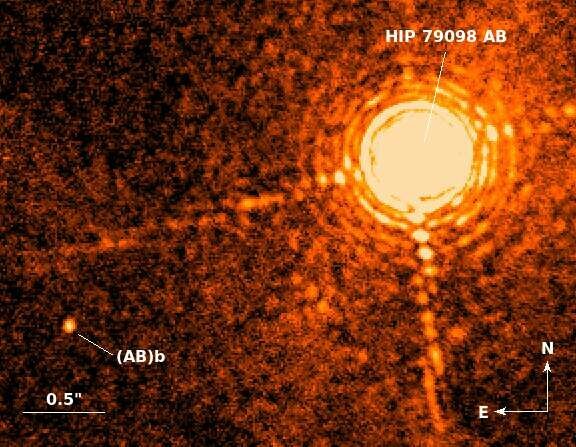
In 2019, the BEAST survey—which targets planets around B-type stars in the Scorpius–Centaurus association—announced the discovery of a brown dwarf orbiting the HIP 79098 central pair. The object had actually appeared in earlier archival images: the ESO 3.6-metre telescope captured it in 2000, NACO on the Very Large Telescope in 2004, and SPHERE on the VLT in 2015. In each case, researchers dismissed it as a background star because its colour was redder than expected for a co-moving object. The 2019 team combined all three epochs and demonstrated a shared proper motion with HIP 79098, confirming a physical link. Designated HIP 79098 (AB)b, the brown dwarf is circumbinary, sitting at a separation of roughly 345 AU (2.4 arcseconds). Its unusually red colour and luminosity point to a spectral type of M9 to L0, an effective temperature of 2,300–2,600 K, and a mass of 15 to 26 Jupiter masses. The mass ratio between this object and the central binary is only 0.3 to 1 percent, a value comparable to some massive-planet systems, hinting that it may represent the upper boundary of the planet population rather than a true star.
A Wider Family of Stars
Beyond the central binary and its circumbinary brown dwarf, two additional low-mass red dwarfs may be physically associated with HIP 79098. These companions share similar proper motions and distances with the primary system, and both are confirmed members of the Scorpius–Centaurus association, lending support to the idea of a common origin. The first is an M5 dwarf located 65 arcseconds from the primary, corresponding to a projected separation of about 9,500 AU. The second, slightly brighter, is an M3.25 dwarf at 88 arcseconds, or roughly 12,900 AU. Together, these objects sketch out a remarkably extended stellar family: a young B-type binary at the core, a brown dwarf circling at several hundred AU, and two faint red dwarfs trailing far out in the outer reaches. The full ensemble—primary, secondary, brown dwarf, and two red dwarfs—spans a wide range of masses and makes HIP 79098 a compelling case study for understanding how diverse stellar and substellar objects can coexist within a single system. The fact that all members share the same youthful age of roughly ten million years and the same association membership underscores that this family was born together in the same star-forming episode.
Gallery
Frequently Asked Questions
What is HIP 79098?
HIP 79098 is a young binary star system in the constellation Scorpius, made up of two B-type stars with a combined apparent magnitude of roughly 5.9. It is a member of the Upper Scorpius subgroup within the Scorpius–Centaurus OB association, the nearest such stellar grouping to the Sun.
What kind of variable star is HIP 79098?
It is classified as an α2 Canum Venaticorum (α2 CVn) variable, a type whose brightness changes are driven by rotating chemical inhomogeneities on the stellar surface. The dominant pulsation cycle runs about 2.69 days, and a shorter secondary period of 0.28 days has also been detected.
What is the circumbinary brown dwarf around HIP 79098?
In 2019, researchers identified a brown dwarf orbiting both stars in the binary pair rather than just one, making it a circumbinary companion. This turned HIP 79098 into one of the few known systems where a substellar object encircles a young binary instead of a single star.
How old is HIP 79098 and what are its stellar properties?
The system is estimated at roughly ten million years old, still well before settling onto the main sequence. The primary component carries about 2.5 solar masses and is catalogued as a B9V star with anomalous spectral lines pointing to enhanced manganese, gallium, and silicon.
Why is HIP 79098 important to variable-star fans and researchers?
Its youth, unusual chemical abundances, and the rare circumbinary brown dwarf together make it a valuable natural laboratory for studying massive-star evolution and substellar-panion formation in binary settings. Because it sits in the closest OB association to the Sun, it is also comparatively easy to observe in detail.
More in Variable Stars, Part 6 1-24
Spotted an error? Know more?
Reader corrections go straight into our review queue. Suggest an edit · How this site is sourced