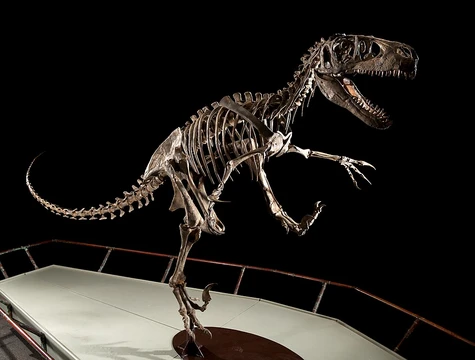
Iguanacolossus
A large iguanodontian ornithopod from the Early Cretaceous of Utah.
Last updated
Iguanacolossus is a genus of iguanodontian ornithopod dinosaur from the Early Cretaceous of North America. Its name, meaning 'iguana colossus' or 'colossal iguana', reflects its large size and iguanodontian affinities. The genus is known from a partial skeleton of a single individual.
Scientific classification
- KingdomAnimalia
- PhylumChordata
- ClassReptilia
- CladeDinosauria
- Clade†Ornithischia
- Clade†Ornithopoda
- Genus†Iguanacolossus
Named by McDonald et al., 2010
Sources: Wikipedia taxobox: Iguanacolossus (CC BY-SA 4.0)
Quick Facts
- Type species
- Iguanacolossus fortis
Facts from the source article.
Discovery and naming
The holotype, UMNH VP 20205, was discovered in 2005 by Donald D. DeBlieux in the Yellow Cat Member of the Cedar Mountain Formation in Utah, dating to the Valanginian stage. It was named and described in 2010 by a team including Andrew T. McDonald, James I. Kirkland, Donald D. DeBlieux, Scott K. Madsen, Jennifer Cavin, Andrew R. C. Milner, and Lukas Panzarin, alongside the genus Hippodraco from the same formation.
The specimen comprises skull elements, vertebrae, ribs, a scapula, ilium, pubis, metatarsals, and a fibula. The generic name combines 'Iguana' with the Latin 'colossus', meaning colossal, while the specific name 'fortis' means mighty, yielding the binomial 'Mighty Iguana Colossus'. Additional juvenile material from the Doelling's Bowl site, including lower jaws and a humerus, is under revision, along with a large femur and pubis.
Description
Iguanacolossus was a large, robust iguanodontid, estimated at 9 meters in length and 5 tonnes in body mass. It is distinguished by several features: a curved contact surface for the supraoccipital on the squamosal, a cranial pubic process with a concave dorsal margin, a blade-like postorbital process of the squamosal, a pubis tapering to a blunt point, a horizontal boot on the preacetabular process of the ilium, a blade-like and semi-circular axial neural spine, and a straight dorsal margin of the ilium. The maxilla preserves 14 alveoli, and the teeth show shield-shaped and lozenge-shaped crowns.
The left fibula measures 63.0 cm. The scapula is nearly complete, and the vertebrae indicate a typical iguanodontian body shape. The right pubis exhibits both derived and plesiomorphic traits.
Paleoecology
Iguanacolossus was recovered from the Lower bed of the Yellow Cat Member in the Cedar Mountain Formation. In this bed, it coexisted with the theropods Falcarius, Geminiraptor, and Yurgovuchia, the sauropod Mierasaurus, the turtle Naomichelys, and indeterminate goniopholidids. The Upper Yellow Cat bed hosted a different fauna, including the sauropods Cedarosaurus and Moabosaurus, the iguanodontians Cedrorestes and Hippodraco, the theropods Martharaptor and Utahraptor, the nodosaurid Gastonia, and various other vertebrates such as turtles, fish, and the mammal Cifelliodon.
More in Valanginian Dinosaurs
Sources
Compiled from Wikipedia and the sources listed below. Text from Wikipedia is available under CC BY-SA 4.0; this entry is adapted from it.
- Wikipedia: Iguanacolossus (CC BY-SA 4.0).
- Word definitions: the , each quoted from its Wikipedia article.
Spotted an error? Know more?
Reader corrections go straight into our review queue. Suggest an edit · How this site is sourced