Gastonia (dinosaur)
Early Cretaceous ankylosaur with a sacral shield and shoulder spikes.
Last updated
Gastonia was a plant-eating ankylosaur from the Early Cretaceous of North America, living about 139 to 125.77 million years ago. This dinosaur, often grouped with nodosaurids and related to Polacanthus, is recognized by its bony sacral shield and prominent shoulder spikes.
Scientific classification
- KingdomAnimalia
- PhylumChordata
- ClassReptilia
- CladeDinosauria
- Clade†Ornithischia
- Clade†Thyreophora
- Clade†Ankylosauria
- Family†Nodosauridae
- Genus†Gastonia
Named by Kirkland, 1998
Sources: Wikipedia taxobox: Gastonia (dinosaur) (CC BY-SA 4.0)
Quick Facts
- Type species
- Gastonia burgei
- Subdivision
- G. burgei, Kirkland, 1998, G. lorriemcwhinneyae, Kinneer et al., 2016
Facts from the source article.
Discovery and species
The first known specimen of Gastonia, a single skull cataloged as CEUM 1307, was dug up from a limestone bonebed in the lower Cedar Mountain Formation at Yellow Cat Quarry in Grand County, eastern Utah. This skull, the holotype, was found with four partial skeletons that became paratypes, plus the holotype of Utahraptor and an iguanodontid. Gastonia is one of the most frequent dinosaur fossils in the Cedar Mountain Formation, with numerous individuals uncovered from several quarries in the southwest.
By 2004, four skulls had been recorded; by 2014, that count reached ten. Paleontologist James Kirkland formally named and described Gastonia in 1998, using the holotype and other fossils collected starting in 1989. The genus name honors Robert Gaston, a paleo artist and CEO of Gaston Design Inc., while the species G. burgei recognizes Donald L. Burge, director of the College of Eastern Utah Prehistoric Museum. G. burgei comes from the Yellow Cat Member of the Cedar Mountain Formation, which dates to the Valanginian stage, 139 to 134.6 million years ago.
A second species, G. lorriemcwhinneyae, was named in 2016 from the same formation, based on a large bonebed found by Lorrie McWhinney in 1999, likely formed when a group perished from drought or drowning. The incomplete type specimen, a skull roof, and its paratypes, which include many other skeletal parts, were collected by the Denver Museum of Nature and Science from Lorrie's Site in Grand County, Utah. Though first reported as coming from the lower Ruby Ranch Member, the site was later corrected to the older Poison Strip Member, dating to the Hauterivian-Barremian.
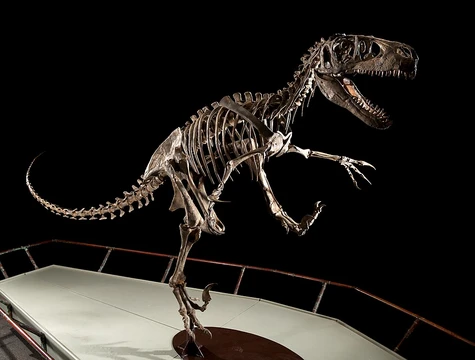
Overall, more complete remains exist for Gastonia than for any other basal ankylosaur. However, the abundance of disarticulated material from bonebeds makes it hard to know exactly how many spikes a single Gastonia carried. In the late 1900s, a mounted skeleton was created using polyurethane casts of bones from different individuals, with distortions fixed and missing parts completed. This made Gastonia the first basal ankylosaurian dinosaur put on display at the Denver Museum of Nature and Science, alongside the related Gargoyleosaurus.
Description
Gastonia was a medium-sized armored dinosaur. Estimates of its length vary, with one from 1998 suggesting 6 meters, while a 2010 source gave a body length of 5 meters and a weight of 1.9 metric tons. A mounted skeleton measures 4.59 meters long and stands 1.12 meters tall at the hip. Because its relationships within the group are unclear, its unique features are hard to pin down.
However, three traits were identified in 1998 that seem to be exclusive to this dinosaur within the larger ankylosaur family. These include a broad, gently curved notch in the bony core of the upper beak along the midline of the front snout, nostrils placed far back on the skull, and elongated projections on the underside of the braincase. Gastonia had a flat, exceptionally wide rump, with a belly that bulged out between its short, strong legs. Its tail was of moderate length and did not have a club.
The neck was fairly long, and the skull was likely small. The skull itself is somewhat long and pointed, measuring 295 by 283 millimeters in the type specimen. Its top profile is rounded, with the back of the skull roof dipping below the level of the upper eye socket rims. The quadrate bone leans strongly backward, and the joint connecting the skull to the neck points downward, a feature that would have kept the head angled toward the ground.
The beak had no teeth, and the upper jaw tooth rows were fairly straight, each holding fifteen to sixteen small teeth without a swollen base. There was no armor on the snout. Farther back, the bony plates on the skull roof have a faint pattern, though a small central plate on the parietal bones is visible. The horns at the rear corners of the skull and on the cheeks were small.
Paleobiology
Gastonia made its home in a partly wooded landscape where riverine forests were broken up by open spaces, and the climate was mostly dry with a brief rainy season. It shared the Yellow Cat area with dinosaurs like the ornithopods Hippodraco and Cedrorestes, the sauropods Cedarosaurus and Moabosaurus, and the theropods Martharaptor, Nedcolbertia, and Utahraptor. As the only ankylosaur in the region, Gastonia was also one of the most common species there.
Kirkland thought this abundance might stem from its armor, which provided good protection against the top predator Utahraptor, whose remains turned up in the same quarry as Gastonia. Its defense followed the polacanthine pattern: passive protection from upright spikes and active defense by swinging the horizontal spikes on its flexible tail at attackers. The armor likely played a role in male-on-male fights too, with the vertical spikes used to intimidate rivals and head-ramming contests to establish dominance.
Kirkland suggested that the typical ankylosaurid down-turned head, made possible by a more downward-facing occipital condyle than in nodosaurids, along with looser rear skull bones to absorb impact, evolved for this head-butting behavior. While ankylosaurs are usually thought to be solitary because their short legs seem unsuited for traveling in herds, the clustered Gastonia fossils suggest otherwise.
More in Valanginian Dinosaurs
Sources
Compiled from Wikipedia and the sources listed below. Text from Wikipedia is available under CC BY-SA 4.0; this entry is adapted from it.
- Wikipedia: Gastonia (dinosaur) (CC BY-SA 4.0).
- Word definitions: the , each quoted from its Wikipedia article.
Spotted an error? Know more?
Reader corrections go straight into our review queue. Suggest an edit · How this site is sourced