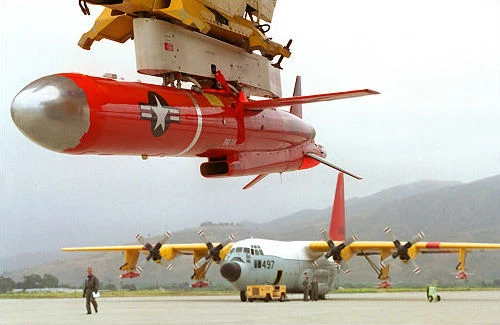
Gyrodyne QH-50 DASH
Expendable drone helicopter for anti-submarine warfare from small ships.

The Gyrodyne QH-50 DASH, short for Drone Anti-Submarine Helicopter, was a compact unmanned helicopter produced by the Gyrodyne Company of America. It was designed to deliver anti-submarine weapons at long range from vessels too small to accommodate a conventional manned helicopter. Manufacturing continued until 1969, and a handful of units remain in service for ground-based tasks.
The DASH emerged from the U.S. Navy’s Fleet Rehabilitation and Modernization (FRAM) program of the late 1950s. FRAM was initiated because the Soviet Union was constructing submarines faster than the United States could build dedicated anti-submarine frigates. Rather than building new frigates, the FRAM upgrades allowed the Navy to quickly modernize older ships that had become less effective in contemporary naval combat. These World War II-era destroyers could receive upgraded sonar, but they lacked space for a full flight deck. The DASH concept addressed this by providing a lightweight drone helicopter capable of releasing a nuclear depth charge or torpedoes. The aircraft was considered expendable.
The groundwork for the DASH came from the manned Gyrodyne Rotorcycle program of the mid-1950s. The Rotorcycle was modified to create the first drone version, the DSN-1/QH-50A, which used a 72-horsepower Porsche YO-95-6 piston engine and carried a single Mark 43 homing torpedo. The next variant, the DSN-2/QH-50B, featured two Porsche YO-95-6 engines but still carried one Mk 43 torpedo. Serial production began with the DSN-3/QH-50C, which replaced the piston engine with a 255-horsepower Boeing T50-4 turboshaft engine and increased payload capacity to two Mark 44 torpedoes. A total of 378 QH-50Cs were built before production ended in January 1966.
One retired QH-50A (DS-1006), which had been used for contractor testing until 1961, was reactivated in 1964 to test tilt-float landing gear. This setup added a long cylindrical float to each corner of an extended skid framework. Each float could rotate 90 degrees from a horizontal, forward-facing orientation and had a pad for landing on hard surfaces. For water landings, the floats were rotated vertically, and the helicopter would settle until the floats were about 75 percent submerged, providing substantial stability.
Quick Facts
- National Origin
- United States
- Manufacturer
- Gyrodyne Company of America
- First Flight
- 1959
- Introduction
- 1963
- Primary User
- United States Navy
- More Users
- United States Army / Japanese Maritime Self-Defense Force
- Produced
- 1962–1969
- Number Built
- 755
- Developed From
- Gyrodyne RON Rotorcycle
Facts from the source article.
Lore & Background
The DASH was a major part of the United States Navy's Fleet Rehabilitation and Modernization (FRAM) program of the late 1950s. FRAM was started because the Soviet Union was building submarines faster than the US could build anti-submarine frigates. Instead of building frigates, the FRAM upgrade series allowed the US to rapidly update by converting older ships that were less useful in modern naval combat. The navy could upgrade the sonar on World War II-era destroyers but needed a stand-off weapon to attack at the perimeter of the sonar's range. The old destroyers had little room for add-ons such as a full flight deck. The original DASH concept was a light drone helicopter that could release a nuclear depth charge or torpedoes. The aircraft was considered expendable.
The manned Gyrodyne Rotorcycle program of the mid-1950s provided prototype work for the DASH, and ultimately the Rotorcycle was modified to produce the initial drone version, the DSN-1/QH-50A. The DSN-1 was powered by a Porsche YO-95-6 72 hp piston engine and carried one Mark 43 homing torpedo. The next developmental version was the DSN-2/QH-50B that was powered by two Porsche YO-95-6 engines and also carried a single Mk 43. Serial production of the DASH began with the third version, the DSN-3/QH-50C, in which a 255 hp Boeing T50-4 turboshaft engine replaced the piston engine and the payload was increased to two Mark 44 torpedoes. A total of 378 QH-50Cs were produced before production ended in January 1966.
The DASH's control scheme had two controllers: one on the flight deck, and another in the combat information center. The flight-deck controller handled take-off and landing. The controller in the Combat Information Center (CIC) would fly DASH to the target's location and release weapons using semiautomated controls and radar. The CIC controller could not see the aircraft or its altitude and occasionally lost operational control or situational awareness. Late in the program, there were successful experiments to add a TV camera to the drone. These DASH SNOOPYs were also used as airborne spotters for naval gunfire.
Reader's Guide
The DASH program was canceled in 1969 and withdrawn from service 1968–1973. DASHes proved unreliable in shipboard service, with over half of the US Navy's 746 drones lost at sea. This was possibly due to inadequate maintenance support, as other services had few difficulties with their DASHes. Although low reliability was the official reason, the manufacturer pointed to the expenses of the Vietnam War, and the lack of need for antisubmarine capability in that war. Modified DASH vehicles continued to operate for several more years in the Vietnam War, used as remote artillery spotters and organic reconnaissance by their ships. Until May 2006, a small number of QH-50D DASH drones were operated by the United States Army at White Sands Missile Range, where they were used to tow targets and calibrate radars and electronic systems. The Japanese Maritime Self-Defense Force operated a fleet of 20 QH-50 drones, for use on its destroyers. Because the JMSDF regarded the DASH operation as highly prestigious and the aircraft were flown and serviced regularly, they suffered a much lower loss rate than the US Navy. However, with the difficulty of maintaining DASH operations after the termination of the U.S. program, the drones and associated equipment were removed from JMSDF service in 1977. The DASH's legacy lies in its pioneering role as an expendable, remotely piloted anti-submarine helicopter, demonstrating both the potential and the pitfalls of early drone warfare at sea.
Did You Know?
- Over 80% of operational DASH losses were traced to single-point failures of the electronics.
- The DASH was considered expendable and used off-the-shelf industrial electronics with no back-ups.
- A tethered landing system was developed to allow launch and recovery in seas up to Force 6.
- The Japanese Maritime Self-Defense Force operated 20 QH-50 drones and had a much lower loss rate than the US Navy.
More in Unmanned Aerial Vehicles by Country 1-24
Spotted an error? Know more?
Reader corrections go straight into our review queue. Suggest an edit · How this site is sourced