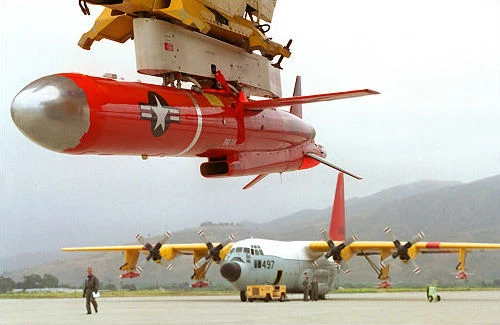
AeroVironment T-20
Runway-independent UAV with ADS-B detect-and-avoid capability.

The AeroVironment T-20 is a medium-range, composite unmanned aerial vehicle (UAV) originally developed by Arcturus UAV in 2009. It is notable for its ability to operate without an airfield, launching from a portable catapult and landing on unimproved surfaces, and for being the first UAV to detect and avoid a manned aircraft using an ADS-B transponder.
Quick Facts
- Aircraft Type
- Runway independent tactical reconnaissance UAV
- Manufacturer
- AeroVironment
- Primary User
- US military
- More Users
- Ukraine military / Taiwan CGA
- Number Built
- 200 + Delivered/more Planned
- Introduction
- 2009
- First Flight
- January 28, 2009, Edwards Air Force Base
Facts from the source article.
Lore & Background
The T-20 was developed in 2009 in Rohnert Park, California as an Intelligence, Surveillance and Reconnaissance platform. Flight testing of the prototype was completed at Edwards Air Force Base in February 2009. The first air drop test occurred in August 2009 at Camp Roberts, California with payloads from the Naval Postgraduate School. In October 2009, the T-20 flew air drops at the Precision Airdrop Technology Conference and Demonstration at Yuma Proving Ground in support of the Naval Postgraduate School Snowflake guided parafoil. On October 24, 2012, the T-20 made aviation history as the first unmanned aerial vehicle to detect and avoid a general aviation manned aircraft using an ADS-B transponder, an event sponsored by the Cascade Chapter of AUVSI. In August 2013, the T-20 flew to an altitude of 23,500 ft with no special modifications, surpassing its previous record of 15,000 ft, and flew for eight hours before landing. The T-20 and its VTOL variant, the JUMP 20, are used extensively with the Mexican Navy and are also operated by the Turkish government.
Reader's Guide
The T-20's significance lies in its runway independence and its role as a pioneer in unmanned detect-and-avoid technology. Its ability to launch from a portable catapult and land on dirt, grass, desert, or gravel roads eliminates the need for airfields, making it suitable for expeditionary operations. The aircraft's internal payload bay and wing-mounted drop pods allow for flexible sensor and cargo configurations. The T-20's ADS-B demonstration in 2012 marked a milestone in integrating UAVs into shared airspace. The U.S. Army selected the JUMP 20, the vertical takeoff and landing variant, for the first increment of the Future Tactical Unmanned Aircraft System (FTUAS) in August 2022, awarding an $8 million contract for one system. The JUMP 20 was also included in a February 2023 American aid package for Ukraine under the Ukraine Security Assistance Initiative, and a system was delivered to the Coast Guard Administration of Taiwan in 2023. AeroVironment acquired Arcturus UAV, the original developer of the T-20 and JUMP 20, on February 22, 2021.
Did You Know?
- The T-20 can land on dirt, grass, desert, or gravel roads without requiring an airfield.
- The T-20 set an altitude record of 23,500 ft in August 2013 with no special modifications.
- The JUMP 20, a VTOL variant of the T-20, was selected by the U.S. Army for the FTUAS program in 2022.
Frequently Asked Questions
What is the AeroVironment T-20?
It is a medium-range, composite-material unmanned aerial vehicle that first flew in 2009 out of Rohnert Park, California. The design was originally created by Arcturus UAV and later carried under the AeroVironment name.
What makes the AeroVironment T-20 stand out from other UAVs?
It holds the distinction of being the first unmanned aircraft to use an ADS-B transponder to detect and avoid a manned plane in shared airspace. It is also fully runway-independent, launching from a portable catapult and touching down on unimproved ground.
How does the AeroVironment T-20 launch and land without a runway?
Takeoff is handled by a portable catapult that slings the airframe to flying speed, while landing simply requires a flat, unimproved surface. This eliminates the need for a paved strip and lets operators deploy the drone from virtually any clear area.
What are the AeroVironment T-20's key performance figures?
It reached a maximum altitude of 23,500 feet in August 2013 and can sustain an eight-hour endurance at that ceiling. Its four-stroke, fuel-injected gasoline engine consumes roughly two pounds of fuel per hour during cruise.
Why is the AeroVironment T-20 considered a milestone in UAV history?
By integrating ADS-B-based detect-and-avoid for manned aircraft, it proved that an unmanned craft could safely share the same airspace as a piloted plane. Its 2009 debut also showed that a composite, medium-range drone did not need a dedicated airfield to be operationally useful.
More in Unmanned Aerial Vehicles by Country 1-24
Spotted an error? Know more?
Reader corrections go straight into our review queue. Suggest an edit · How this site is sourced