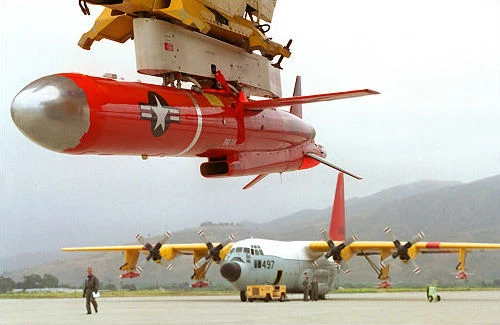
AQM-127 SLAT
A cancelled supersonic target drone plagued by flight test failures.

The AQM-127 Supersonic Low-Altitude Target (SLAT) was a target drone developed during the 1980s by Martin Marietta for the United States Navy. Derived from the cancelled Advanced Strategic Air-Launched Missile, the SLAT was intended to replace the MQM-8 Vandal as a high-speed, recoverable target for naval training. The program was cancelled in 1991 after repeated flight test failures.
Quick Facts
- Origin
- United States
- Is Missile
- yes
- Design Date
- 1984
- Manufacturer
- Martin Marietta
- Number
- 15
- Weight
- 2400 lb
- Length
- 5.47 m
- Diameter
- 54 cm
- Engine
- Marquardt ramjet with integrated Thiokol solid rocket booster
- Vehicle Range
- 55 nmi
- Speed
- Mach 2.5
Facts from the source article.
Lore & Background
Development of the YAQM-127 began in 1983 after the cancellation of the BQM-111 Firebrand, as the Navy still needed a replacement for the MQM-8 Vandal. A specification was issued for a recoverable, parachute-retrieved target drone capable of air launch from various aircraft. Martin Marietta, Ling-Temco-Vought, and Teledyne Ryan submitted bids; Martin Marietta won the design competition in September 1984. The design was derived from the cancelled Advanced Strategic Air-Launched Missile (ASALM) developed for the United States Air Force. The SLAT used a Marquardt hybrid rocket-ramjet: a solid rocket booster provided initial thrust, and after burnout the rocket chamber became the combustion chamber for a ramjet sustainer. It was designed to fly at Mach 2.5 at an altitude of 30 ft, following a pre-programmed autopilot course, and was to be fitted with radar signature augmentors and a radar seeker emulator. Initial operational capability was projected for 1991.
Reader's Guide
The AQM-127 SLAT program is notable as a failed attempt to field a high-speed, low-altitude target drone for the United States Navy. Of the fifteen YAQM-127A pre-production test missiles built, only six test flights were conducted between November 1987 and January 1989, with just one success. After a twenty-two month stand-down to reassess and modify the design, flight testing resumed in November 1990 but ended in failure; a final test in May 1991 also failed. With consistent failures and rising costs, the United States Congress intervened, and the program was cancelled in the summer of 1991. The Navy, still needing a high-speed target drone to replace the Vandal, turned to an interim solution: a drone conversion of a Russian missile, the MA-31, which entered service in small numbers during 1999. The SLAT's legacy is that of a technically ambitious but ultimately unsuccessful project that highlighted the challenges of developing a recoverable supersonic target system.
Did You Know?
- The AQM-127 was derived from Martin Marietta's work on the cancelled ASALM missile.
- Only one of the six initial test flights was a success.
- The program was cancelled in 1991 after eight test flights, seven of which failed.
- The Navy later used a drone conversion of the Russian MA-31 missile as an interim target drone.
Frequently Asked Questions
What is the AQM-127 SLAT?
The AQM-127 Supersonic Low-Altitude Target was a 1980s-era target drone built for the U.S. Navy to serve as a fast, recoverable training target, intended to succeed the MQM-8 Vandal.
Who manufactured the AQM-127 SLAT?
Martin Marietta developed the SLAT for the United States Navy during the 1980s, basing its airframe on the cancelled Advanced Strategic Air-Launched Missile.
How fast could the AQM-127 SLAT fly and at what altitude?
Powered by a Marquardt hybrid rocket-ramjet paired with a solid rocket booster, the drone could reach Mach 2.5 while skimming at roughly 30 feet above the surface.
Why was the AQM-127 SLAT program cancelled?
The Navy terminated the program in 1991 after the drone suffered repeated failures during its flight-test campaign, rendering it too unreliable for operational training use.
What designation did the pre-production AQM-127 SLAT carry?
The pre-production variant was designated YAQM-127A, marking it as an early target-drone prototype in the U.S. military's classification system.
More in Unmanned Aerial Vehicles by Country 1-24
Spotted an error? Know more?
Reader corrections go straight into our review queue. Suggest an edit · How this site is sourced