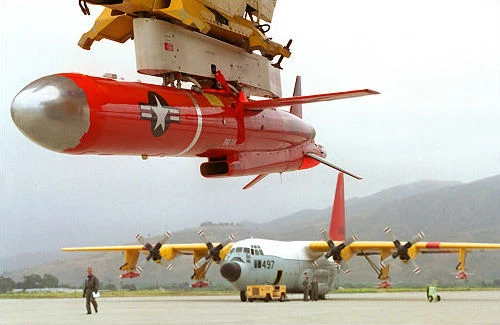
Glomb
Unmanned glide bomb project cancelled after technical and wartime changes.

The Glomb (a contraction of 'glide bomb') was a United States Navy project during World War II to develop an unmanned aircraft capable of delivering bombs to high-value, well-protected targets without endangering aircrew. Despite several prototype aircraft being built and tested, technical limitations—particularly with guidance systems—prevented any Glomb from seeing operational service, and the program was cancelled at the end of the war.
Quick Facts
- Origin
- United States
- Is Missile
- yes
- Service
- 1944–1945
- Used By
- United States Navy
- Wars
- World War II (test only)
Facts from the source article.
Lore & Background
The Glomb project originated in late 1940 when the United States Navy began studying remotely controlled gliders to carry bombs, reducing risk to aircrew. In 1941 the Joint Air Advisory Committee approved the project as a joint effort between the War Department and Navy Department, and on 19 April the Navy's Bureau of Aeronautics established a project office at the Naval Aircraft Factory. A 1942 specification called for a glider carrying either 18,000 lb of explosives or 3,000 US gallons of fuel, but by 1944 such a large aircraft was no longer needed. A smaller glide bomb based on a modified production glider was pursued instead, with radio command guidance tests beginning in September 1942 using modified training gliders.
Under Project George, the Taylorcraft XLNT-1, Piper XLNP-1, Aeronca XLNR-1, and Waco XLRW-1 were evaluated. The Taylorcraft model, designated XLNT-2 in its definitive Glomb form, was considered most suitable. It was fitted with a tricycle undercarriage for ease of towing during takeoff and used television guidance—the only sufficiently reliable form of guidance at the time—and could carry up to 4,000 lb. Trials were deemed satisfactory enough for the Naval Aircraft Factory to release production specifications in August 1943.
Production contracts were awarded in September 1943 to Pratt-Read (LBE), Piper (LBP), and Taylorcraft (LBT) for 100 aircraft each. The first full expendable tests of the XLNT Glomb occurred in September 1944; aerodynamics and effects were satisfactory, but the guidance system was not. Continued guidance issues, difficulty generating electricity for onboard systems, the changing war situation, and the low performance inherent in a glider led to program reductions. The LBT was cancelled in October 1944 after only 25 aircraft, and orders for the LBE and LBP were cut to 85 each in November 1944, then to 35 each in February 1945. Handling issues during landing caused the LBP's cancellation in June 1945, and on 14 August the LBE—the sole remaining Glomb—was terminated with only four aircraft delivered. The related LBD Gargoyle missile, an offshoot of the Glomb program, continued development as it was considered more suitable for carrier aircraft.
Reader's Guide
The Glomb program's significance lies in its early attempt to create a practical unmanned combat aircraft, predating modern drones by decades. It demonstrated the Navy's willingness to invest in remote-controlled weaponry to protect aircrew, but the project was ultimately undone by the technological limitations of the era—particularly unreliable guidance systems and power generation issues. The changing course of World War II also reduced the need for such a weapon. While no Glomb ever entered operational service, the program contributed to the development of the LBD Gargoyle missile, which was seen as more practical for carrier operations. The Glomb thus represents a transitional step between manned bombing and guided missiles, highlighting both the ambition and the constraints of mid-20th-century unmanned aviation.
Did You Know?
- The name 'Glomb' is a contraction of 'glide bomb'.
- The Glomb was designed to be towed by a Grumman F6F Hellcat.
- Television guidance was used because it was the only sufficiently reliable form of guidance at the time.
- Only four LBE Glombs were delivered before the program was terminated on 14 August.
More in Unmanned Aerial Vehicles by Country 1-24
Spotted an error? Know more?
Reader corrections go straight into our review queue. Suggest an edit · How this site is sourced