Globe KD5G
Pulsejet-powered target drone operated briefly by the U.S. Navy.

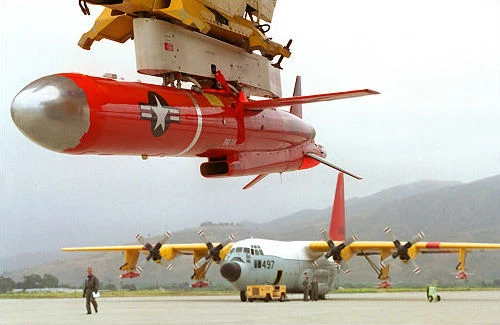
The Globe KD5G is a pulsejet-powered target drone developed by the Globe Aircraft Corporation for the United States Navy. It is notable as one of the last aircraft produced for the U.S. military to be powered by a pulsejet, and for its external engine mounting similar to the German V-1.
Quick Facts
- Aircraft Type
- Target drone
- National Origin
- United States
- Manufacturer
- Globe Aircraft Corporation
- Primary User
- United States Navy
Facts from the source article.
Lore & Background
The XKD5G-1 was of conventional high-wing, twin-tail design, with a Marquardt PJ46 pulsejet mounted externally atop the fuselage, in the same style as the World War II German V-1. Development began in 1949, and the drone first flew in 1950. It was tested at the Naval Air Test Center in Point Mugu, California. If not shot down during its mission, the KD5G could be recovered by parachute to be flown again.
By 1952, speed requirements for target drones had increased to the point that the KD5G was considered too slow for operational service. Additionally, pulsejets lost efficiency quickly at higher altitudes. As a result, the XKD5G-1 project was cancelled, and the drone was only operated by the United States Navy for a short period.
A surviving XKD5G-1 was donated to the National Air and Space Museum by the U.S. Navy in 1966, and is displayed in the Steven F. Udvar-Hazy Center.
Reader's Guide
The Globe KD5G represents a transitional phase in target drone development, bridging the era of pulsejet propulsion and the increasing speed demands of post-war aerial combat training. Its design, with an externally mounted Marquardt PJ46 pulsejet, directly echoed the V-1 flying bomb, reflecting early Cold War reliance on proven wartime technology. The drone's brief operational life—from its first flight in 1950 to cancellation by 1952—illustrates how rapidly military requirements evolved during this period. The KD5G's top speed of 345 mph, while adequate at its inception, quickly became insufficient as faster jet aircraft entered service. The cancellation also highlighted the limitations of pulsejet engines, which lost efficiency at higher altitudes. Despite its short service, the KD5G contributed to the development of recoverable drone technology, as its parachute recovery system allowed reuse if not shot down. The survival of one example, now displayed at the Steven F. Udvar-Hazy Center, preserves a tangible link to this early phase of unmanned aviation. The drone's legacy is as a footnote in the rapid technological escalation of the early 1950s, where even a newly developed system could be rendered obsolete within a few years.
Did You Know?
- The Globe KD5G was one of the last U.S. military aircraft to be powered by a pulsejet.
- Its Marquardt PJ46 pulsejet was mounted externally atop the fuselage, similar to the German V-1.
- The drone could be recovered by parachute if not shot down during its mission.
More in Unmanned Aerial Vehicles by Country 1-24
Spotted an error? Know more?
Reader corrections go straight into our review queue. Suggest an edit · How this site is sourced