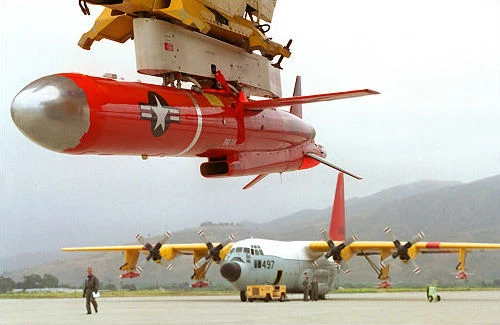
Dynetics X-61 Gremlins
Experimental recoverable UAV designed for midair retrieval by a transport aircraft.

The Dynetics X-61 Gremlins is an experimental drone built by Dynetics. It came out of a DARPA program aimed at proving a low-cost, recoverable unmanned aircraft with digital flight controls and navigation. Its key feature is being snatched out of the sky by a modified cargo plane after finishing its mission. Dynetics was one of four companies awarded an initial contract in 2016 and won the next phase in 2018.
The X-61A runs on a Williams F107 turbofan engine and can haul various payloads, such as electro-optical sensors, infrared imagers, electronic warfare gear, and weapons. It works with existing launch and ground support equipment. The drone is semi-autonomous, letting a single operator in the mothership or on the ground control up to eight of them at once.
As of early 2020, five X-61A units had been built. An earthquake near China Lake in July 2019 damaged some test gear, causing delays. The first captive flight, with the drone aboard a Lockheed C-130A Hercules mothership, happened in November 2019. The first free flight took place on January 17, 2020. While the flight itself went well, the main parachute failed during recovery, and the aircraft was lost. The other four vehicles remained operational.
In August 2020, Dynetics announced a second test flight, this time successfully recovering the drone by parachute. That flight lasted over two hours and included rendezvous and formation flying with the C-130. In October 2021, DARPA reported that a specially equipped C-130 had recovered an X-61A in midair.
Quick Facts
- Aircraft Type
- Experimental unmanned aerial vehicle
- National Origin
- United States
- Manufacturer
- Dynetics
- First Flight
- November 2019 (captive) / January 17, 2020 (free flight)
- Introduction
- 2019
- Primary User
- DARPA
- Produced
- 2019–present
- Number Built
- 5
Facts from the source article.
Lore & Background
The X-61 stemmed from the DARPA Gremlins program to demonstrate a recoverable, low-cost UAV with digital flight controls and navigation systems. It is designed to be recovered in midair by a modified transport airplane following its mission. Dynetics was one of four companies to be awarded a Phase I contract for the program in 2016, and was the winner of the Phase III contract in April 2018. The X-61A is powered by a Williams F107 turbofan engine and can carry a variety of payloads, including electro-optical sensors, infrared imagers, electronic warfare systems, and weapons. It was designed to be compatible with existing launch and ground support equipment. The UAV is semi-autonomous, allowing a controller either in the mothership or on the ground to control up to eight X-61As at one time.
As of January 2020, five X-61A Gremlins have been built. On July 5, 2019, an earthquake near China Lake damaged some of the first X-61A's test equipment, delaying the program. The first captive flight of the X-61A on board a Lockheed C-130A Hercules mother ship was in November 2019. The first free flight of the X-61A was conducted on January 17, 2020. The flight was successful, however, the main parachute failed to deploy during the recovery and the aircraft was lost. The four remaining vehicles are still operational. In August 2020 the company announced they had completed a second test flight, this time successfully recovering the aircraft by parachute. The flight lasted over two hours and included rendezvous and formation flight with the C-130 mother ship. In October 2021 DARPA announced that a specially equipped C-130 Hercules cargo plane had successfully recovered an X-61A from mid-air.
Reader's Guide
The X-61 Gremlins represents a significant step in the development of recoverable, low-cost unmanned aerial vehicles, as demonstrated through the DARPA Gremlins program. Its design emphasizes midair recovery by a modified transport airplane, a capability that could reduce operational costs and enable reuse of the airframe. The program's progression from Phase I contract in 2016 to Phase III in 2018, and the subsequent flight tests, highlight the technical challenges and achievements in this area. The loss of the first free-flight vehicle due to parachute failure underscores the risks inherent in experimental programs, while the successful recovery in August 2020 and the midair retrieval in October 2021 validate the core concept. The X-61A's semi-autonomous control system, allowing a single operator to manage up to eight vehicles, and its compatibility with existing launch and ground support equipment, point toward potential operational flexibility. The program's legacy lies in advancing the feasibility of airborne launch and recovery for UAVs, with implications for future military and civilian applications.
Did You Know?
- The first free flight of the X-61A on January 17, 2020, was successful but the aircraft was lost due to a parachute failure.
- In October 2021, a specially equipped C-130 Hercules successfully recovered an X-61A from mid-air.
- A single controller can operate up to eight X-61A Gremlins simultaneously.
More in Unmanned Aerial Vehicles by Country 1-24
Spotted an error? Know more?
Reader corrections go straight into our review queue. Suggest an edit · How this site is sourced