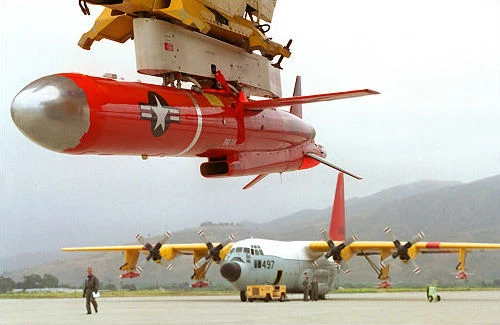
BQM-147 Dragon
Tactical UAV evolved from an expendable jammer to a reconnaissance drone.

The BAI Aerosystems BQM-147 Dragon is a tactical battlefield drone used by the United States Marine Corps. It began as an expendable communications jammer but was later fitted with a camera for reconnaissance. The Dragon Drone is a refined version of the earlier BQM-147A Exdrone, acquired under a 1996 Marine Corps contract.
The project started in 1986, when the Marines hired the Johns Hopkins University Applied Physics Laboratory to build a small, piston-powered drone for electronic warfare jamming, under the name "ExJam." BAI Aerosystems supplied airframe parts as a subcontractor. As the Marines added more uses for the drone, the program was renamed BQM-147A "Exdrone" in 1987. The jammer version was tested in a wind tunnel at the University of Maryland and completed flight tests at Naval Air Station Patuxent River and White Sands Missile Range. However, the Applied Physics Laboratory could not meet the Marines’ schedule, so the program was handed to BAI Aerosystems, with the Navy developing a video imaging system for reconnaissance.
NASA Langley Flight Research Center also helped with wind-tunnel tests and aerodynamic improvements. After these changes, the Exdrone entered service in time for the Marines to use it during the operation to push Iraqi forces out of Kuwait City. Later, the UAV Joint Program Office bought several hundred Exdrones for demonstrations and training to familiarize tactical officers with battlefield drones.
The current Dragon Drone is a flying wing with a single tailfin, designed symmetrically so it can fly with either side up. It is powered by a small piston engine and can carry one of three plug-in turrets: daylight color TV with a laser rangefinder, daylight color TV alone, or an infrared imager. An auxiliary fuel tank can be added for longer range.
The United States Coast Guard is now acquiring a navalized version called the "Condor," intended for use on cutters and small ocean-patrol vessels. Missions include search and rescue and drug interdiction. Launching and recovering drones from small ships is difficult. Traditional methods like catapults or rocket boosters and net recovery are unreliable on small vessels, often causing damage or loss. Advanced Aerospace Technologies Incorporated, based in Saint Louis, Missouri, has developed an alternative called the "runway in the sky" system.
Quick Facts
- National Origin
- United States
- Manufacturer
- BAI Aerosystems
- Primary User
- United States Marine Corps
- Number Built
- 500+
Facts from the source article.
Lore & Background
The Dragon began life in 1986 when the U.S. Marine Corps contracted with the Applied Physics Laboratory (APL), an offshoot of Johns Hopkins University, to build a small piston-powered UAV as an expendable jammer for battlefield electronic warfare, under the program name 'ExJam'. BAI Aerosystems was a subcontractor to APL, providing airframe parts. The program was renamed BQM-147A 'Expendable Drone' or 'Exdrone' in 1987. The communications-jammer configuration was tested in the University of Maryland Glenn L. Martin wind tunnel and completed developmental flight testing at Naval Air Station Patuxent River and a combined Developmental Test/Operational Test at White Sands Missile Range. APL could not meet the Marines' schedule, so the program was passed to BAI Aerosystems, with the Navy assisting by developing a video imaging system for tactical reconnaissance. NASA Langley Flight Research Center performed wind-tunnel tests and made aerodynamic recommendations. The Exdrone entered service in time to help chase Iraqis out of Kuwait City. The UAV-JPO later bought several hundred Exdrones for demonstrations and training.
The current Dragon Drone is a flying wing with a single tailfin, symmetrically designed to fly with either side up. It is powered by a small piston engine and can carry one of three plug-in turrets: daylight color TV with a laser rangefinder, daylight color TV, or infrared imager. It can also be fitted with an auxiliary fuel tank for increased range. The U.S. Coast Guard is procuring a navalized version called 'Condor' for use on cutters and small ocean-patrol vessels, intended for search and rescue or drug interdiction. A Saint Louis company, Advanced Aerospace Technologies Incorporated (AATI), developed an alternative launch and recovery scheme called 'runway in the sky' (RITS) using a parasail. In this method, a Dragon Drone is attached to a piggyback frame harnessed to a parasail, which is reeled out to about 250 m altitude; the drone is then released, diving to gain speed. For recovery, the parasail lifts a tow line with recovery lines; the drone flies into the lines and a snaplock mechanism on the wing grabs a line, then the drone is reeled down. The RITS scheme can handle UAVs up to 180 kg, and AATI claims it is inexpensive and easy to use, also noting the parasail could loft an antenna for over-the-horizon communications. Whether the Coast Guard intends to use this scheme is uncertain.
Reader's Guide
The BQM-147 Dragon represents a shift from a purely expendable electronic warfare asset to a reusable reconnaissance platform, reflecting the evolving needs of tactical battlefield operations. Its development history illustrates the challenges of military procurement, including schedule pressures and the phenomenon of 'creeping featurism' as additional applications were considered. The involvement of APL, BAI Aerosystems, the Navy, and NASA Langley highlights a collaborative effort across government and private sectors. The Dragon's symmetrical flying-wing design, allowing it to fly with either side up, is a distinctive aerodynamic feature. The Condor variant for the Coast Guard extends the platform's utility to maritime missions such as search and rescue and drug trafficking interdiction. The innovative RITS launch and recovery system, using a parasail to avoid the damage and reliability issues of catapults and nets, addresses a longstanding challenge of operating UAVs from small vessels. Although the Coast Guard's adoption of RITS remains uncertain, the concept demonstrates ongoing efforts to improve UAV deployment flexibility. The Dragon's service in the Gulf War and subsequent use in training helped familiarize tactical officers with UAV capabilities, contributing to the broader integration of drones into military operations.
Did You Know?
- The Dragon began as the 'ExJam' expendable jammer program in 1986.
- A parasail-based launch and recovery system called 'runway in the sky' (RITS) was demonstrated for the Dragon Drone.
More in Unmanned Aerial Vehicles by Country 1-24
Spotted an error? Know more?
Reader corrections go straight into our review queue. Suggest an edit · How this site is sourced