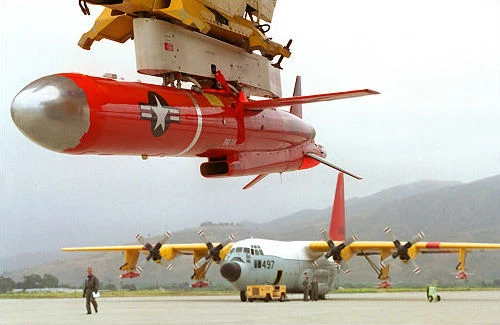
Aurora Goldeneye
A ducted-fan tail-sitter UAV for covert operations.

The Aurora Goldeneye is a reconnaissance unmanned aerial vehicle (UAV) developed in the United States under a DARPA contract, focused on covert or special forces operations. It is a ducted fan design in roughly the same class as the Sikorsky Cypher II, notable for its tail-sitter or pogo configuration that takes off and lands vertically.
Quick Facts
- Aircraft Type
- Reconnaissance UAV
- National Origin
- United States
- Manufacturer
- Aurora Flight Sciences
- First Flight
- 2003 (Goldeneye 100) / 2004 (Goldeneye 50)
Facts from the source article.
Lore & Background
The Goldeneye was initially developed and manufactured mainly by Aurora Flight Sciences. Later versions, the Goldeneye 50 and Goldeneye 80, were developed by 'Team Goldeneye', led by Aurora, in collaboration with Northrop Grumman, Signal Systems Corporation, and General Dynamics Robotics Systems. The aircraft is a stumpy-looking machine with four tailfins, each with landing gear on the fintip, and a wing that pivots, allowing it to be aligned with the aircraft centerline in cruise flight and at a right angle to the centerline in hover flight. It has a low radar, infrared, and acoustic signature. The DARPA specification required that it be able to carry 'two coke-can size payloads' that were not described further. Aurora worked on a half-scale version of the Goldeneye for commercial sales.
Reader's Guide
The Goldeneye represents a specific approach to vertical takeoff and landing UAVs, combining a ducted fan design with a pivoting wing for efficient transition between hover and forward flight. Its development under DARPA contract underscores an interest in low-signature, covert reconnaissance platforms for special forces. The collaboration with major defense contractors for later variants indicates an effort to scale and refine the design for broader military applications. The requirement for two unspecified coke-can-sized payloads suggests a modular or specialized mission capability that was not publicly detailed. The half-scale commercial version points to an attempt to transfer the technology to the civilian market, though the overall legacy of the Goldeneye remains tied to its experimental, special-forces-oriented origins.
Did You Know?
- The Goldeneye is a tail-sitter or pogo machine that takes off and lands straight up.
- It is built of graphite and fiberglass composites for low radar, infrared, and acoustic signatures.
- A half-scale version of the Goldeneye was developed for commercial sales.
Frequently Asked Questions
What is the Aurora Goldeneye?
It is a small reconnaissance drone built in the United States under a DARPA program, designed specifically for covert missions alongside special-operations teams. Its compact ducted-fan layout places it in roughly the same size class as the Sikorsky Cypher II.
What makes the Aurora Goldeneye's configuration unusual?
Instead of conventional propellers or jet engines, it uses a ducted-fan propulsion system paired with a tail-sitter (pogo) arrangement, so it launches and recovers straight up and down. That vertical takeoff-and-landing capability suits the tight, low-visibility deployment environments typical of special forces operations.
What engine powers the Aurora Goldeneye?
The airframe is driven by a 28 kW (38 hp) Wankel-rotary engine made by AV Engines Ltd in the United Kingdom. The rotary design keeps the powerplant compact, which is essential for fitting inside the drone's small ducted-fan structure.
How does the Aurora Goldeneye fly and navigate?
It relies on an autonomous flight-control system that fuses GPS data with an inertial navigation unit (GPS-INS) to hold its position without a human pilot in the loop. The airframe itself is constructed from graphite and fiberglass composites to keep overall weight low.
Why is the Aurora Goldeneye significant in the UAV field?
It represents a DARPA-backed push toward ultra-small, vertically launching reconnaissance platforms capable of operating in denied or contested areas alongside special operators. The combination of rotary power, composite construction, and fully autonomous navigation makes it a notable example of next-generation covert ISR drones.
More in Unmanned Aerial Vehicles by Country 1-24
Spotted an error? Know more?
Reader corrections go straight into our review queue. Suggest an edit · How this site is sourced