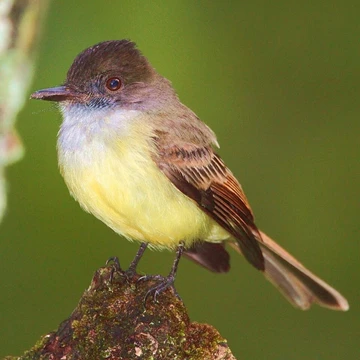
Asity
Small forest birds with unique collagen-based wattles.
Last updated
The asities are a family of birds, Philepittidae, endemic to Madagascar. They comprise four species in two genera, including the Neodrepanis sunbird-asities formerly known as false sunbirds. The genus Philepitta is the type-genus of this family.
Scientific classification
- KingdomAnimalia
- PhylumChordata
- ClassAves
- OrderPasseriformes
- FamilyPhilepittidae
Named by Sharpe, 1870
Sources: Wikipedia taxobox: Asity (CC BY-SA 4.0)
Quick Facts
- Subdivision
- Philepitta, Neodrepanis
Facts from the source article.
Description
Asities are small forest birds with sexually dichromic plumage. Males have brightly coloured wattles around the eyes, most conspicuous during breeding season, coloured by arrays of collagen fibres—a pigmentation method unique in the animal kingdom. They have twelve tail feathers on extremely short tails (virtually absent in Philepitta), a syrinx encased with a large bronchial ring, and forked tongues adapted to nectivory. A long outer primary feather buzzes in flight, possibly used in courtship signalling.
Behavior and ecology
The major component of the asity diet is fruit; they are among the most important avian seed dispersers in Madagascar due to the scarcity of other frugivorous birds. They also take insects. Neodrepanis sunbird-asities take nectar using a long tongue rather than inserting their curved bills far into flowers. Rainforest asities breed during the Malagasy rainy season, beginning just before the rains from September to November.
The velvet asity begins breeding slightly sooner in the north of its range; it is the only species with detailed breeding information available. It has a polygynous system with males holding small territories or leks, while females alone build nests, incubate, and raise young. Reports of male yellow-bellied sunbird-asities feeding young indicate variation in breeding strategies. Nests are elaborate, pear-shaped woven structures hanging from branches; uniquely, the entrance is created by pushing through the wall after construction.
Status and conservation
The yellow-bellied sunbird-asity is now classified as vulnerable, after earlier fears it might be extinct or endangered proved unfounded due to a lack of surveys in its high-altitude home. It remains threatened by habitat loss and fragmentation. Schlegel's asity is near threatened, with a very scattered range but many stable populations in hard-to-reach ravines.
Did You Know?
- The asities were once thought related to pittas, but a 1993 study suggested they are a subfamily of Eurylaimidae.
- The morphology of the asity syrinx is very similar to that of Grauer's broadbill of Africa.
- Some authors have placed the sapayoa of South America in the family, though it is now often placed in its own family, Sapayoidae.
More in Tyranni
Sources
Compiled from Wikipedia and the sources listed below. Text from Wikipedia is available under CC BY-SA 4.0; this entry is adapted from it.
- Wikipedia: Asity (CC BY-SA 4.0).
- Word definitions: the , each quoted from its Wikipedia article.
Spotted an error? Know more?
Reader corrections go straight into our review queue. Suggest an edit · How this site is sourced