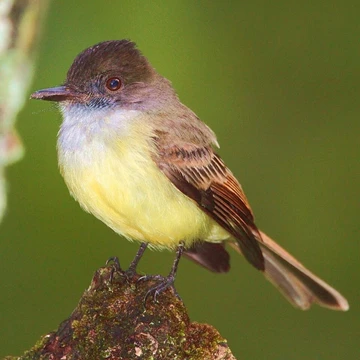
Gnateater
Small suboscine passerines of South and Central America.
Last updated
The gnateaters are a bird family, Conopophagidae, consisting of twelve small suboscine passerine species in two genera. They occur in South and Central America.
Scientific classification
- KingdomAnimalia
- PhylumChordata
- ClassAves
- OrderPasseriformes
- FamilyConopophagidae
Named by Garrod, 1877
Sources: Wikipedia taxobox: Gnateater (CC BY-SA 4.0)
Quick Facts
- Subdivision
- Conopophaga
- Vieillot, 1816, Pittasoma
- Cassin, 1860
Facts from the source article.
Taxonomy
The bird family Conopophagidae was first described by English zoologist Alfred Henry Garrod in 1877. It originally contained only the gnateaters in the genus Conopophaga, but a 2005 genetic study revealed that the genus Pittasoma, previously placed in Formicariidae, is a close relative.
This link is backed by similarities in behavior, body structure, and calls. These birds are most closely related to antbirds, with a more distant connection to antpittas and tapaculos. Because they live in dark, remote areas, gnateaters remain a little-studied and poorly understood family.
Distribution and habitat
Gnateaters inhabit forest understory, bamboo stands, and the forest floor. Conopophaga species occur in the Amazon and Orinoco basins, east and central Andean slopes, Atlantic Forest, and nearby regions. Pittasoma species are found in the Chocó, Panama, and Costa Rica.
Some live in impenetrable thickets; others in more open forest. Most are restricted to humid habitats, but several extend into drier regions in eastern Brazil. Conopophaga stay near the forest floor, typically not rising more than 1.5 m above ground, while Pittasoma are more commonly seen hopping on the ground.
Behaviour and ecology
Gnateaters are insectivorous. Conopophaga feed by perching above the forest floor and lunging down to snatch prey, then leaving the ground within seconds, or by gleaning insects from low vegetation. Typical prey includes spiders, caterpillars, insect larvae, grasshoppers, and beetles; some individuals have been observed eating fruit and in one case a frog. Little is known about the diet of Pittasoma, but they are presumably also insectivorous.
Did You Know?
- All species are sexually dimorphic, though the extent varies greatly.
- Most Conopophaga species have a white tuft behind the eye.
- They are round, short-tailed, and long-legged birds, with Pittasoma being larger than Conopophaga.
More in Tyranni
Sources
Compiled from Wikipedia and the sources listed below. Text from Wikipedia is available under CC BY-SA 4.0; this entry is adapted from it.
- Wikipedia: Gnateater (CC BY-SA 4.0).
- Word definitions: the , each quoted from its Wikipedia article.
Spotted an error? Know more?
Reader corrections go straight into our review queue. Suggest an edit · How this site is sourced