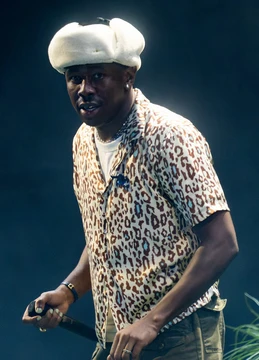
Hodgy Beats
The quiet architect behind the loudest chaos in modern hip-hop.
Hodgy Beats, born Justin Dyson, is the producer, rapper, and founding member of Odd Future (later rebranded Odd Future Wolfhrt Gding) who has stood as Tyler the Creator's closest creative partner since the collective's earliest days in the mid-2000s. Where Tyler brought the theatrical fire, Hodgy brought the architectural beatwork and the calm, almost conspiratorial humor that gave the group its signature duality—aggressive on the surface, deeply playful underneath. From the raw, lo-fi energy of the early Odd Future mixtapes to the more polished productions that followed, Hodgy's fingerprints are embedded in the sonic identity of the entire collective. For fans, he represents the 'behind the curtain' half of the Tyler story—the one who makes the spectacle possible without ever needing to be the spectacle himself.
Quick Facts
- Birth name
- Gerard Damien Long
- Alias
- Hodgy Beats (2007–2016); Hodgy (2016–2023)
- Born
- 9 November 1990
- Birthplace
- Trenton, New Jersey, U.S.
- Origin
- Pasadena, California, U.S.
- Genre
- Alternative hip hop
- Occupation
- Rapper
- singer
- songwriter
- record producer
- music video director
- Instrument
- Vocals
- keyboard
- FL Studio
Facts from the source article.
Lore & Background
Hodgy Beats entered the Tyler the Creator story not as a side character but as co-author. In the mid-2000s, in the Los Angeles underground, a group of teenagers were trading beats, writing verses, and building a collective identity out of shared aesthetic obsessions. Justin Dyson was among them, and his production style—layered, slightly unhinged, blending hip-hop rhythms with electronic textures and an almost cartoonish sense of humor—became the sonic bedrock of what would become Odd Future. He was the one in the room when the OFWGKTA wolf logo was sketched out, when the group's name was hammered into existence, when the first rough tracks were bounced off a laptop in a bedroom that smelled like cheap energy drinks and ambition. In the broader Tyler mythology, Hodgy occupies a role that fans often describe as 'the anchor.' Tyler's public persona has always been maximalist—shouting, performing, pushing boundaries, courting controversy. Hodgy, by contrast, is the guy in the background of every group photo, headphones around his neck, offering a dry one-liner that undercuts the tension. Without the Hodgy counterweight, the story becomes monologue; with him, it becomes conversation. Fans who follow the Odd Future saga see him as the character who remembers the original joke, the one who says 'dude, we were just trying to make beats in a garage' when the world has turned the project into a cultural institution. His production work threaded through multiple phases of Tyler's evolution. The early Odd Future sound—raw, confrontational, deliberately abrasive—carried Hodgy's fingerprints in its rhythmic choices and textural layering. As Tyler's solo career accelerated and the collective's sound matured, Hodgy's role shifted from front-and-center beatmaker to more of a behind-the-scenes collaborator, but he never fully stepped away. He remained part of the Golf Wang orbit, the extended family of artists, designers, and creatives that Tyler has built around his vision.
Reader's Guide
Hodgy Beats functions in Tyler's cultural mythology as the 'everyman' counterpoint to Tyler's larger-than-life persona. Fans tell stories about him the way they tell stories about the quiet guy in the band—the one who actually knows how the song works, who's been in the room since day one, who never needed the spotlight because the spotlight was never the point. In the broader hip-hop conversation, this dynamic mirrors a long tradition of producer-artist partnerships where the beatmaker's identity gets subsumed into the artist's brand. Hodgy's case is notable because he was never fully subsumed; he remained a named, visible member of the collective, a co-founder rather than a ghost in the machine. Aesthetically, Hodgy sits at the intersection of the early-2000s internet-rap underground and the streetwear culture that Odd Future helped catalyze. His visual identity—headphones, relaxed posture, understated clothing—contrasts with Tyler's more theatrical, fashion-forward presentation. For fans who grew up with the Odd Future era, that contrast is part of the emotional texture: the group felt like a real friend group, not a corporate act, and Hodgy was the friend who'd always be in the back of the group chat, sending a single 'lol' that somehow said everything. In the wider fashion and hip-hop narrative, the Odd Future collective (and by extension Hodgy's role within it) helped normalize the idea that a rap group could be a lifestyle brand, a design house, and a creative collective simultaneously.
Did You Know?
- He is consistently described in fan and press coverage as Tyler the Creator's closest friend and most consistent creative collaborator across the group's entire history.
- In the broader Golf Wang ecosystem, Hodgy has maintained a presence as part of the extended creative family, contributing to the collective identity that extends beyond music into fashion and visual culture.
More in Band Members & Collaborators
Elsewhere in Tyler the Creator
Spotted an error? Know more?
Reader corrections go straight into our review queue. Suggest an edit · How this site is sourced