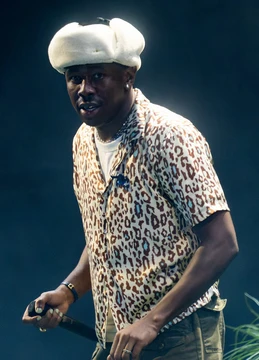
See You Again
A quiet goodbye to the person you were before the world got soft.
"See You Again" is a track on Tyler, the Creator's 2017 album Flower Boy, one of the most emotionally vulnerable records in his catalog. It sits within an album that marked a dramatic tonal departure from the aggression and shock of his earlier work, instead reaching for tenderness, self-doubt, and the quiet ache of outgrowing who you used to be.
Within the broader Tyler the Creator narrative, the song functions as a small eulogy—not for a person, but for a version of himself. It's the sound of someone standing at the edge of a new chapter, looking back with a mixture of gratitude and grief, and whispering a goodbye to the person he was two years ago.
Quick Facts
- Artist
- Tyler, the Creator featuring Kali Uchis
- Album
- Flower Boy
- Written
- 2014
- Released
- August 29, 2017
- Recorded
- 2013 🞗 2014-2017
- Genre
- R&B, pop-rap
- Label
- Columbia
- Writer
- Tyler Okonma
Facts from the source article.
Lore & Background
Flower Boy arrived in the summer of 2017 and redefined what Tyler, the Creator was allowed to be in public. After years of shock humor, aggressive delivery, and a persona built on provocation, the album stripped all of that away in favor of falsetto, piano-driven beats, and lyrics that sounded almost like a diary left open on a kitchen table. "See You Again" lives in that world: a track where the production breathes, where Tyler's voice sits lower and closer to the mic, and where the subject is simply the passage of time and the people and versions of yourself it leaves behind.
The song's title carries a double weight for listeners who know Tyler's history. It's not a grand farewell; it's the casual, almost offhand way you'd say goodbye to a friend you know you'll see in a different context, or not at all. That understatement is what makes it land. In an album full of declarations—love songs, confessions, apologies—"See You Again" is the exhale between them. It's the moment after the speech, when the room goes quiet and you realize you actually mean it.
Fans often point to this track as the emotional hinge of Flower Boy: the point where the album stops performing vulnerability and simply is it. It's the track people pull out on long drives, on the last night in a city, or when they're trying to figure out if they've actually changed or just gotten older.
Reader's Guide
Flower Boy dropped in August 2017, and for a lot of Tyler's fans, "See You Again" was the track that made the whole album click. Up to that point, Tyler had been this force of nature—loud, confrontational, built on a persona that made people either love him or want to throw their phones at the screen. Then this record came out, and he was just… a guy in his mid-twenties trying to figure out if he was okay. And "See You Again" is where you hear him actually be okay, or at least try.
What made the moment land wasn't just the song itself. It was the context. Tyler had moved to Los Angeles, had gone through a genuinely difficult stretch, had publicly wrestled with his past and with who he was becoming. The album felt like a letter he wrote to himself and accidentally sent to everyone. "See You Again" is the part of that letter where he stops talking at you and starts talking to you. The production pulls back. His voice drops. There's no hook designed to stick in your head at a party. It's a track for 2 a.m. in a parking lot.
Fans experienced it as permission. Permission to be soft. Permission to say goodbye to the version of yourself that got you here but can't take you further. In a hip-hop landscape that still rewards armor, Tyler putting that armor down on a track that's basically just a piano and a voice felt genuinely radical. It didn't need to be. It just needed to be true. And for a lot of people listening, it was the first time a rapper's vulnerability didn't feel like a performance. It felt like a confession.
Did You Know?
- Flower Boy, the album containing "See You Again," was recorded largely after Tyler relocated to Los Angeles, a move that fans and critics tied directly to the album's softer, more introspective sound.
- The album marked a sharp tonal break from Goblin (2011) and Wolf (2013), shifting Tyler's public persona from shock-driven aggression to something closer to open emotional vulnerability.
- The title "Flower Boy" itself became a point of both celebration and controversy, as Tyler embraced a label he'd previously been mocked for, reframing it as a badge of self-acceptance.
Elsewhere in Tyler the Creator
Spotted an error? Know more?
Reader corrections go straight into our review queue. Suggest an edit · How this site is sourced