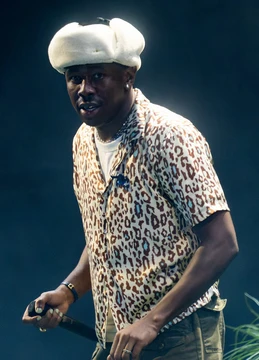
Denzel Curry
The Miami hurricane who shares the same fearless DNA as the West Coast's loudest creative storm.
Denzel Curry is a Miami-born rapper, singer, and songwriter whose ferocious, high-octane delivery has made him one of the most distinctive voices in modern hip-hop. Their worlds intersect in the shared language of hip-hop's underground-to-mainstream pipeline, festival stages, and the culture of artists who refuse to be boxed into a single lane. Denzel represents the kind of raw, unfiltered creative energy that Tyler's early collective celebrated: the idea that a kid with a voice and a vision can carve out a space that no one else can replicate.
Quick Facts
- Birth name
- Denzel Rae Don Curry
- Alias
- Zeltron 6 Billion
- Black Metal Terrorist
- Raven Miyagi
- Aquarius Killa
- Big Ultra
- Denny Cascade
- Birthplace
- Miami Gardens, Florida, U.S.
- Born
- 16 February 1995
- Genre
- Hip-hop
- SoundCloud rap
- trap
- trap metal
- punk rap
- conscious hip-hop
- Occupations
- Rapper; songwriter
- Years active
- 2011–present
- Label
- Loma Vista
- C9
- L&E
Facts from the source article.
Lore & Background
Denzel Curry emerged from Miami's hip-hop scene with a sound that felt like a controlled detonation — rapid-fire bars layered over pounding 808s, his voice cracking and soaring in a way that no autotune could fake. Where many rappers of his generation leaned into a single production style, Denzel stretched across trap, electronic, and even melodic singing, treating each album like a different instrument he was learning to play. His early work, particularly Nostalgica and Melt My FF's, established him as an artist who could fill a room with pure kinetic energy while still writing with emotional specificity. In the Tyler the Creator narrative, Denzel exists as a parallel axis. Tyler built his world in Los Angeles, surrounded by a collective of misfits who turned vulnerability into a weapon. Denzel built his in Miami, where the heat and the humidity seep into the bass and the flow. Yet both artists share a core philosophy: that hip-hop is not a genre to be performed but a feeling to be exorcised. Both have evolved from aggressive, confrontational early work into more textured, emotionally complex projects without losing the underlying fire. Their shared spaces in the hip-hop world — festival lineups, industry events, the broader conversation about what rap can be — create a natural kinship. They are not the same artist, not the same city, not the same sound, but they orbit the same gravitational center: the belief that a rapper's voice is as important as the beat beneath it.
Reader's Guide
He entered the shared hip-hop landscape not as a member of any collective but as a force of nature from Miami whose aggressive, genre-fluid style echoes the fearless creative energy Tyler championed in Odd Future's early days. Both artists built empires from the underground, both refused to let their sound calcify into a single formula, and both treat the microphone as a physical instrument rather than just a delivery tool. He is the artist who proves that the same creative DNA — vulnerability wrapped in aggression, melody hiding inside a snare pattern — can produce entirely different organisms on different coasts. Their shared spaces in the industry, the festival circuits, and the cultural conversation about what rap is allowed to be, create a kinship that doesn't require a shared studio session. What makes Denzel's contribution to the landscape distinctive is his vocal identity. In a world where production can be replicated and flows can be imitated, Denzel's voice — its crack, its range, its physicality — is uncopyable.
Did You Know?
- Denzel Curry's vocal style is so distinctive that he has been described as having one of the most recognizable voices in modern hip-hop, something that cannot be replicated by autotune or production tricks.
- He has operated across multiple sub-genres — from aggressive trap to melodic electronic-influenced tracks — treating each album as a different sonic identity rather than a continuation of the last.
- His Miami roots give his music a humid, bass-heavy texture that contrasts with the drier, more reverb-laden production often associated with West Coast hip-hop, creating a natural sonic dialogue between the two coasts.
More in Band Members & Collaborators
Elsewhere in Tyler the Creator
Spotted an error? Know more?
Reader corrections go straight into our review queue. Suggest an edit · How this site is sourced