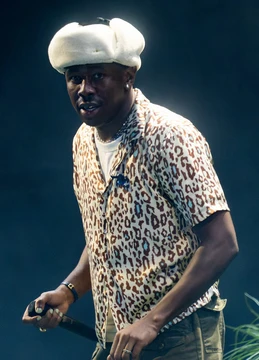
Earl Sweatshirt
The masked poet who turned silence into the loudest verse in Odd Future.

Frank Morales · via Wikipedia: Earl Sweatshirt · CC BY-SA 4.0
Earl Sweatshirt is a rapper, songwriter, and founding member of the Odd Future collective, widely regarded as the group's most introspective and lyrically dense voice. Where Tyler the Creator built the collective's theatrical, confrontational exterior, Earl operates in the shadows—crafting dense, stream-of-consciousness verses that circle depression, isolation, and the surreal architecture of a young mind trying to make sense of Los Angeles, identity, and creative obsession. His reclusive public persona, often obscured by a mask or a low-set cap, has become as iconic as the music itself, turning absence into a brand and silence into a statement. Fans position him as the emotional core of Odd Future's early mythology—the kid who wrote the darkest bars in the group's mixtapes and then vanished into a bedroom studio for years, emerging with albums that felt less like releases and more like confessions delivered through a keyhole.
Quick Facts
- Birth name
- Thebe Neruda Kgositsile
- Born
- 24 February 1994
- Birthplace
- Chicago, Illinois, U.S.
- Other names
- Sly Tendencies
- randomblackdude
- Brad Pitt
- dar Qness
- Occupation
- Rapper
- songwriter
- record producer
- actor
- Years active
- 2007–2010, 2012–present
- Spouse
- Aida Osman (2025)
- Children
- 2
Facts from the source article.
Lore & Background
Earl Sweatshirt's mythology within the Odd Future world is built almost entirely on what he does not show. In a collective defined by Tyler's elaborate costumes, live shows, and confrontational energy, Earl became the figure who simply wasn't there—no interviews, no red carpets, no social media presence that matched the volume of his output. Fans narrated this absence as a kind of artistic purity: a writer who refused to perform the writer, who let the words carry the weight while the face stayed hidden behind a surgical mask or a brim pulled low. This aesthetic of concealment became inseparable from his sound, which favored dense, interlocking internal rhymes and imagery that felt half-dream, half-diagnosis.
The early Odd Future mixtapes positioned Earl as the group's dark conscience. While Tyler raged and performed, Earl's verses peeled back the skin of the collective's bravado, touching on anxiety, creative paralysis, and the strange loneliness of being a teenager in a city that never sleeps. This dynamic—loud exterior, quiet interior—became a recurring narrative fans projected onto the whole OFWGKTA story. Earl was the proof that the chaos had a center, a still point around which the maelstrom spun.
His solo albums deepened this mythology. Doris arrived after a long silence and felt like a diary left open on a desk. Sick! doubled down on the claustrophobic, self-referential quality, as if the album were a room with no doors. Some Type of Laziness broadened the palette slightly, introducing more melodic and collaborative textures, yet the core identity remained: a mind working through its own architecture in real time, with the listener invited in only as far as the door would open.
Reader's Guide
Earl Sweatshirt occupies a specific lane in hip-hop's broader mythology: the poet who chose obscurity over visibility at a time when the culture was accelerating toward the influencer economy. His masked, reclusive image became a deliberate counter-narrative to the era's demand for constant self-promotion. Fans frame him as the 'true artist' archetype—the one who disappears into the work and resurfaces only when the work is finished, if at all. In the fashion and streetwear conversation, Earl's aesthetic—oversized hoodies, surgical masks, minimal branding—became a touchstone for the 'quiet luxury' and anti-fashion movements that followed. While Tyler built Golf Wang into a full lifestyle brand, Earl's look remained deliberately unbranded, almost anti-commercial, and that tension became part of the Odd Future story: one member building an empire, the other building a bunker. Culturally, his lyrics are often cited in fan communities as some of the most psychologically raw in 2010s hip-hop. The narrative fans tell is that Earl gave a generation of anxious, introverted listeners permission to be loud on the page and silent in the room. His story became part of the larger conversation about mental health, creative isolation, and what it costs to make art that is genuinely personal rather than performative. He is the question the group never answers, and that's what makes him unforgettable.
Did You Know?
- Earl Sweatshirt's public persona is defined almost entirely by concealment—masks, low caps, and a near-total absence from interviews—making him one of hip-hop's most visually enigmatic figures of the 2010s.
- His debut solo album Doris (2013) was released after a notably long period of silence, and fans often describe it as feeling like a private diary made public against the artist's will.
More in Band Members & Collaborators
Elsewhere in Tyler the Creator
Spotted an error? Know more?
Reader corrections go straight into our review queue. Suggest an edit · How this site is sourced