Old World
A 4X strategy game blending dynasty simulation with ancient-era empire building.

Bibi Saint-Pol · Public domain
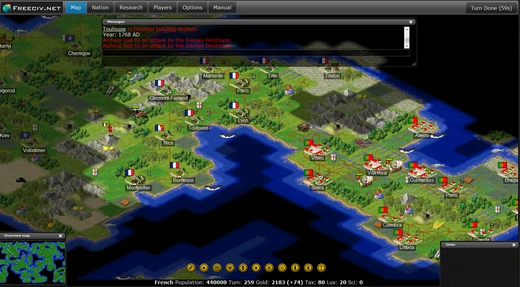
Old World is a turn-based strategy game in the 4X subgenre, set in the ancient and classical eras. Developed by Mohawk Games, it launched for Microsoft Windows and macOS on July 1, 2021, with versions for Steam and GOG, plus Linux support, following on May 19, 2022. The game blends the expansive empire-building of the Civilization series with the dynasty management and narrative events found in Crusader Kings. Leaders age and die, requiring a prepared heir, and develop traits based on education and in-game decisions. Each turn, the ruler can issue only a limited number of orders, meaning a large army needs multiple commands to move, while a single unit can act repeatedly until it runs out of actions.
The base game includes seven playable nations: Assyria, Babylonia, Carthage, Egypt, Greece, Persia, and Rome. Six additional nations appear across four DLCs: the Hittites in Heroes of the Aegean, Kush in Pharaohs of the Nile, Aksum in Wrath of Gods, and Maurya, Tamilakam, and the Yuezhi in Empires of the Indus.
Mohawk Games, an American studio founded in 2013 and previously known for Offworld Trading Company, is led by CEO Leyla Johnson. The game was designed by Soren Johnson, the lead designer of Civilization IV. He chose to focus on the earliest eras of civilization rather than covering 6,000 years of history, which he saw as both a blessing and a curse. Originally titled 10 Crowns and set to be published by Starbreeze, the publishing rights were sold back during Starbreeze’s restructuring, leading to a rename and release through the Epic Games Store. Early Access began on May 5, 2020, via Epic, with the full launch on July 1, 2021. Hooded Horse later took over publishing, and the Steam and GOG versions arrived on May 19, 2022. As of March 2026, seven DLCs have been released.
Reception was generally favorable, according to Metacritic. IGN’s Leana Hafer gave it an eight out of ten, calling it a smaller-scale 4X game than its Civilization predecessors but praising its new ideas for adding depth and complexity. PC Gamer named it the best strategy game of 2021. The soundtrack by Christopher Tin earned a Grammy nomination for Best Score Soundtrack for Video Games and Other Interactive Media. Old World was also among the top three best-selling games released in 2022 on GOG.com.
Quick Facts
- Title
- Old World
- Developer
- Mohawk Games
- Publisher
- Hooded Horse
- Designer
- Soren Johnson
- Engine
- Unity
- Platforms
- Windows / macOS / Linux
- Released
- Windows, macOS / July 1, 2021 / Linux / May 19, 2022
- Genre
- Turn-based strategy, 4X
- Modes
- Single-player, multiplayer
Facts from the source article.
Lore & Background
Old World is the second game developed by American studio Mohawk Games, which was founded in 2013 and also developed Offworld Trading Company. The studio is led by CEO Leyla Johnson, and the game was designed by Soren Johnson, who had previously served as the lead designer for Civilization IV. Johnson considered a game that covered 6,000 years of world history both a blessing and a curse, and instead focused Old World on the earliest eras of civilization. Initially the game was known as 10 Crowns and was to be published by Starbreeze, but during a restructuring of Starbreeze, publishing rights were sold back, and the game was renamed and published through Epic Games Store. On April 28, 2020, Mohawk Games announced the game would be released on Early Access on May 5, 2020, via the Epic Games Store. It was later announced that Hooded Horse would publish the game, with Steam and GOG versions releasing on May 19, 2022. As of March 2026, seven DLCs have been released for the game.
Gameplay is set in the ancient and classical eras. Nations' leaders age and die, and an heir must be ready to step up. Leaders develop traits based on their education and the choices made in the game. The leader can give only a limited amount of orders each round, so while a large army will require multiple orders to move, a single unit can perform multiple orders until it is exhausted. There are thirteen major playable Nations present in Old World, seven in the base game: Assyria, Babylonia, Carthage, Egypt, Greece, Persia, and Rome; and six more added with various DLCs: the Heroes of the Aegean DLC adds the Hittites, the Pharaohs of the Nile DLC adds Kush, the Wrath of Gods DLC adds Aksum, and the Empires of the Indus DLC adds Maurya, Tamilakam, and the Yuezhi.
Reader's Guide
Old World received 'generally favorable' reviews, according to aggregate review website Metacritic. Leana Hafer of IGN wrote 'Old World is a smaller-scale 4X game than its Civilization forebears but its new ideas add both interesting depth and intimidating complexity', awarding the game eight out of ten. PC Gamer named Old World the best strategy game of 2021. The game's soundtrack by Christopher Tin was nominated for the Grammy Award for Best Score Soundtrack for Video Games and Other Interactive Media. Old World was among the top three best-selling games that were released in 2022 at GOG.com. Its legacy lies in successfully blending the 4X formula with character-driven dynasty mechanics, offering a more focused historical scope than the Civilization series while introducing order-based resource management that limits player actions per turn. The game's critical and commercial reception, including a Grammy nomination for its soundtrack and a top-three sales position on GOG in 2022, underscores its impact within the turn-based strategy genre of the 2020s.
Defining the Genre: Core Mechanics and Identity
The real-time strategy genre occupies a specific niche within the broader family of strategy video games. What sets it apart is the continuous, unpaused flow of decision-making: players must manage resources, direct units, and pursue objectives all while the clock keeps ticking, in sharp contrast to turn-based strategy titles where opponents wait their turn. The very label "real-time strategy" was not an organic description but a marketing coinage, introduced by Brett Sperry in the early 1990s to promote Dune II. In a classic entry of the genre, a player positions buildings, steers a fleet of units under indirect command, contests territory on the map, and works to dismantle the enemy's infrastructure. Growth is gated by an economy: new units and structures can only be produced by spending accumulated resources, which are in turn collected through dedicated map locations or specialized gathering units. The genre's signature pillars—resource collection, base construction, technological progression, and indirect unit management—demand so much simultaneous attention that elaborate user interfaces developed over time, even borrowing interaction patterns like click-and-drag box selection from desktop computing.
A Fragmented Prehistory: The Genre's Scattered Roots
The real-time strategy genre did not arrive fully formed. It crystallized through a long, messy period of experimentation across multiple regions, and the games we now call "early RTS" were never conceived or sold under that label, making retrospective classification inherently awkward. In the United Kingdom, titles like Stonkers (1983) and Nether Earth (1987) appeared on the ZX Spectrum. In North America, The Ancient Art of War (1984) by the Murry brothers is often cited as one of the oldest titles later grouped into the genre. Japan contributed Bokosuka Wars (1983), a strategy RPG where players led armies in real time while recruiting soldiers, and later Sega's Gain Ground (1988) and TechnoSoft's Herzog (1988). On the American side, Utopia (1982) is frequently called the genre's "birth," though it blended turn-based cycles with real-time events, and Cytron Masters (1982) is sometimes named the very first real-time strategy title. Even earlier, a 1981 multiplayer space strategy game running on an IBM mainframe in the San Francisco Bay Area demonstrated "real-time response" in a strategy context. These scattered, region-specific experiments gradually merged into the unified worldwide tradition we recognize today.
Herzog Zwei, Dune II, and the Birth of a Template
Two titles stand as the genre's defining inflection points. Herzog Zwei, released in 1989 for the Sega Mega Drive/Genesis, is frequently called "arguably the first RTS game ever" and is credited as the "progenitor of all modern real-time strategy games." It fused traditional strategic depth—unit construction, resource management, base control—with fast, arcade-style real-time action, and its split-screen two-player mode forced both competitors to act simultaneously without any pause. Its point-and-click control scheme also foreshadowed the interaction model that would become standard. Chuck Sperry himself acknowledged Herzog Zwei as an influence on Dune II. Dune II, in turn, is where the phrase "real-time strategy" was first coined as a marketing term by Brett Sperry in the early 1990s, effectively naming and packaging the genre for a mainstream audience. Around the same period, titles like Supremacy (1990) and Mega-Lo-Mania (1991) expanded the design vocabulary with deep economic systems and branching technology trees, even though they lacked direct unit micro-management. Together, these games transformed a collection of regional experiments into a recognizable, repeatable formula.
Drawing the Line: What Counts as Real-Time Strategy and What Doesn't
Despite its popularity, the RTS label has firm boundaries that separate it from neighboring genres. City-building games, construction and management simulations, and real-time tactics titles all share conceptual or mechanical DNA with strategy games, yet none are generally classified as real-time strategy in the strict sense. The distinguishing thread is the combination of resource gathering, base building, technological development, and—critically—indirect control of multiple units under a single player's command. A god game, where the player assumes a creator-like role over an entire world, touches on RTS territory only in that specific framing. The genre's tasks are notoriously demanding on the player, which is why its user interfaces grew increasingly complex over the years, incorporating desktop-computing conventions such as the click-and-drag selection box. Meanwhile, turn-based strategy games, where players alternate moves, occupy a fundamentally different rhythm of play. The insistence on continuous, unpaused decision-making under resource constraints remains the core criterion that keeps the RTS category distinct from its many strategic cousins.
Gallery



Frequently Asked Questions
What is Old World and who made it?
Old World is a turn-based 4X strategy game set in the ancient and classical eras, developed by Mohawk Games with Soren Johnson serving as lead designer. It shipped on July 1, 2021 for Windows and macOS, and later added Linux support in May 2022.
How does Old World differ from Civilization?
Although it shares the broad empire-building loop of the Civ line, Old World adds a full dynasty layer: your ruler ages, gains traits shaped by education and in-game choices, and will eventually die, so you must groom a prepared heir. That makes long-term bloodline planning as critical as any single military campaign.
What is the order limit and why does it matter?
On each turn the active ruler can issue only a capped number of orders across units and cities, so you cannot command everything at once. This forces you to decide which actions are most urgent and plan ahead rather than micromanaging every tile.
On which platforms and stores can I buy Old World?
The title is available on Windows and macOS via Steam and GOG, with Linux support arriving on May 19, 2022. Hooded Horse published the Steam and GOG editions, while the Epic Games Store carried it at initial launch.
Who is Soren Johnson and what role did he play?
Soren Johnson is credited as the lead designer on Old World at Mohawk Games. His design direction is what stitched together the dynasty-simulation mechanics and the classical-era 4X framework that define the game's identity.
More in Turn-Based Strategy Games of the 2020s 1-17
Spotted an error? Know more?
Reader corrections go straight into our review queue. Suggest an edit · How this site is sourced